
AI and the New Milieu of Digital Capitalism

For more than a century, the pulse of pistons and conveyor belts dictated the tempo of capitalism, an inheritance that the digital age has continued to reinterpret, guided by the human impulse to rewrite the wealth of nations and firms. The digital economy has gathered its power from an ensemble of technologies that have recast the terms on which commerce, institutions and societies interact. AI is becoming a defining component of digital capitalism, supported by the expansion of cloud infrastructure, data centres, digital platforms and big data. The economic structure behind this diffusion remains concentrated. Cloud infrastructure, frontier models, computing, venture finance and semiconductor capabilities are controlled by a relatively small group of firms and economies, even as adoption spreads through middle-income markets. Market competition has, therefore, extended beyond the performance of models into compute, capital expenditure, talent, distribution, standards and regulations. States have responded through industrial policy, investment, export controls, national strategies and governance frameworks, making AI simultaneously a disruptive technology, a value creator and an instrument of economic statecraft.
The Digital Economy in Transition
Analysis published in 2026 by the Organisation for Economic Co-operation and Development (OECD), using national accounts data from 32-member economies, shows digital assets accounting for approximately one quarter of business investment. Between 2014 and 2023, investment in software, data and computer hardware increased at about 5 per cent annually, compared with approximately 1 per cent for most other asset classes. The OECD Digital Economy Outlook 2024 reports that the information and communication technology sector grew at an average rate of 7.6 per cent in 2023, approximately three times the pace of the total economy across OECD countries over the preceding decade. UN Trade and Development estimates global exports of digitally deliverable services at US$4.5 trillion in 2023, reaching 56 per cent of world services exports in 2024 after average annual growth of 7.1 per cent during the preceding decade. Developing economies exceeded US$1 trillion of those exports in 2023, with an estimated US$1.3 trillion in 2025.
Source: International Telecommunication Union, The ICT Development Index 2025, Annex 3.
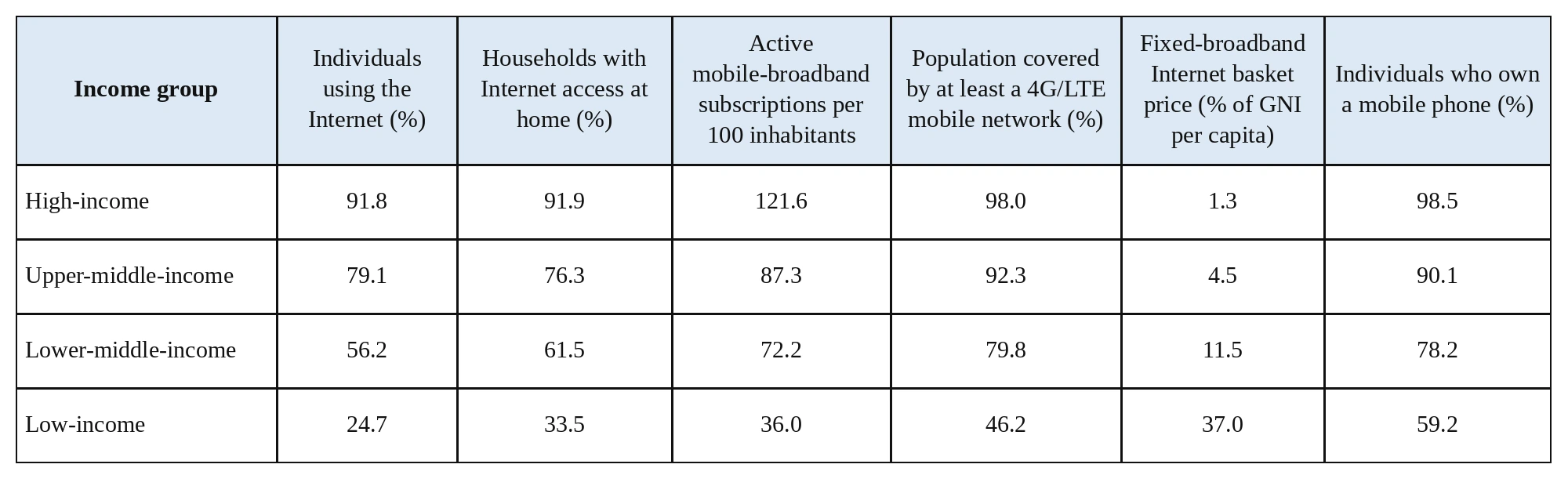
The World Bank’s Global Findex Database 2025 reports account ownership among 79 per cent of adults worldwide, compared with 74 per cent in 2021 and 51 per cent in 2011. Mobile phone ownership reached 86 per cent of adults worldwide, including 68 per cent with smartphones. Digital merchant payments reached 42 per cent of adults in low- and middle-income economies in 2024, compared with 35 per cent in 2021. The International Telecommunication Union (ITU) estimates that 6.0 billion people, equivalent to 74 per cent of the global population, were using the Internet in 2025, up from a revised 5.8 billion in 2024 and 60 per cent of the population in 2020. A further 2.2 billion people remained offline. More than 96 per cent of the global population had access to a mobile broadband network, while 5G coverage reached 55 per cent and approximately 3 billion 5G subscriptions represented about one third of all mobile broadband subscriptions. Global fixed broadband traffic reached approximately 6 zettabytes in 2024, compared with 5.1 zettabytes in 2023, while mobile broadband traffic increased from 1 zettabyte in 2023 to an estimated 1.3 zettabytes in 2024. Satellite broadband subscriptions increased from 3.3 million in 2023 to 4.6 million in 2024, including 1.1 million additional subscriptions during the year. More than 80 per cent of satellite broadband subscriptions were located in the Americas, while the Broadband Commission reported continuing expansion of low Earth orbit services, non-terrestrial networks and direct-to-cell technologies serving remote and underserved locations. Sixth generation (6G) mobile communication remains at the standards development stage rather than commercial deployment. The ITU established the International Mobile Telecommunications 2030 (IMT-2030) framework in 2023, completed draft technical requirements in February 2026 and evaluation guidelines in June 2026, with final 6G radio interface standards targeted for approval by the end of the decade.
The World Bank describes data as both an input to production and a by-product of economic activity, generated through transactions, web searches, payments, inventories, customer interactions, mobile and connected devices. UN Trade and Development (UNCTAD) describes a data value chain extending through collection, transmission, storage, processing and analysis. The expansion of data traffic has been accompanied by additional storage and processing infrastructure. UNCTAD reports that the number of co-location data centres increased from 4,714 in January 2021 to 5,522 in January 2024. Installations grew by 22 per cent in developing economies during the period, compared with 16 per cent in developed economies, although developed countries still hosted more than 80 per cent of the global total. The number of hyperscale data centres exceeded 800 in 2022 and reached an estimated 926 by mid-2023, with another 427 facilities in the development pipeline. The United States accounted for 53 per cent of hyperscale capacity in 2022, followed by Europe at 16 per cent and China at 15 per cent. Global installed data centre capacity increased by an estimated 20 per cent during 2024, adding approximately 15 gigawatts, while investment in data centres approached US$500 billion.
Cloud computing is delivered through several service and deployment models. The National Institute of Standards and Technology (NIST) has classified the service models as Infrastructure as a Service (IaaS), which provides processing, storage and network resources, Platform as a Service (PaaS), which provides environments for developing and deploying applications, and Software as a Service (SaaS), through which users access applications operated by the provider. Cloud infrastructure may be deployed through public, private, community or hybrid models. Synergy Research Group measures the cloud infrastructure services market through IaaS, PaaS and hosted private cloud services. Worldwide revenue from these services reached US$143.4 billion during the second quarter of 2026, an increase of more than US$43 billion from the corresponding period in 2025. Amazon accounted for 28 per cent of worldwide cloud infrastructure revenue, Microsoft 20 per cent and Google 15 per cent.
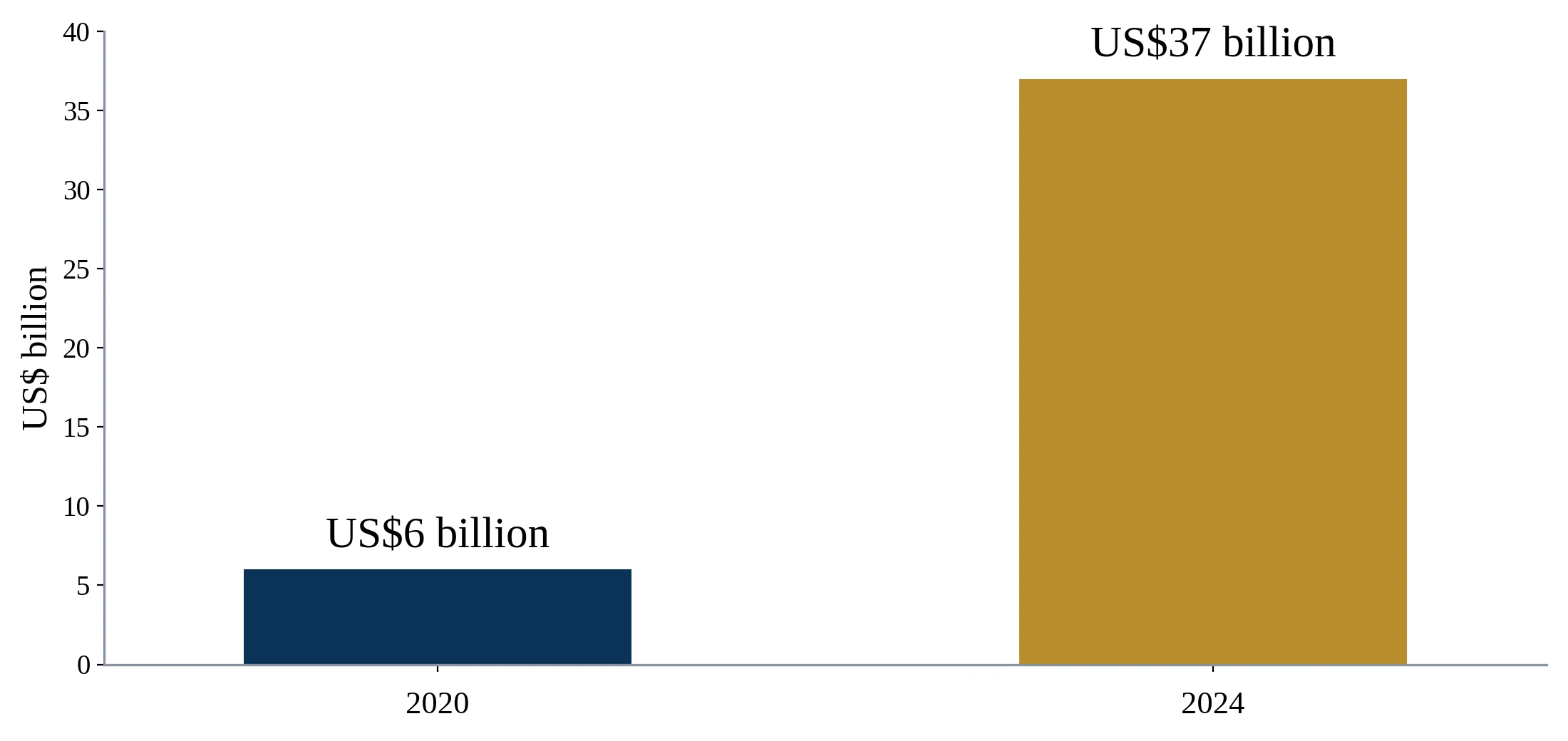
Digital platforms have expanded through e-commerce, advertising, digital content, app distribution and other platform-mediated services. UNCTAD’s World Investment Report 2025 lists Amazon, Apple, Alphabet, Microsoft, JD.com, Meta Platforms, Alibaba, ByteDance, Walt Disney and Tencent among the ten largest digital enterprises by sales. The number of Chinese firms represented in the top digital enterprise ranking increased from two in 2017 to eleven in 2025, while the United States accounted for 56 of the 100 firms. The report indicates that investment in the digital economy accounted for 5.5 per cent of global foreign direct investment a decade earlier and averaged 8.3 per cent between 2021 and 2023. Developing economies attracted more than US$530 billion in greenfield digital economy projects between 2020 and 2024, while investment in digital services increased from US$6 billion in 2020 to US$37 billion in 2024. By 2024, 86 per cent of developing economies and 80 per cent of least developed countries had adopted national digital strategies, compared with less than half and one quarter respectively in 2017.
Source: UN Trade and Development, World Investment Report 2025.
The expansion of connectivity, cloud infrastructure, data centres and digital platforms created much of the incentive required for AI development and deployment. The World Bank’s Digital Progress and Trends Report 2025 has described connectivity, computing capacity, digital skills and data as the foundations of contemporary AI systems. Cloud platforms provide access to processors, storage and AI services without requiring firms to build on-premise infrastructure. Analysis published by the OECD in 2025 has described cloud computing as an important complement to AI. In 2025, seven major cloud providers operated 531 availability zones, of which 66 per cent, offered computing resources capable of supporting AI workloads. Access through cloud application programming interfaces (APIs) provides firms with AI models on demand and on pay-as-you-go consumption. UNCTAD reported in 2025 that several of the largest digital corporations were operating simultaneously in cloud computing, digital platforms and AI, giving these firms established infrastructure, data resources and channels through which AI services could be developed and distributed.
AI at the Frontier
AI has shifted smart manufacturing from connected automation towards adaptive production, where machines, software and control systems can respond to changing conditions with limited human intervention. The United Nations Industrial Development Organization (UNIDO) describes Industry 4.0 as the integration of enterprise systems, manufacturing systems, the Industrial Internet of Things (IoTs), robotics, machine learning, cloud computing, digital twins and predictive maintenance, allowing production planning, quality assurance, maintenance and inventory control to draw on real-time data. Smart factories use sensor streams and machine-state information to detect process deviation, anticipate equipment failure, adjust production parameters and test changes within digital twins before physical execution. Guidelines published by UNIDO in 2024 for the establishment of a Smart Factory Lab in the automotive sector state that digital twins can return information to the production system in real time, enabling computer-controlled decisions and continuous data flow between design, planning, manufacturing and service. The International Federation of Robotics (IFR) reports that robotics is moving beyond rule-based automation through natural language and vision-based task acquisition, simulation-generated training data and agentic AI, while the convergence of Information Technology (IT) and Operational Technology (OT) has connected data processing with physical control for real-time machine response. By January 2026, the International Federation of Robotics reported the global market value of industrial robot installations at an all-time high of US$16.7 billion. Global installations were projected to rise to 575,000 units in 2025 and surpass 700,000 by 2028, representing compound annual growth of approximately 7 per cent between 2025 and 2028, although the IFR still cites dexterity, cycle time, energy consumption, maintenance costs, safety and certification as constraints on industrial robotics.
In finance, AI has shifted core functions from periodic human assessment towards machine-led analysis using transactions, market data and customer behaviour. Bank for International Settlements (BIS) surveys reported in 2024 indicated that about 70 per cent of financial services firms were using AI to improve cash flow forecasting, liquidity management, credit scoring and fraud detection. Fintech has extended AI into digital payments, lending, banking, investment management, insurance, fraud prevention and regulatory compliance, where machine learning is used to authenticate transactions, assess risk, personalise products, automate decisions and detect anomalous activity. World Bank analysis shows digital lenders drawing on transaction history, mobile activity, utility payments and other non-traditional information when scoring borrowers. The Financial Stability Board (FSB) and the Organisation for Economic Co-operation and Development (OECD) report AI deployment in risk modelling, trading, claims handling, fraud detection and financial crime prevention, while research published by the BIS has extended the applications to insurance underwriting, collateral valuation and analysis of unstructured information.
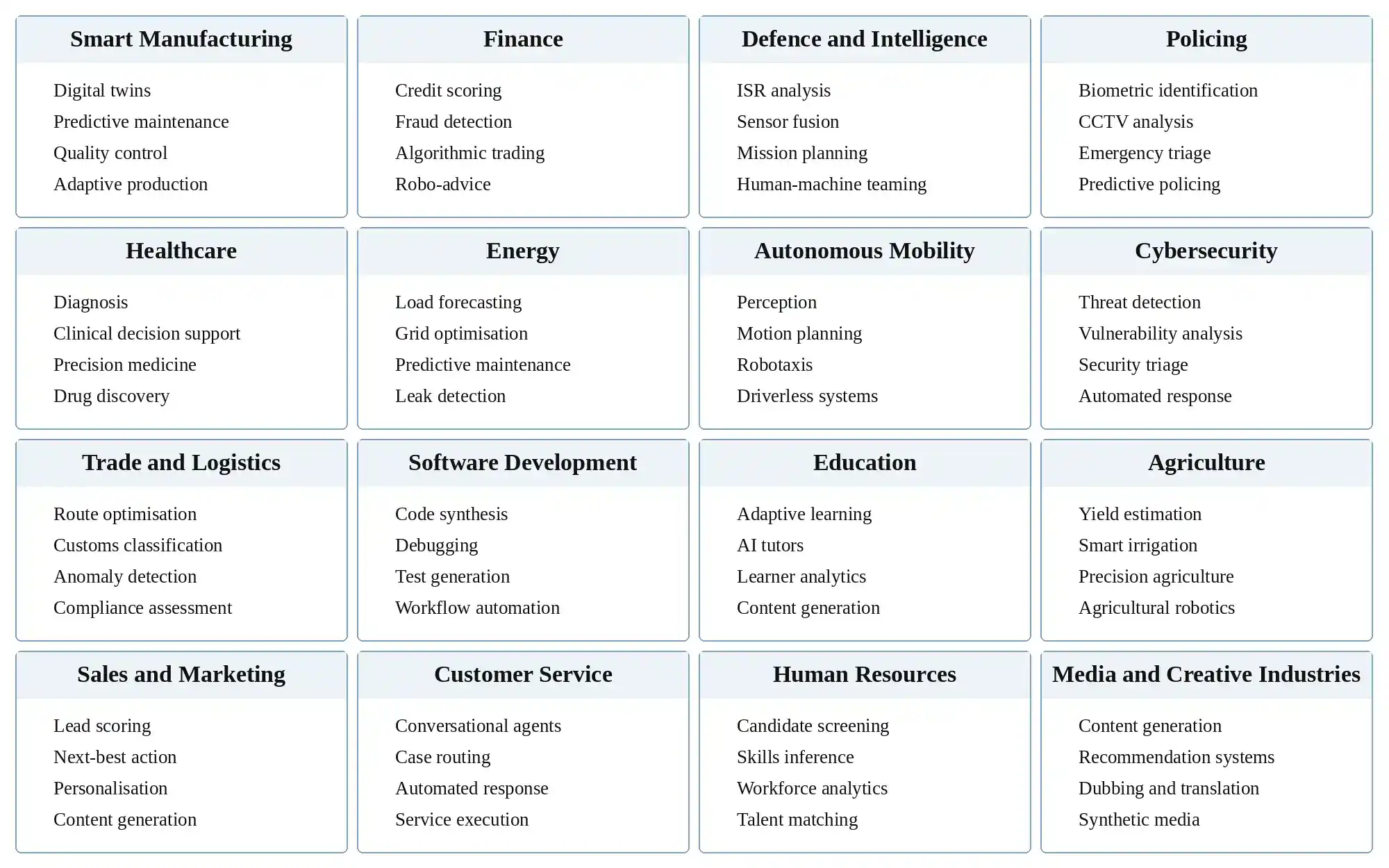
The International Monetary Fund (IMF) reports AI applications supporting security selection, asset allocation, high-frequency execution, portfolio rebalancing, derivatives pricing, collateral optimisation, counterparty assessment and market surveillance. Patent evidence cited by the IMF shows AI content within algorithmic-trading applications rising from 19 per cent in 2017 and remaining above 50 per cent annually since 2020. Automated investment management has also expanded, with the IMF projecting assets managed by robo-advisers to reach US$2.3 trillion by 2028. BIS Project Hertha tested modern AI techniques on real-time retail payment data to detect coordinated financial crime spanning multiple institutions, while an IMF note published in April 2026 examined agentic systems capable of moving payments from human-initiated instructions towards agent-mediated decisions. Supervisory authorities are applying AI to large datasets, market surveillance, sanctions screening, complaints processing and prudential analysis. By July 2026, the IMF described AI as embedded in the decision-making framework of finance, affecting risk pricing, credit allocation and responses to stress. The FSB nevertheless cites model risk, data quality, third-party dependence, cyber risk, market correlations and governance weaknesses among the vulnerabilities arising from machine authority within financial systems.
AI has altered the processes underpinning defence and intelligence by reducing the time between sensor data collection, situational awareness and action. Intelligence, surveillance and reconnaissance (ISR) systems can generate volumes of imagery, radar returns, acoustic signals, electronic emissions and other sensor data that exceed the capacity of human analysts to process conventionally. AI enables automated detection, classification, correlation and prioritisation within these streams, while sensor fusion can construct a common picture from information produced by different platforms. The United Nations Institute for Disarmament Research (UNIDIR) reported in 2025 that military AI applications span command and control (C2), information management and intelligence, autonomy, logistics, training and simulation. Its assessment states that AI can increase the speed and quality of battlefield analysis while processing large quantities of intelligence data for situational awareness and threat detection. Australia, the United Kingdom and the United States deployed common AI algorithms aboard P-8 maritime patrol aircraft to process sonobuoy data, accelerating the identification of potential underwater targets in congested acoustic environments. The same AUKUS programme demonstrated AI algorithms developed to support the detection and localisation of targets for strike missions.
AI-enabled decision support systems can synthesise intelligence, compare courses of action, support mission planning and continuously update assessments as battlefield conditions change. Military command systems are consequently moving towards data-centric systems in which sensors, command networks and weapon platforms exchange information at machine speed. The United Kingdom’s Strategic Defence Review 2025 sets out a vision of a force connected through a common digital foundation and a single digital targeting web, with crewed platforms operating with increasing numbers of uncrewed and autonomous systems. AI has also changed the economics and scale of force deployment through human-machine teaming. In June 2025, the United Kingdom’s Defence Science and Technology Laboratory conducted a live trial on Salisbury Plain in which a single operator controlled one uncrewed aerial vehicle and two uncrewed ground vehicles from a crewed command vehicle to detect and classify threats, with subsequent work focused on drone swarms for ISR. Electronic warfare, cyber defence, predictive maintenance and military logistics have also incorporated machine learning for signal classification, anomaly detection, equipment health assessment and supply planning. UNIDIR nevertheless has identified reliability, data quality, explainability and human oversight as continuing concerns, while the International Committee of the Red Cross (ICRC) has warned that increasingly complex AI decision-support systems can leave human judgement vulnerable to epistemic opacity.
Policing agencies have been using AI in image and video analysis, biometric identification, text and speech processing, emergency response systems, investigative triage, risk assessment and resource allocation. The International Criminal Police Organization (INTERPOL) and the United Nations Interregional Crime and Justice Research Institute (UNICRI) have cited automatic patrol systems, the identification of vulnerable or exploited children and police emergency call centres among applications already encountered by law enforcement agencies. Their technical guidance also covers facial recognition for biometric verification and identification, object recognition within CCTV footage, natural language processing (NLP) of text and voice material, and predictive analytics applied to historical crime data. Predictive systems can estimate where particular forms of offending may occur and inform the allocation of policing resources, but INTERPOL and UNICRI have cautioned that historical data can reproduce bias and encourage automation bias when officers treat machine outputs as determinations rather than assistive agents.
The World Health Organization (WHO) guidance published in March 2025 includes diagnosis and healthcare delivery, patient support, scientific research and drug development among the major health applications of large multimodal models. These models can handle text, images, video and other inputs, enabling machine inference from multiple modalities rather than through single-purpose algorithms. By September 2026, the United States Food and Drug Administration (FDA) had authorised more than 1,600 AI-enabled medical devices. Grand View Research valued the global AI healthcare market at US$36.7 billion for 2025 and projects US$505.6 billion by 2033, representing compound annual growth (CAGR) of 38.9 per cent between 2026 and 2033. The global market for AI-based diagnostics was valued at US$2.0 billion for 2025 and is projected at US$9.7 billion by 2033, while AI medical imaging is expected to rise from US$1.8 billion to US$20.2 billion over the corresponding period.
Longitudinal electronic health records are being analysed for clinical decision support, demand forecasting, patient flow management, resource allocation and population health. MarketsandMarkets values the global healthcare analytics market at US$69.74 billion for 2026 and projects US$213.27 billion by 2031, equivalent to a CAGR of 25.1 per cent. Its market definition encompasses predictive and diagnostic analytics, claims, revenue cycle management, fraud detection, precision medicine, imaging, supply chains, workforce planning and population health. Precision medicine uses clinical, molecular, genomic and other health data to optimise prevention, diagnosis and treatment according to biological variation between patients. Machine learning can analyse genomic variants, biomarkers, treatment history and other molecular information at scales that are difficult to manage through conventional interpretation. According to the OECD Science, Technology and Innovation Outlook 2025, neural networks trained on genotype-phenotype relationships can predict the effects of mutations and other genetic modifications, while the World Health Organization reported in December 2025 that genomic technologies are becoming essential to disease diagnosis, treatment and monitoring. The global genomics market was valued by MarketsandMarkets at US$47.07 billion for 2025 and is projected to reach US$85.09 billion by 2030.
Drug discovery relies on computational models to identify disease targets, predict protein structures and molecular interactions, screen chemical libraries, generate novel compounds and estimate absorption, distribution, metabolism, excretion and toxicity before experimental testing. OECD analysis has shown that virtual screening can search approximately 10⁹ molecules on commercial platforms and 10¹⁵ or more within proprietary pharmaceutical libraries, compared with about 10⁶ molecules through conventional wet-laboratory screening. AlphaFold 3 can predict structures and interactions involving proteins, deoxyribonucleic acid, ribonucleic acid and other biomolecules, while generative models can design candidate molecules against specified biological and physicochemical properties. MarketsandMarkets valued the global AI drug discovery market at US$3.92 billion for 2025 and projects US$17.56 billion by 2031, with de novo molecular design accounting for the largest share of the market by application in 2025. Between 2016 and 2023, the FDA received more than 500 drug and biological product submissions containing AI components, covering non-clinical research, clinical development, manufacturing and post-marketing activity. The FDA and the European Medicines Agency (EMA) issued joint principles in January 2026 governing AI throughout medicine development, including data governance, defined contexts of use, risk-based performance assessment, lifecycle management and human-centred design. WHO guidance nevertheless warns that large multimodal models can produce false, incomplete or biased outputs and remain vulnerable to cybersecurity risks, while representative datasets, clinical validation and human oversight remain necessary where computational outputs can affect diagnosis, treatment or therapeutic development.
The International Energy Agency (IEA) has documented AI applications in subsurface data processing, reservoir simulation, remote operations, predictive maintenance, leak detection and process automation, together with load and generation forecasting, transmission and demand. The International Renewable Energy Agency (IRENA) has cited monitoring, forecasting, optimisation and automated control among the capabilities being applied to power systems. Analysis published by the IEA estimates that widespread adoption of AI in power plant operation and maintenance could generate annual savings of up to US$110 billion by 2035, while AI-enabled network management could unlock as much as 175 gigawatts of transmission capacity from existing lines. Data accessibility, interoperability, digital infrastructure and specialist skills remain constraints on deployment.
Machine perception, localisation, sensor fusion, trajectory prediction, motion planning, automated steering and autonomous navigation have expanded machine authority over vehicle operation. The IEA estimates that Level 2 driving automation featured in about half of new cars sold globally in 2025, while Level 4 driverless taxi services operated commercially in more than 20 cities and the global robotaxi fleet reached about 8,000 vehicles. The IEA cites rare objects, extreme weather, unexpected road-user behaviour, sensor malfunction and the cost of high-performance sensing and computing as continuing constraints on greater autonomy. The United Nations Economic Commission for Europe (UNECE) adopted the first global regulatory framework for fully driverless Automated Driving Systems (ADS) in June 2026, requiring safety management systems, safety validation, in-service monitoring and performance capable of executing the dynamic driving task without a human driver.
Malware classification, behavioural anomaly detection, intrusion detection, threat intelligence, attack surface analysis, vulnerability assessment, code analysis, security orchestration and automated response span the applications of AI in cybersecurity. The World Economic Forum (WEF) reports the use of AI in cyber operations by 77 per cent of organisations surveyed globally in 2025. Its 2026 assessment reports machine participation in log analysis, security event triage, vulnerability identification, threat detection and orchestrated cyber defence. The International Telecommunication Union (ITU) has identified security, trust, privacy and AI-specific threat management as requirements for information and communication technology systems. WEF have also cited prompt injection, agent permissions, AI-generated attack techniques, human oversight and continuous verification among the constraints accompanying machine authority in cyber defence.
Predictive logistics, supply chain optimisation, multimodal routing, customs classification, rules of origin analysis, anomaly detection in trade data and compliance assessment are some of the applications of AI in logistics and global trade. The World Trade Organization (WTO) and International Chamber of Commerce (ICC) found the use of AI in customs operations in three quarters of surveyed adopting firms in March 2025, including tariff and duty calculation, Harmonized System classification, predictive analytics, anomaly detection and pre-filling of customs declarations. The World Customs Organization (WCO) has reported the adoption of AI and machine learning in risk management, business process analysis and targeting, with data management, interoperability, cybersecurity and Machine Learning Operations (MLOps) required for model reliability and scalability. Modelling provided by the WTO estimates that AI-enabled reductions in trade costs and gains in tradable services and production efficiency could increase global trade by 34 to 37 per cent by 2040 under its assessed scenarios.
AI has supported code synthesis, repository scale reasoning, program analysis, test generation, debugging, specification interpretation, context management, tool orchestration and verification in software development. Gartner describes enterprise AI coding agents as autonomous or semiautonomous systems that perceive repository context, translate human intent into multistep plans, execute those plans through engineering tools and verify changes against code, tests and related artefacts. Its 2026 assessment estimates the market at approximately US$9.8 billion to US$11.0 billion annualised and includes planning, implementation, testing, review and deployment among the functions undertaken in agentic workflows. A survey by McKinsey in 2026 finds about one fifth of organisations scaling coding agents, rising to 31 per cent among larger enterprises, while 32 per cent had chosen to build at least one software product or feature internally because agentic coding tools made internal development viable. GitHub has recorded more than 180 million developers on its platform and significant growth in repositories, pull requests and commits during 2025, providing the environment in which coding agents are being deployed at scale.
Digital learning platforms are able to do more than host courses and distribute content. The UNESCO Institute for Information Technologies in Education reported in 2025 that learning analytics-driven and AI-powered platforms can analyse learner behaviour, predict performance and provide personalised interventions. Learner models can allow content and pacing to change as performance changes. Learning management systems (LMS) provide the environment through which these functions can be delivered. The global learning management system market was valued by Fortune Business Insights at US$24.09 billion in 2025 and is projected to reach US$104.04 billion by 2034, with cloud deployment, adaptive learning and AI-enabled functionality contributing to the development of the market.
Virtual assistants and AI tutors have made the learner interface increasingly conversational. The OECD Digital Education Outlook 2026 distinguishes these systems from earlier intelligent tutoring systems whose interactions depended on predefined scripts. Generative AI has allowed tutors to nudge and change instructional strategy through natural language dialogue, although tutoring still depends on learner modelling and pedagogical design. Predictive analytics use the digital traces generated by learning platforms to identify disengagement and detect patterns associated with weak performance. The review of digital learning systems by UNESCO in 2025 has identified performance prediction, learner analytics and tailored intervention among the key functions of contemporary AI-powered learning technologies. The global adaptive learning market was valued at US$6.36 billion in 2025 and is projected by Fortune Business Insights to reach US$37.34 billion by 2034, representing a CAGR of 21.73 per cent. Generative AI has also changed the production of educational content. This capacity has allowed the same learning environment to supply different instructional materials according to learner performance. The global digital education market was valued by MarketsandMarkets at US$32.36 billion in 2025 and is projected to reach US$95.70 billion by 2030, representing a CAGR of 24.2 per cent.
Satellite imagery, drones, field sensors, weather observations and machine telemetry can be analysed to estimate expected yield at the farm level. The Food and Agriculture Organization of the United Nations (FAO) sees smart farming as AI, the Internet of Things (IoT), precision agriculture and data analytics working together to guide decisions about water, fertiliser, pesticides, energy and other inputs. World Bank AgriConnect guidance states that AI can combine satellite, weather, soil and field data to estimate yields and flag early signs of crop stress, although model performance remains dependent on data and soil conditions. CropWatch, listed by the World Bank as a global AI-based crop-monitoring system, can analyse multispectral satellite imagery for crop type and agroclimatic stress at approximately 30-metre resolution, with coverage extending to more than 160 countries.
At FAO’s Global Conference on Smart Farming in July 2026, the organisation cited rice production systems where optimisation algorithms paired with remote sensing reduced the use of fertiliser by up to 40 per cent and increased grain yield potential by 15 to 20 per cent relative to uniform application. Machine learning can combine soil moisture measurements, weather forecasts, crop stage and evapotranspiration estimates to determine irrigation needs and timing, while predictive models use similar inputs for pre-harvest yield estimates. The global precision farming market was valued by MarketsandMarkets at US$11.38 billion in 2025 and is projected to reach US$21.45 billion by 2032, representing a CAGR of 9.5 per cent.
Autonomous tractors, robotic harvesters, spraying systems, agricultural drones and field rovers use machine vision, geolocation and sensor data to navigate fields, recognise crops or weeds, vary application rates and perform repeated operations with less operator control. Precision livestock systems apply computer vision, wearable sensors and continuous monitoring to animal identification, abnormality detection, behaviour analysis and health or welfare assessment. The commercial expansion of agricultural automation is correspondingly rapid. MarketsandMarkets valued the global agricultural robots market at US$17.73 billion in 2025 and projects US$56.26 billion by 2030, equivalent to a CAGR of 26.0 per cent.
FAO reported in August 2026 that 65 governments had strengthened strategies supporting smart farming since 2015, with more than 775 policy actions directed towards implementation. According to the assessment, deployment depends on connectivity, access to real-time data, digital capability, viable business models and access to capital, particularly where small-scale producers face higher entry costs. BCC Research estimated the global market for AI in agriculture at US$2.8 billion in 2025 and projects US$8.5 billion by 2030, representing a CAGR of 25.1 per cent. FAO nevertheless reports that small-scale farmers produce approximately one-third of the world’s food while having the least access to resources and innovation, restricting the scale at which these technologies can be deployed.
Recommendation engines, propensity models, customer segmentation and next-best action systems determine which product, message or offer reaches a customer. Transaction history, browsing behaviour, search activity, prior responses and customer relationship management data can be analysed to estimate purchase propensity, churn risk, lifetime value and likely response to an intervention. Generative AI has added the production and variation of advertising copy, product descriptions, images and personalised messages, while real-time decision engines can select content and offers according to behavioural signals received during the customer journey. McKinsey’s The State of AI: Global Survey 2026, based on 1,719 respondents from 97 countries, found that marketing and sales was the business function most frequently associated with revenue gains from AI. AI can identify prospects, score leads, analyse account activity, prepare customer-specific propositions, recommend next actions, generate outreach, interpret responses and maintain customer relationship management records. The business-to-business survey of nearly 4,000 buyers and sellers from 13 countries by McKinsey in 2026 describes agents supporting high-value accounts through opportunity validation, account-specific messaging and next-best action recommendations, while lower-value opportunities can be handled further through prospecting, response nurturing, intent interpretation and meeting scheduling before transfer to a salesperson. MarketsandMarkets valued the global AI market for sales and marketing at US$58.0 billion in 2025 and projects US$240.59 billion by 2030, representing a CAGR of 32.9 per cent.
Customer service has become one of the most engaging applications of AI. Conversational systems classify intent, retrieve account information, summarise interactions, route cases, recommend responses to human agents and complete service actions through connected business systems. Gartner surveyed 1,303 senior leaders between January and April 2026 and found that service and support leaders had devoted a median 12 per cent of their 2025 budgets to AI, the highest proportion among the ten business functions examined. A separate survey of 199 service and support leaders conducted during April and May 2026 found AI expenditure rising by 38 per cent while total service and support budgets increased by only 2 per cent. Generative AI chatbots, voicebots and agentic platforms were expected to produce the greatest future value, while Gartner projects that at least 70 per cent of customers will begin their service journeys through conversational AI interfaces by 2028. MarketsandMarkets valued the global AI customer service market at US$12.06 billion in 2024 and projects US$47.82 billion by 2030, equivalent to a CAGR of 25.8 per cent. The global conversational AI market was valued at US$17.05 billion in 2025 and is projected at US$49.80 billion by 2031. McKinsey estimates that AI agents could mediate between US$3 trillion and US$5 trillion of global business-to-consumer retail commerce by 2030. The same development introduces new constraints around identity, data protection, fraud and accountability, while Gartner found that 87 per cent of customers considered access to a human agent essential when generative AI forms part of customer service.
Applicant tracking systems, human capital management platforms and workforce analytics are using machine learning to screen candidates, infer skills, forecast staffing requirements, support scheduling, benchmark compensation and analyse performance. The International Labour Organization (ILO) examined recruitment, compensation, and performance management as some of the applications of AI in human resource management during 2025. Recruitment systems can parse résumés and job profiles, rank applicants, identify skills adjacencies and match candidates to vacancies. Skills-based matching differs from conventional keyword screening because models can infer capabilities from employment history, qualifications and related experience rather than rely exclusively on job titles. Gartner has identified skills inference, taxonomies and ontologies as core components of AI-enabled internal talent marketplaces, where employee profiles can be matched with permanent roles, projects, short-term assignments, mentoring and development opportunities. AI-enabled systems can detect, classify and infer skills, map relationships between competencies and compare existing talent supply with requirements attached to roles or work. These capabilities support competency mapping, succession planning, internal mobility, learning recommendations and decisions on whether capability should be built internally, recruited externally or sourced through contingent labour. Predictive workforce analytics can draw on headcount, vacancies, turnover and performance data to estimate future staffing requirements, risk of attrition and emerging skills gaps. The use of machine judgement in employment decisions also exposes weaknesses that are more consequential than routine administrative error. The ILO warns that biased data and opaque programming can distort recruitment and performance assessment, creating legal and ethical risks for employers and workers. Adverse impact, proxy discrimination, explainability, auditability and human review therefore sit within the design of AI-enabled HR systems. Market Glass estimated the global AI in Human Resources market at US$4.9 billion in 2025 and projects US$23.9 billion by 2032, representing a CAGR of 25.2 per cent.
AI has become part of the production process in film, television, music, journalism, gaming, photography and digital publishing. Generative models can develop story concepts, scripts, dialogue, images, music, voices, animation and video, while machine learning systems support editing, visual effects, computer-generated imagery, colour correction, restoration and other post-production functions. The World Economic Forum (WEF) reported in 2025 that generative AI can support scripted production from story development and character creation through dialogue writing, while post-production systems can automate visual effects, three-dimensional animation and computer-generated imagery. Automated translation, dubbing, text-to-voice and text-to-video have reduced the technical requirements for adapting content to different languages and markets. The global generative AI content creation market was valued by Grand View Research at US$14.8 billion in 2024 and is projected to reach US$80.1 billion by 2030, representing a CAGR of 32.5 per cent between 2025 and 2030.
Distribution has become dependent on machine prediction of audience preference. Recommendation and ranking systems can analyse viewing, listening, search and interaction history to determine what is presented to each user. WEF reports that AI already supports personalised recommendations on streaming platforms, social media, search engines and media outlets, while generative systems have strengthened this capability through conversational discovery, automated content creation and more granular audience analysis. Real-time analytics can also inform narrative pacing, programming and live event production as audience behaviour changes. PricewaterhouseCoopers (PwC) reported that global entertainment and media revenue reached US$3.5 trillion in 2025 and projects US$4.2 trillion by 2030. Advertising revenue exceeded US$1 trillion in 2025 and is projected at US$1.4 trillion by 2030, with AI-powered real-time personalisation contributing to audience targeting, creative production and the pricing of digital advertising.
Generative AI can produce dialogue, characters, environments, textures and other game assets, while behavioural models can adjust content according to player activity. WEF includes gaming among the media sectors where generative AI is being applied to scripted content, asset creation and interactive experiences. PwC valued global video game revenue at US$224 billion in 2024 and projects approximately US$300 billion by 2029, exceeding the projected revenues of cinema and recorded music in aggregate. Music production has similarly developed beyond conventional editing into systems capable of generating compositions, instrumental performances and synthetic vocals from prompts. The International Federation of the Phonographic Industry (IFPI) reported global recorded music revenue of US$31.7 billion in 2025, with streaming accounting for 69.6 per cent of income and paid streaming subscriptions reaching 837 million users. In July 2026, IFPI reported that AI-generated tracks constituted 44 per cent of new music delivered to Deezer and more than one third of uploads to Apple Music, prompting the industry to introduce labels distinguishing AI-generated from AI-assisted recordings.
News production has integrated transcription, translation, summarisation, headline generation, research assistance, automated reporting and the adaptation of stories into different formats. UNESCO reported in 2025 that generative AI was already changing newsroom production while increasing the capacity to create synthetic or altered text, images and audio at scale. The same capability that lowers production costs also complicates verification because synthetic material or deepfakes can circulate with the appearance of authentic media. Grand View Research valued the global AI media and entertainment market at US$33.7 billion in 2025 and estimates US$43.1 billion for 2026, with a projection of US$159.3 billion by 2033. Services accounted for more than 60 per cent of market revenue during 2025, while applications included gaming, personalisation, production planning, content capture, automatic sports production, marketing and content analysis. Asia-Pacific accounted for 32.5 per cent of global revenue in 2025. The World Intellectual Property Organization (WIPO) has nevertheless identified unresolved issues concerning copyright, performers’ rights, digital replicas, voice and likeness replication, attribution and compensation arising from synthetic images, video, audio and text.
Legal practice is using AI for research, e-discovery, document review, contract analysis, due diligence, litigation support, regulatory monitoring and first-stage drafting, with natural language processing able to search bodies of legislation and case law while predictive coding assists the classification of evidence. In the built environment, AI is being applied to generative design, Building Information Modelling (BIM), digital twins, quantity surveying, cost estimation, construction sequencing, safety monitoring, defect detection, predictive maintenance and property valuation. Architecture and engineering practices can test design alternatives against structural, environmental and cost constraints before construction, while computer vision can compare site conditions with design specifications during delivery.
The present AI capability comprises systems optimised for particular functions as well as general-purpose systems able to perform several tasks. The Organisation for Economic Co-operation and Development (OECD) has assessed AI systems as falling between Levels 2 and 3 on its five level capability scales for language, social interaction, problem solving, creativity, metacognition and critical thinking, knowledge, learning and memory, vision, manipulation and robotic intelligence.
Market Participation
Worldwide spending on cloud infrastructure services reached US$143 billion in the second quarter of 2026. Amazon held 28 per cent of the market, Microsoft 20 per cent and Google 15 per cent, giving the three largest providers a 63 per cent global revenue share, while CoreWeave, Oracle, Crusoe, Nebius and Nscale were among those expanding fastest. Economies of scale in data centres, enterprise relationships, software integration and migration costs have given incumbent providers advantages spanning both supply and distribution, but they have not eliminated entry where new suppliers can differentiate on capacity, price or services.
China’s cloud infrastructure expenditure reached US$14.7 billion in the fourth quarter of 2025. Alibaba Cloud held 37 per cent of the market, Huawei Cloud 17 per cent and Tencent Cloud 10 per cent, leaving the three providers with a 64 per cent market share. Alibaba’s advantage rested on infrastructure supply, its Model Studio and enterprise agent products, while Huawei continued to integrate models, cloud services and industry applications.
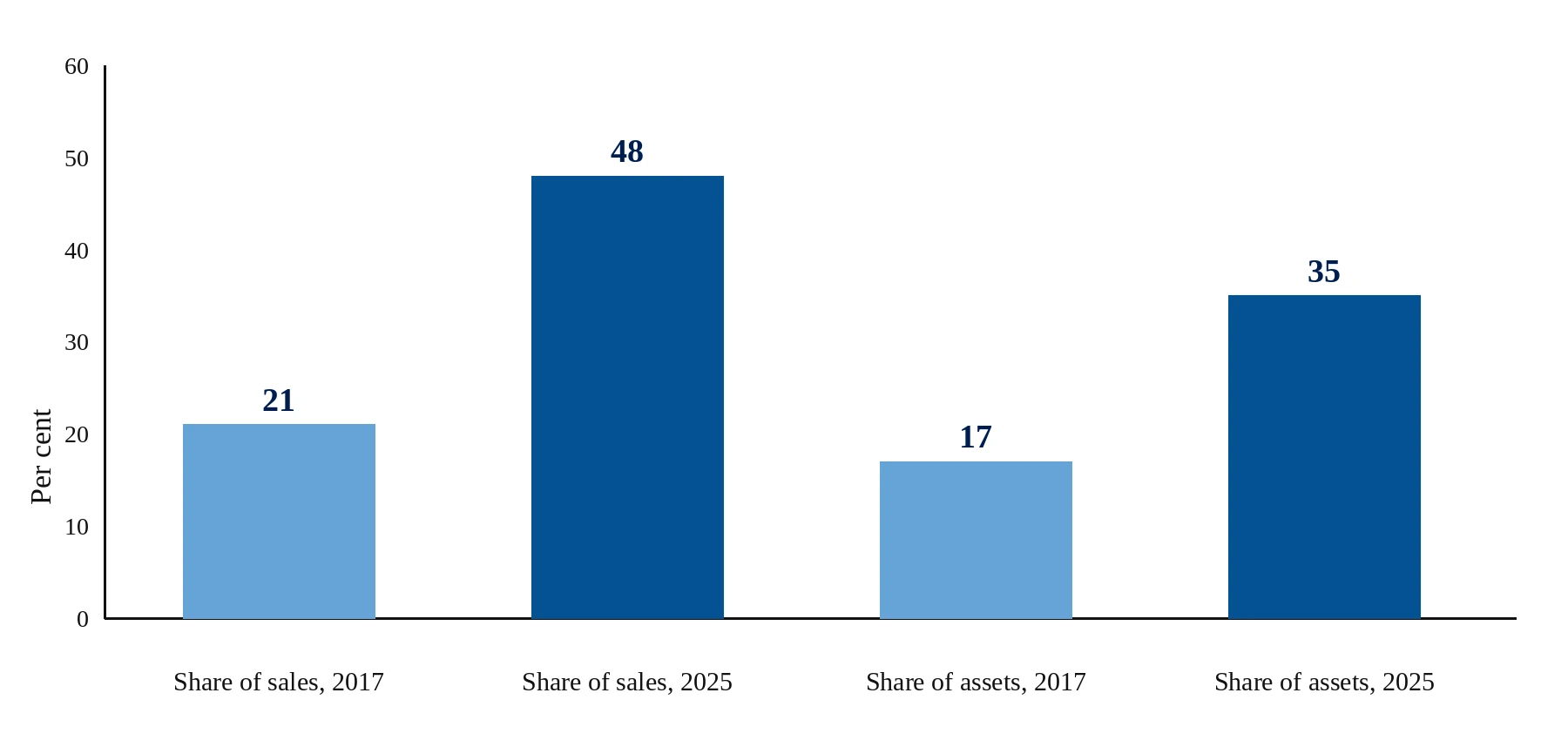
Source: UN Trade and Development, Global Trade Update, July 2025. Top five digital multinational enterprises by sales in 2025: Amazon, Apple, Alphabet, Microsoft and JD.com.
Menlo Ventures estimates Anthropic at 40 per cent of United States enterprise large language model (LLM) application programming interface expenditure in 2025, OpenAI 27 per cent and Google 21 per cent. The position has changed markedly since 2023, when OpenAI held 50 per cent, Anthropic 12 per cent and Google 7 per cent. The dataset covers United States enterprise expenditure rather than the global market. The Federal Trade Commission (FTC) identified more than US$20 billion of cumulative investment in partnerships between Alphabet, Amazon and Microsoft and the model developers Anthropic and OpenAI by January 2025. Equity interests, revenue-sharing rights, cloud spending commitments, access to computing resources and information sharing placed several firms in more than one stage of the supply chain. The Commission identified switching costs, access to talent and concentrated computing resources among the competitive effects requiring attention. AI-native firms have nevertheless gained significant positions at the application layer. Menlo Ventures estimates that start-ups captured 63 per cent of application layer revenue in 2025, up from 36 per cent a year earlier. Sales stood at 78 per cent, compared with 91 per cent for finance and operations. Incumbents retained 56 per cent of AI infrastructure expenditure. Enterprise AI application spending reached US$19 billion. Departmental applications accounted for US$7.3 billion, horizontal products US$8.4 billion and vertical applications US$3.5 billion.
India provides evidence of entry through locally differentiated products. Bengaluru-based Sarvam raised US$234 million at the first close of a planned US$300 million Series B in June 2026, with HCLTech and Bessemer Venture Partners participating. Its commercial relationships include IDFC FIRST Bank in banking, the payments provider Razorpay, the personal computing company HP and the digital commerce company Swiggy. Sarvam develops models, inference infrastructure and enterprise applications rather than limiting its participation to a single application category.
DeepSeek provides a Chinese example of price differentiation and reduced switching costs. Its application programming interface (API) uses formats compatible with OpenAI and Anthropic software development kits, allowing customers to use compatible applications with limited changes. Compatibility lowers part of the cost associated with changing suppliers, while time-based pricing uses cost differentiation to compete for price-sensitive workloads. Neither mechanism has eliminated the infrastructure required to develop models, but both have reduced barriers at the distribution interface between model suppliers and application developers.
Capital expenditure has raised the minimum scale required in infrastructure development. Amazon reported capital expenditure of US$128.3 billion in 2025, primarily for technology infrastructure supporting Amazon Web Services (AWS) and additional fulfilment capacity. Alphabet spent US$91.4 billion on property and equipment, mainly servers, network equipment, data centre and construction, compared with US$52.5 billion in 2024. Meta purchased property and equipment worth US$69.69 billion in 2025 and projected 2026 expenditure between US$115 billion and US$135 billion to support AI initiatives and its businesses. The infrastructure commitments have extended beyond the United States. Microsoft reported expenditure exceeding US$4.6 billion on cloud and data centres in the United Arab Emirates (UAE) between 2023 and 2025, with more than US$5.5 billion of additional capital expenditure planned for 2026–2029. These amounts form part of Microsoft’s disclosed US$15.2 billion expenditure and investment programme in the UAE. The capacity required to compete in cloud and AI infrastructure is consequently being reproduced internationally, although only firms possessing sufficient resources can finance multi-billion-dollar commitments. These figures establish the fixed investment available to firms competing simultaneously in cloud infrastructure, training and development of models and distribution. Alphabet spent US$61.1 billion on research and development (R&D) in 2025, equivalent to 15 per cent of revenue. Meta spent US$57.4 billion, or 29 per cent of revenue, attributing the increase largely to employee compensation and infrastructure associated with research and development, including AI initiatives. Microsoft reported increases in research and development, AI talent and data during fiscal 2026, while additions to property and equipment rose as the company expanded data centres, servers and network equipment.
Competition for AI talent has added another cost to market participation. Salesforce described the AI and cloud labour market in its April 2026 filing as highly competitive. Meta projected employee compensation as the second largest source of its expense in 2026, driven by investment in technical personnel, particularly AI talent. NVIDIA identified Alphabet, Amazon, Apple, Meta and Microsoft among companies competing with it for talent. Electricity supply has become another constraint on infrastructure expansion. The International Energy Agency (IEA) estimated that data centres consumed 485 terawatt-hours of electricity worldwide in 2025 and projected consumption of approximately 950 terawatt-hours by 2030. CoreWeave identified data centre and power availability as factors affecting expansion of its cloud infrastructure and cited power shortages, capacity constraints and higher electricity costs among conditions affecting its ability to compete.
NVIDIA occupies a commanding position in the infrastructure used to train and serve AI models. TrendForce estimated its share of the global AI chip market at approximately 70 per cent in 2025. Its position spans graphics processing units, the CUDA software environment, high-speed networking and integrated systems built around the Blackwell and Rubin platforms, giving customers a hardware and software environment that competitors must challenge rather than a processor in isolation. AMD has supplemented its accelerator hardware with networking, rack-scale systems and software development. Broadcom designs custom AI accelerators and supplies Ethernet networking for hyperscale customers. Google introduced its seventh generation Ironwood Tensor Processing Unit in April 2025 for large-scale inference. Amazon Web Services made Trainium3 UltraServers generally available in December 2025, following deployment of Trainium2 at large scale for Anthropic. Microsoft introduced the Maia 200 inference accelerator in January 2026, while Meta has announced four further generations of its Meta Training and Inference Accelerator for recommendation, ranking and generative AI workloads. United States export controls on advanced AI chips have accelerated efforts by Chinese firms to reduce dependence on NVIDIA and AMD processors. TrendForce projected domestic suppliers, including Huawei and Cambricon, to capture approximately 40 per cent of China’s AI server chip market in 2025, while the share supplied by foreign processors was expected to decline from 63 per cent in 2024 to about 42 per cent. Huawei’s Ascend family, Cambricon’s Siyuan processors and custom chips developed by Alibaba, Baidu and Tencent have consequently gained greater penetration in China’s AI compute market.
Cloud providers and model developers have also bound computing capacity, model distribution and market reach through long-term commercial relationships. In November 2024, Amazon increased its Anthropic investment by US$4 billion, bringing the total commitment to US$8 billion and establishing AWS as Anthropic’s primary cloud and training provider. Anthropic also began collaborating with AWS’s Annapurna Labs on Trainium accelerators and the Neuron software stack. In April 2026, Anthropic committed more than US$100 billion over ten years to AWS technologies, securing as much as five gigawatts of computing capacity. South Korea’s SK Telecom committed an additional US$100 million to Anthropic in 2023 and entered an agreement for the development of a multilingual large language model (LLM) serving telecommunications applications. The collaboration included Korean, English, Japanese and Spanish language capability and gave SK Telecom access to Anthropic technology for the development of telecommunications-specific services. SK Telecom supplemented the Anthropic relationship through the development of its proprietary models and relationships involving other model suppliers. Anthropic has expanded its use of Google Cloud Tensor Processing Units while retaining Amazon as its primary cloud and training provider. It subsequently contracted additional next-generation capacity with Google and Broadcom and committed US$30 billion of Azure capacity through a relationship involving Microsoft and NVIDIA. Anthropic possesses a multi-platform computing base spanning Amazon Trainium, Google Tensor Processing Units and NVIDIA graphics processing units.
Bell Canada and Cohere agreed in July 2025 that Bell would become Cohere’s preferred infrastructure partner for Canadian deployments, while Cohere would serve as Bell’s preferred supplier of agentic AI and LLM solutions to the Canadian market. An agreement in June 2026 added Bell data centre and connectivity infrastructure, Cohere software, BUZZ High Performance Computing graphics processing capacity and hardware produced by the Canadian manufacturer Hypertec. Bell contributes enterprise customers, telecommunications infrastructure and distribution while Cohere contributes models and enterprise software. The reciprocal relationship has allowed Bell and Cohere to use complementary assets without common ownership. On 27 April 2026, Microsoft and OpenAI announced an amended agreement governing their partnership. The agreement retained Microsoft as OpenAI’s primary cloud partner, preserved Microsoft’s licence covering OpenAI intellectual property through 2032 and continued OpenAI revenue-sharing payments until 2030, while making Microsoft’s model licence non-exclusive and permitting OpenAI products to be served via other cloud providers.
SoftBank pursued participation through capital investment rather than distribution rights, committing a maximum of US$40 billion to OpenAI in March 2025. Of the amount, US$10 billion was intended for syndication among co-investors, leaving SoftBank with a commitment capped at US$30 billion. The transaction has allowed the Japanese group to invest in the model developer without acquiring control of its operating business. Microsoft acquired a minority stake in Abu Dhabi-based G42 for US$1.5 billion and secured a seat on the company’s board. G42 agreed that its AI applications and services would run on Microsoft Azure, while jointly developed products would be distributed to enterprise customers in the Middle East, Central Asia and Africa. Unlike SoftBank’s investment in OpenAI, the G42 transaction paired equity participation with cloud infrastructure and customer distribution commitments. Advanced Micro Devices (AMD) acquired technical capability when it completed its US$665 million purchase of Finland-based Silo AI in August 2024. AMD’s filing allocated US$19 million of the purchase consideration to identifiable intangible assets. It recorded US$577 million as goodwill, reflecting mainly Silo AI’s workforce and its capacity for accelerating model and software deployment on AMD hardware. The transaction added multilingual model development and enterprise software expertise to a company whose established position lay in processors and computing systems. South Korea’s Rebellions and SAPEON Korea pursued scale through consolidation, signing a merger agreement in August 2024 following an agreed equity value ratio of 2.4 to 1. Rebellions’ management was designated to lead the merged company, while SK Telecom remained involved as an investor. Both businesses developed AI semiconductors. Their restructuring placed chip development assets and financing within a larger supplier rather than turning an incumbent semiconductor manufacturer into a software company. In July 2023, SAP invested in Germany’s Aleph Alpha, Anthropic and Cohere, while SAP-backed Sapphire Ventures committed more than US$1 billion to AI-oriented enterprise technology companies. SAP had also announced AI-related commercial relationships with IBM, Google Cloud and Microsoft in May 2023, giving it access to multiple AI providers without acquiring control of those businesses. ASML decided in September 2025 to lead Mistral AI’s €1.7 billion financing round, connecting firms positioned far apart along the AI chain. France-based Mistral AI raised the capital at an €11.7 billion post-money valuation. ASML and Mistral have also entered a commercial relationship covering AI-enabled products and joint research. ASML supplies equipment used in semiconductor manufacturing, while Mistral develops foundation models and enterprise AI products. The investment connects semiconductor production equipment with model development through equity participation rather than vertical ownership.
In Washington, corporate political activity has become part of market competition. United States Senate disclosure data reported by Axios showed Meta’s federal lobbying expenditure at US$26.3 million in 2025, while Amazon spent US$18 million, Google US$13 million and OpenAI about US$3 million. During the second quarter of 2026, Meta spent US$5.99 million, Amazon US$4.36 million and Google US$3.57 million, while Anthropic increased its expenditure over the first half of the year. These figures measure lobbying expenditure and the financial resources firms commit to participation in debates on liability, disclosure, procurement, intellectual property and rules for AI. In the European Union, influence over the rulebook has also taken a route through the General-Purpose AI Code of Practice, which drew input from more than 1,000 stakeholders, including model providers, small and medium-sized enterprises, academics and rightsholders. Amazon, Anthropic, Google, Microsoft, Mistral AI, OpenAI, Aleph Alpha, Cohere and IBM became signatories. Providers adhering to the Code may rely on it as evidence that relevant obligations have been met, with lower administrative requirements and a method for demonstrating conformity rather than alternative proof mechanisms. Participation in its drafting and subsequent adherence can affect documentation requirements, copyright procedures and the cost of regulatory compliance. Singapore’s AI Verify Foundation has brought many of the same actors into standard-setting, with premier members including AWS, Dell, Google, IBM, Microsoft, Red Hat and Salesforce. The Foundation develops testing frameworks, standards and practices intended for adoption by AI developers and users. Firms participating in those bodies can influence technical requirements affecting testing, interoperability and product assurance while competitors face the cost of conforming to standards that gain commercial acceptance. Competition in AI has, therefore, extended beyond models, prices and customer acquisition. It also encompasses complementary assets, contractual rights, investment capacity and rules that determine who can enter the market, scale and retain vantage positions.
AI and Statecraft
Among OECD economies with comparable firm data, 20.2 per cent of enterprises reported using AI in 2025, compared with 14.2 per cent a year earlier and 8.7 per cent for 2023. The World Bank finds a different distribution on innovation and infrastructure with high-income economies accounting for most AI innovation, computing resources and start-up funding, while adoption is increasing in middle-income economies and remains limited among many low-income economies. Brazil, China, India and the Philippines are identified by UN Trade and Development as developing economies with comparatively strong combinations of digital infrastructure, developer communities or research and industrial capability.
The breadth of adoption is not matched by the number of economies producing frontier models. Analysis published by the OECD identified ten developer companies from five countries at the organisation’s AI Economic Frontier in January 2025 including the United States, China, the United Kingdom, Germany and France. World Intellectual Property Organization (WIPO) data show that China generated 38,210 generative-AI patent families between 2014 and 2023, more than six times the United States total of 6,276. The Republic of Korea ranked next at 4,155, followed by Japan with 3,409, India 1,350, the United Kingdom 714 and Germany 708. Compared to model development, computing capacity is more narrowly concentrated, with Epoch AI estimating that in May 2025 the United States accounted for 74.5 per cent of aggregate AI supercomputer performance or GPU cluster performance in its dataset, followed by China at 14.1 per cent, the European Union 4.8 per cent, Norway 1.8 per cent and Japan 1.4 per cent. The World Bank separately finds significant high-performance computing and data centre capacity in France, Germany, Italy, the Netherlands and the United Kingdom, while noting the comparatively small number of European-headquartered public cloud providers and AI-chip vendors.
The concentration of computing capacity does not mirror semiconductor production. OECD data for September 2025 show that five economies comprising China, Chinese Taipei, the Republic of Korea, Japan and the United States accounted for 87 per cent of global wafer fabrication capacity. Production differs by process technology and chip type, preventing aggregate wafer capacity from serving as a proxy for AI-chip capability. OECD data show that firms headquartered in the United States received about US$194 billion, or 75 per cent, of worldwide AI venture funding in 2025, followed by the European Union at US$15.8 billion, China US$13.9 billion and the United Kingdom US$13.8 billion.
The analysis by OECD of the semiconductor value chain shows that AI computing depends on design, fabrication, manufacturing equipment and inputs supplied by several major economies, none of which controls the entire production process. China, Chinese Taipei, the Republic of Korea, Japan and the United States accounted for 87 per cent of global wafer fabrication capacity in September 2025. United States-headquartered firms accounted for 68 per cent of global revenue in electronic design automation tools and semiconductor IP in 2022. Extreme ultraviolet lithography equipment is supplied by ASML from the Netherlands, while Japanese firms hold major positions in photomasks, mask blanks, chemicals and manufacturing equipment. Deposition and etching equipment are supplied by firms headquartered in the United States, Japan and the Netherlands. Dependence therefore differs by production function, with even major producers relying on foreign suppliers for particular technologies and inputs. The World Bank estimates that high-income economies host 73 per cent of data centres, while middle-income economies had generated a share exceeding 40 per cent in global generative-AI traffic by mid-2025.
EuroHPC gives the European Union a pooled access model rather than requiring every member state to reproduce the full computing stack. EuroHPC operates 19 AI Factories and 13 AI Factory Antennas distributed through participating economies, with access available to researchers, firms and public bodies beyond the country hosting each machine. Its July 2026 AI Gigafactory procurement envisages up to seven facilities and procurement of compute time by the Union and participating states. Reliance on foreign hardware remains evident in these projects. Germany’s HammerHAI system uses NVIDIA Blackwell graphics processors and networking technology, while Finland’s LUMI-AI system relies on AMD accelerators and processors.
IndiaAI provides subsidised computing through empanelled cloud suppliers offering NVIDIA, AMD, Intel and Google processing hardware rather than requiring domestic production of each component. Korea reported 416 H100 graphics processors secured for public use and set a target of 18,000 graphics processors for the first half of 2026, while planning to source 50 per cent of the National AI Computing Center’s chips domestically by 2030. India relies on access to imported computing resources, whereas Korea is seeking to expand domestic semiconductor capacity while continuing to procure foreign processors.
Japan’s Ministry of Economy, Trade and Industry has committed more than ¥10 trillion to support AI and semiconductors through fiscal 2030, with the aim of mobilising over ¥50 trillion in public and private investment during the following decade. The fiscal 2024 supplementary budget provided ¥1.6 trillion for related programmes, including ¥991.6 billion towards post-5G systems, semiconductor design and manufacturing technologies and generative model research, together with ¥471.4 billion supporting domestic semiconductor production capacity.
India’s Cabinet has approved ₹103.72 billion for the five-year IndiaAI Mission. By March 2026, more than 38,000 GPUs had been made available through subsidised access for start-ups and researchers, above the initial target of 10,000. Programme allocations include ₹45.63 billion for compute capacity, ₹19.71 billion towards foundation models and ₹19.43 billion supporting start-up financing. In the Republic of Korea, a KRW1.46 trillion supplementary budget authorised in 2025 provided for the procurement of 10,000 GPUs, with phased deployment commencing from 2025.
The European Commission launched InvestAI in February 2025 to mobilise €200 billion for AI investment, including a €20 billion fund dedicated to AI gigafactories. By early 2026, the United Kingdom government had earmarked up to £250 million under the AI Research Resource for the expansion of cloud capacity. It also earmarked £500 million for the next phase of its Sovereign AI Unit, while five AI Growth Zones had attracted £28.2 billion in private investment.
China’s national AI industry investment fund had reached RMB60 billion by 2025. Shenzhen announced a separate RMB10 billion fund for AI and robotics, plus RMB4.5 billion in 2025 financing that offered subsidies of up to 60 per cent toward qualifying computing costs. HUMAIN was created in May 2025 as a company owned by Saudi Arabia’s Public Investment Fund, with a mandate spanning data centres, cloud infrastructure, models and AI services. National approaches therefore differ both in financial scale and mechanism.
The EU’s digital partnerships with Japan and the Republic of Korea have brought semiconductors, high-performance computing, AI, quantum technologies and research into cooperation that had previously focused on regulatory dialogue. The EU–Korea framework includes a semiconductor researchers’ forum and reciprocal access to high-performance computing facilities for researchers. At the third Digital Partnership Council held in Seoul during November 2025, both parties continued joint research on semiconductors, 6G, AI and quantum technologies. The fourth EU–Japan Digital Partnership Council, convened in May 2026, continued cooperation on AI, semiconductors, digital infrastructure, data and quantum technologies. These partnerships enable economies possessing different technological assets to coordinate research, provide reciprocal access and avoid duplicating the full AI production chain domestically.
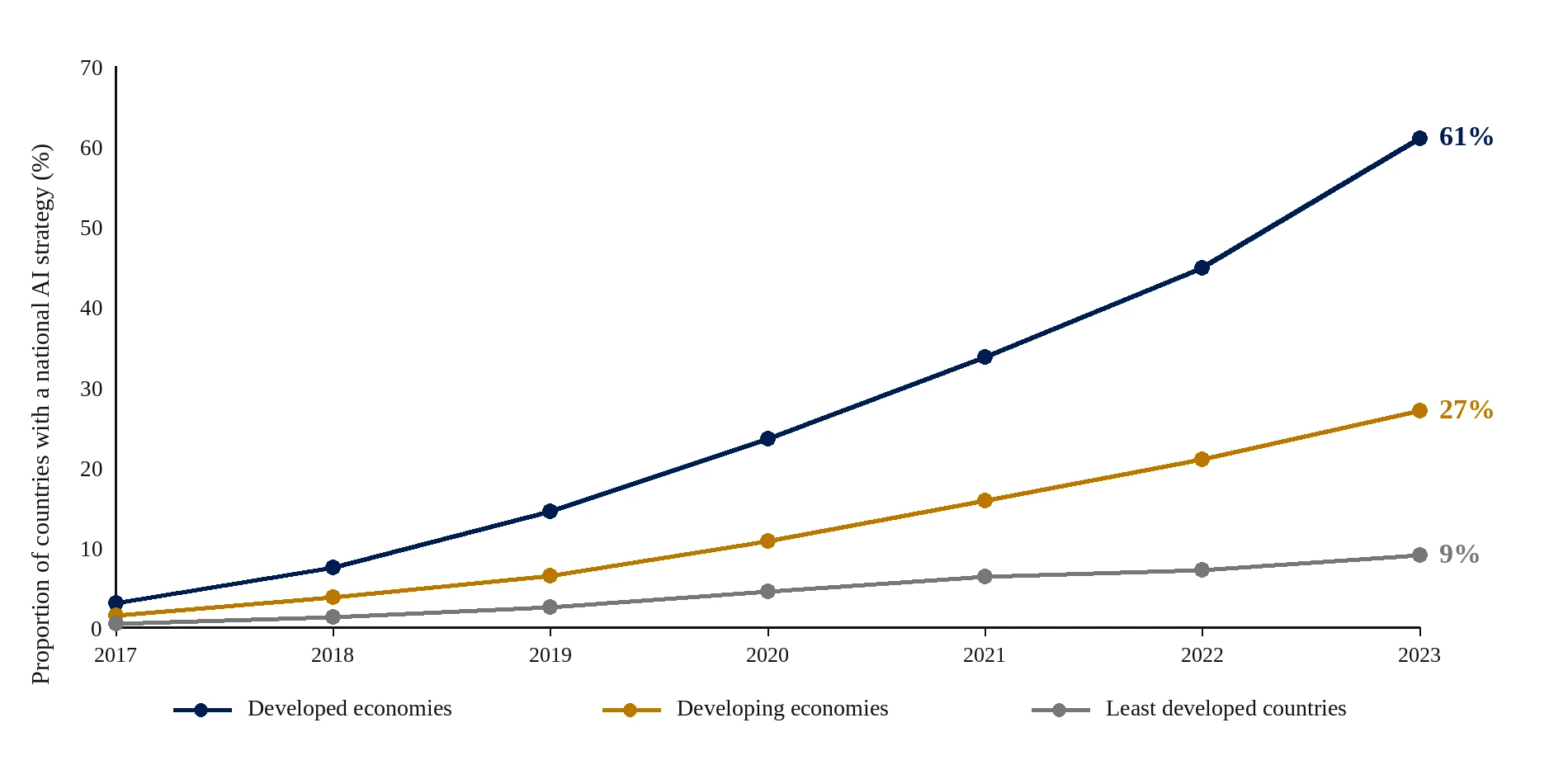
Source: UN Trade and Development, Technology and Innovation Report 2025.
The ASEAN–Japan Co-Creation Initiative for Artificial Intelligence, proposed in October 2025, has broadened Japan’s engagement with Southeast Asia through cooperation on AI models designed to support regional languages and applications, data infrastructure, AI governance and human capability programmes. ASEAN’s Working Group on AI Governance coordinates regional activity and provides the channel for engagement with China, India, Japan, Korea and the United States. The ASEAN Responsible AI Roadmap for 2025–2030 has established a shared regional framework while allowing member states to maintain distinct domestic approaches.
The African Union (AU) Executive Council endorsed the Continental Artificial Intelligence Strategy at its 45th Ordinary Session, held in Accra in July 2024. The Strategy calls on Member States to develop national approaches guided by an Africa-centric, development-focused vision and identifies AI skills, research and development, data, infrastructure, governance, private sector-led innovation and international cooperation as priority areas. On 17 May 2025, a High-Level Policy Dialogue attended by participants from more than 40 African countries reaffirmed implementation of the Continental Artificial Intelligence Strategy and requested the African Union Commission to develop an AI Africa Policy. The resulting communiqué declared AI a strategic priority for the continent and committed participating governments to developing domestic AI capacity, African-led research, high-quality datasets, compute capabilities, digital infrastructure, skills and a Continental AI Governance Mechanism. It also called on African countries to formulate national strategies, policies, laws and regulations consistent with the Continental Artificial Intelligence Strategy and their domestic circumstances. The African Digital Compact, adopted by the African Union Executive Council during the same session, has incorporated AI into the continent’s digital transformation agenda.
France and India issued a bilateral declaration on AI in February 2025 covering open resources, generative models, linguistic diversity, governance, safety and capacity building. Their joint statement of February 2026 reaffirmed cooperation following the Paris AI Action Summit and the AI Impact Summit in India. The documents demonstrate political alignment and continuing bilateral engagement, but they do not provide the type of reciprocal mechanism contained in EU–Korea cooperation. Singapore and France signed a joint action in May 2025 under which their AI safety organisations would work together, while Singapore and Japan conducted joint testing in ten languages covering five categories of harm, including violent crime, non-violent crime, intellectual property, privacy and jailbreaking. Singapore and the Republic of Korea later agreed to pursue joint programme between their AI safety bodies in AI research, governance and industrial applications.
NATO’s Revised AI Strategy of 2024 calls for greater interoperability among AI systems used by member states and consistency in testing methods. Cooperation is channelled through the Defence Innovation Accelerator for the North Atlantic and allied research networks. Its 2025 Data Strategy has established common requirements governing the collection, storage and distribution of information throughout the Alliance, while preserving each member’s control over national data. The Secretary General’s Annual Report 2025 describes implementation through roadmaps guiding AI adoption, training programmes, evaluation tools and the use of AI-enabled systems within Allied Command Operations.
The United States has progressively tightened restrictions on exports to China involving high-performance computing chips, semiconductor manufacturing equipment, high-bandwidth memory and related software. In December 2024, the US Department of Commerce introduced measures covering 24 categories of semiconductor manufacturing equipment, three software-tool categories and high-bandwidth memory, while adding 140 Chinese entities to the Entity List. Further requirements introduced in January 2025 addressed foundry due diligence and the risk that controlled technologies could be redirected to unauthorised end users or uses. In January 2026, the Bureau of Industry and Security allowed licence applications covering NVIDIA H200, AMD MI325X and comparable processors to receive case-by-case review for approved Chinese customers.
The Netherlands requires authorisation for exports outside the European Union of particular deep-ultraviolet lithography equipment, expanding controls in September 2024 beyond the measures introduced a year earlier. Japan added 23 categories of semiconductor manufacturing equipment to the export control under the Foreign Exchange and Foreign Trade Act in July 2023. Tokyo applies the requirement globally and states that licence decisions are based upon whether the equipment could contribute to military applications rather than on a prohibition directed specifically at China. Japanese officials nevertheless acknowledged consultations with the United States and the Netherlands before introducing the measure.
The Outbound Investment Security Program, which took effect in January 2025, brought certain capital flows within the scope of United States technology restrictions by prohibiting or requiring notification of investments connected with semiconductors, quantum information technologies and AI in China, Hong Kong and Macau. China has responded through controls on strategic materials used in advanced technology production. From December 2024, licences were generally withheld for exports to the United States involving dual-use gallium, germanium, antimony and superhard materials, while graphite faced stricter scrutiny of end users and intended applications. Additional measures introduced in April 2025 covered seven categories of rare-earth-related items.
ASML reported that customers in China generated 36.1 per cent of net sales during 2024, falling to 29.1 per cent a year later. The company also identified changes to export controls as a factor affecting operations and customer demand. OECD analysis finds that semiconductor firms based in China retain a comparatively high proportion of productive assets domestically and receive subsidies representing a larger revenue share than peers elsewhere within its dataset. World Bank and IMF reports published in 2025 indicate that Chinese firms were expanding domestic AI-chip fabrication and pursuing import substitution, although shortages of lithography equipment and other components continued to constrain progress.
Algorithmic discrimination, intrusive surveillance, biometric categorisation, social scoring, manipulative systems, synthetic impersonation, privacy infringement, automated decisions affecting fundamental rights and model-level systemic risk have shifted discourse on AI and ethics from a voluntary principle towards an enforceable legal instrument. The 193 Member States of UNESCO have adopted the Recommendation on the Ethics of AI, which sets out principles including human dignity, workforce displacement, non-discrimination, privacy, human oversight, transparency, accountability, auditability and ethical impact assessment. Reports published by the OECD document harms arising from bias, discrimination, polarisation, privacy infringement and security failures. A separate OECD report examining the deployment of AI by public authorities has identified remote biometric identification as one of the applications that can interfere with protected rights through surveillance and discriminatory error. Regulatory responses have attached legal obligations to specific harms rather than the abstract label of AI ethics. Manipulation, exploitation of vulnerability, social scoring, predictive policing based solely on profiling, untargeted facial image scraping, emotion recognition in sensitive settings, biometric categorisation using protected characteristics, deepfakes and model drifts have prompted prohibitions, disclosure duties, impact assessments, incident reporting, requirements for human oversight and model evaluation.
Generative AI has made political communication a matter of statecraft. During Russia’s invasion of Ukraine in March 2022, a deepfake video falsely depicted President Volodymyr Zelensky instructing Ukrainian forces to surrender. The episode became one of the earliest wartime demonstrations of deepfake technology being used to imitate a serving head of state during an armed conflict. Electoral contests have produced further cases. During Slovakia’s parliamentary election in September 2023, deepfake audio targeting a leading political candidate circulated shortly before polling day, prompting International IDEA to identify the case among significant examples of election-related information disorder. In January 2024, voters in New Hampshire received an AI-generated robocall imitating President Joe Biden and urging them not to vote in the Democratic presidential primary. The Federal Communications Commission subsequently confirmed that AI-generated voice calls fall within restrictions governing artificial or prerecorded voices and devised safeguards against fraudulent AI-generated political calls. During Indonesia’s 2024 presidential election, a deepfake video depicting former president Suharto, endorsing the Golkar party attracted approximately 4.2 million views.
State responses have consequently begun to address both the creation and distribution of synthetic political content. Following circulation of an AI-generated video during South Korea’s 2022 local elections that falsely depicted President Yoon Suk Yeol endorsing a candidate, the Public Official Election Act was amended to prohibit AI-generated deepfake campaign material during the 90 days preceding an election. By mid-February 2024, the National Election Commission had identified 129 items breaching the prohibition before the April legislative election. The European Commission has taken a platform-focused route through the Digital Services Act, requiring online platforms and search engines to assess and mitigate risks to electoral processes, including risks associated with generative AI, manipulated content and coordinated influence operations.
The European Union’s AI Act assigns obligations according to the type of system, its risk level and the responsibilities assigned to providers or deployers. From 2 August 2025, providers of general-purpose AI models became subject to requirements covering technical documentation, information supplied to downstream providers, copyright compliance and publication of summaries describing training content. Models classified as presenting systemic risk attract additional duties relating to risk assessment, incident reporting and cybersecurity. Providers established outside the EU must also appoint an authorised representative before placing covered models on the Union market.
China’s Interim Measures for Generative AI Services apply where services are offered to the public within China and impose requirements governing training data, discriminatory content, lawful content and security. Additional rules effective from 1 September 2025 require AI-generated text, images, audio, video and virtual scenes to carry prescribed forms of identification, including metadata. The Republic of Korea’s AI Basic Act entered into force on 22 January 2026 and establishes requirements concerning transparency, safety and national governance of AI, while providing support for research and industry. Several provisions are subject to a grace period of at least one year before enforcement begins. China has imposed obligations on providers and services that distribute content, whereas Korea provides an implementation period during which firms can prepare to meet their statutory obligations.
The United Kingdom has continued to assign much of the responsibility for AI oversight with existing sector regulators, which apply principles covering safety, transparency, fairness, accountability and redress. Legislation enacted in 2026 also allows certain generative AI services to fall within provisions of the Online Safety Act when illegal content or priority offences are involved. Singapore’s Model AI Governance Framework for Agentic AI recommends technical and organisational controls, human accountability and testing practices. AI Verify supports evaluation and assurance through dedicated testing tools.
Germany’s Federal Ministry of Justice and Consumer Protection launched its Corporate Digital Responsibility (CDR) Initiative with companies in 2018, establishing a voluntary form of corporate governance extending beyond minimum legal compliance. The CDR Code requires participating organisations to commit publicly to principles covering avoidance of harm, human autonomy, fairness, transparency, human responsibility, responsible data handling and consumer protection, with participating firms publishing reports on measures undertaken. Those reports remain company-generated disclosures rather than independent assurance. The framework is nevertheless important because it transfers responsibility for digital conduct into corporate governance rather than leaving ethical compliance entirely to external regulators.
Reports published under CDR initiatives remain forms of voluntary self-governance, whereas formal standards and third-party certification provide independent mechanisms for assessing organisational controls. ISO/IEC 42001:2023, developed by the International Organization for Standardization (ISO) and the International Electrotechnical Commission (IEC), has specified requirements for an AI management system covering governance, risk assessment, transparency, accountability and continual improvement. ISO/IEC 42006:2025 has added requirements for bodies responsible for auditing and certifying those systems, providing a basis to support third-party certification rather than self-declaration. High-risk AI systems regulated by the European Union may also require conformity assessment before entering the market, with independent notified bodies conducting reviews where third-party assessment is mandatory. Singapore’s Global AI Assurance Pilot has introduced another form of external scrutiny by pairing specialist testing providers with organisations deploying generative AI applications. The pilot evaluates risks such as unfair treatment, data disclosure, malicious use, deficient transparency and inadequate human oversight. These mechanisms serve different purposes. CDR relies on voluntary self-governance, ISO/IEC 42001 establishes certifiable organisational controls, conformity assessment operates through legal requirements, and AI assurance testing examines the technical and procedural behaviour of systems or applications.
United States federal policy since 2025 has emphasised on reducing regulatory barriers to AI development and promoting a more uniform national approach. Released by the White House on 23 July 2025, Winning the AI Race: America’s AI Action Plan set out federal actions intended to remove rules viewed as obstacles hindering innovation and proposed the export of integrated AI packages comprising hardware, models, software, applications and standards to partner countries. Executive Order 14365, Ensuring a National Policy Framework for Artificial Intelligence, issued on 11 December 2025, directed the preparation of a federal framework intended to pre-empt state laws considered inconsistent with national policy, while preserving state authority in certain areas. Japan’s Act on Promotion of Research and Development, and Utilization of Artificial Intelligence-related Technology entered into force on 1 September 2025, promoting research, development and deployment while providing for government coordination of measures addressing risks, rather than imposing horizontal compliance comparable to the EU regime.
A review published by the OECD finds broad convergence on risk management, public safety and protection of rights, although legal form and enforcement differ between jurisdictions. The Regulatory Policy Outlook published by the OECD in 2025 identifies a parallel tendency towards risk-based regulation, under which higher-risk systems face mandatory requirements while lower-risk categories are governed through principles, guidance and voluntary instruments.
Capitalism has repeatedly changed its instruments without surrendering its essential character. AI has given the world a new hierarchy between those who build the systems and those who live according to their verdicts. It may be distributed through software, yet the compute, capital, semiconductors, data and standards that make it scalable remain unevenly held. The test of this new milieu is not whether AI becomes ubiquitous, but whether its diffusion disperses economic power or concentrates it behind a universal interface.
Disclaimer
The scope of this analysis may differ according to its intended use. Unless otherwise agreed in relation to a specific mandate, it was not prepared by reference to the circumstances or requirements of any particular audience. Nothing in it constitutes investment advice or a determination of its suitability or appropriateness for a particular recipient. The material reflects the evidence and conditions relevant to the period examined and may be affected by subsequent developments. Users are responsible for determining the relevance of its content to their circumstances and for obtaining appropriate advice where a decision requires specialist judgement.
About the Chief Analyst

Nsikan Nyauko is an economist and Chartered Management Consultant with decades of cross-industry experience and a range of postgraduate qualifications spanning Economics, Big Data and Analytics, International Affairs and Diplomacy, International Commercial Law, Digital Transformation, Project Management, Business and Management, and Public Health. He serves the Centre as Faculty, Executive Development and Lead Advisor, Group Regional Programme for EMEA, APAC and the Americas. He has built relationships across industry, government, international organisations, academia, think tanks and civil society and has developed policy and strategy papers to support decision-making by corporations and sovereign entities.
Associate Analysts Nadine Karam; Marek Zieliński; Yun-seo Han; Camila Arriagada; Elias Nordström; Graham Bellamy