Independent Analysis
Independent analysis covers geopolitical, economic and market developments selected by the Centre for their general significance. It is not produced for the specific circumstances of any particular audience.
Independent analysis covers geopolitical, economic and market developments selected by the Centre for their general significance. It is not produced for the specific circumstances of any particular audience.
Commissioned research focuses on a particular sector, country, policy, market development, exposure or context. It is developed around the specific needs of the commissioning organisation.
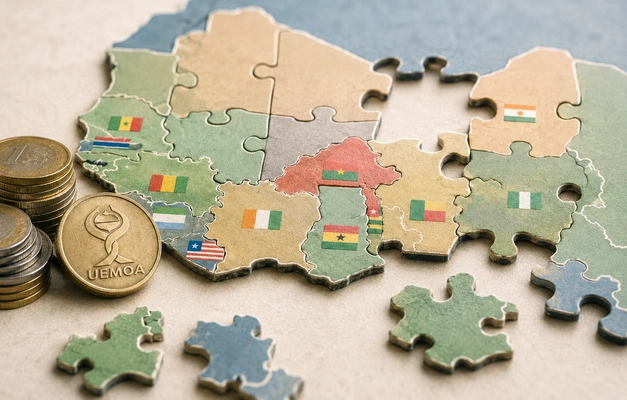
The Eco is not awaiting a banknote. A monetary union requires more than political endorsement of a common currency. It requires agreement on who determines monetary policy, how national fiscal choices are constrained, how reserves are managed, how liquidity is provided, how financial instability is contained and how disputes between national governments and the common monetary authority are resolved. The issues are constitutional as much as monetary for states that do not share the same currency system, economic weight, legal commitments or political affiliations.
A functioning Eco requires participating states to transfer relevant powers to a common authority and to accept rules that may restrict national discretion when domestic political or economic pressures intensify. The fate of the Eco will depend less on the date of issuance than on whether its members can establish an order capable of commanding compliance across economies with markedly different inflation records, fiscal positions, external exposures, exchange rate systems and degrees of monetary sovereignty.

International trade is constructed through overlapping commitments, national authority and economic power and iterated through successive negotiations over tariffs, discrimination, market access and the conditions under which national governments retain or exercise authority. The multilateral system depends less on the elimination of national discretion than on the rules that mediate its exercise.
What warrants reconsideration is the meaning attached to free trade. Much of the discourse still conceives trade openness as a movement along a single spectrum between liberalisation and protectionism. Governments operate within a web of multilateral commitments, regional agreements, domestic regulation, industrial policy, security policy and preferences that determine different conditions of market entry and competition, resulting in a system in which liberalisation, regulation and state intervention become intertwined. For developing economies, participation in a rules-based trading system does not determine the capacity to trade. Law, politics and economic power have continued to influence who benefits from international trade and on what terms.

For more than a century, the pulse of pistons and conveyor belts dictated the tempo of capitalism, an inheritance that the digital age has continued to reinterpret, guided by the human impulse to rewrite the wealth of nations and firms. The digital economy has gathered its power from an ensemble of technologies that have recast the terms on which commerce, institutions and societies interact. AI is becoming a defining component of digital capitalism, supported by the expansion of cloud infrastructure, data centres, digital platforms and big data. The economic structure behind this diffusion remains concentrated. Cloud infrastructure, frontier models, computing, venture finance and semiconductor capabilities are controlled by a relatively small group of firms and economies, even as adoption spreads through middle-income markets. Market competition has, therefore, extended beyond the performance of models into compute, capital expenditure, talent, distribution, standards and regulations. States have responded through industrial policy, investment, export controls, national strategies and governance frameworks, making AI simultaneously a disruptive technology, a value creator and an instrument of economic statecraft.

Global health is being tested against the commitments that have defined international health policy for decades, including the right to the highest attainable standard of health, universal health coverage, financial protection, equitable access to medical products and collective action against health emergencies. Progress in survival rates, disease control and medical technology has not produced equivalent capacity to deliver essential health services in every setting. Health financing, workforce distribution, infrastructure, regulatory capacity and preparedness have remained unequal between countries. Intellectual property provisions have continued to influence licensing, production and access to medicines and technologies.
Armed conflict, displacement, climate-related risks, sanctions and digital health are consequential in global health discourse. Commercial determinants of health have also acquired greater significance. Health has become increasingly embedded in foreign policy, development cooperation and international negotiations, extending responsibility for population health beyond ministries of health. International health law, multilateral financing, bilateral cooperation and philanthropy have expanded the instruments available, but gaps remain.