
West Africa’s Unfinished Monetary Union

The Eco is not awaiting a banknote. A monetary union requires more than political endorsement of a common currency. It requires agreement on who determines monetary policy, how national fiscal choices are constrained, how reserves are managed, how liquidity is provided, how financial instability is contained and how disputes between national governments and the common monetary authority are resolved. The issues are constitutional as much as monetary for states that do not share the same currency system, economic weight, legal commitments or political affiliations.
A functioning Eco requires participating states to transfer relevant powers to a common authority and to accept rules that may restrict national discretion when domestic political or economic pressures intensify. The fate of the Eco will depend less on the date of issuance than on whether its members can establish an order capable of commanding compliance across economies with markedly different inflation records, fiscal positions, external exposures, exchange rate systems and degrees of monetary sovereignty.
The Currency Before the Banknote
A common currency transfers monetary powers from national authorities to a regional central bank. It assigns authority over the policy rate, issuance of currency, shared reserves, central bank liquidity and monetary financing of government. It also places the exchange rate beyond national control. These decisions define the content of a monetary union.
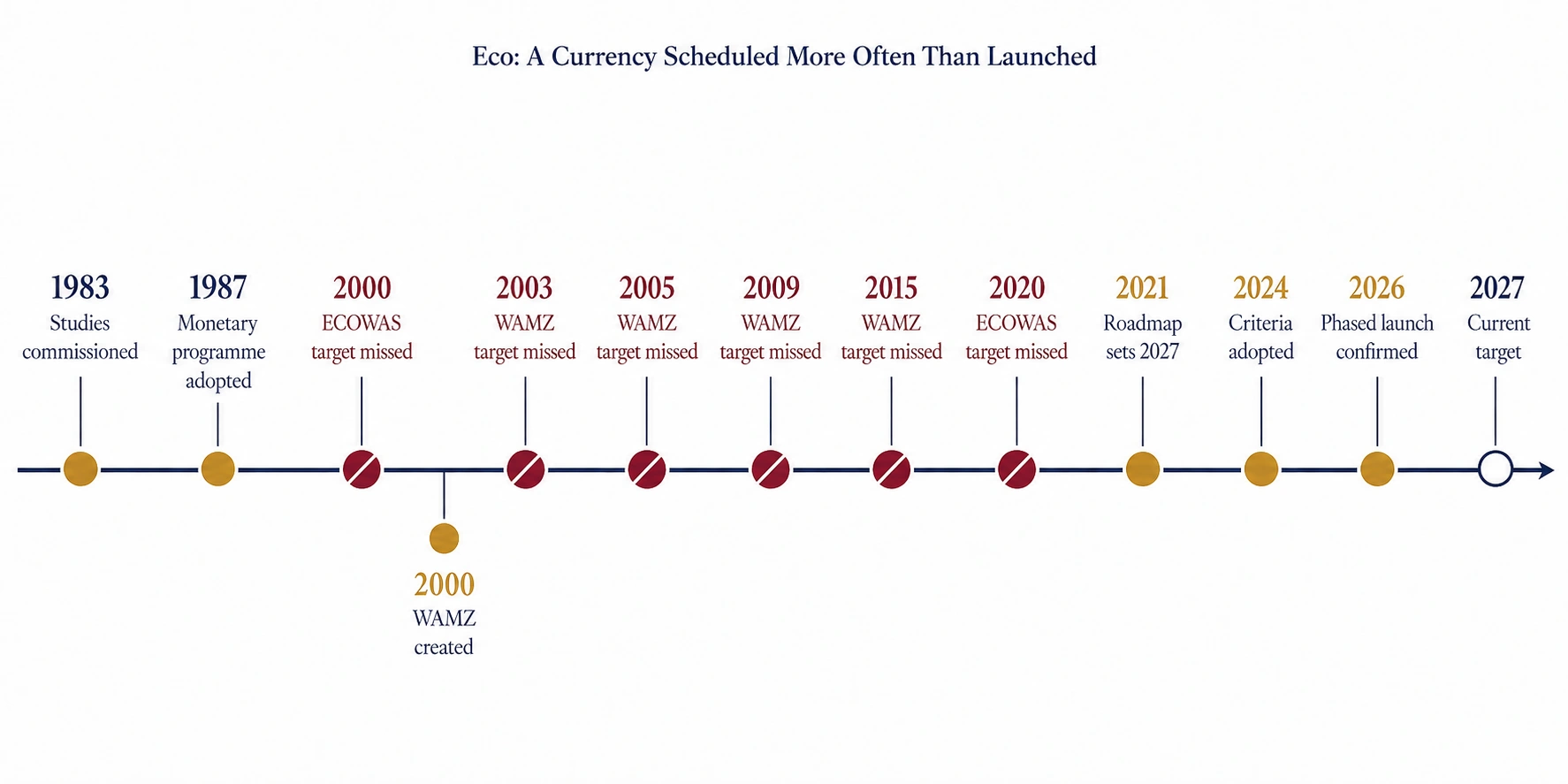
On 19 July 2026, ECOWAS reaffirmed 2027 as the proposed date for the Eco and endorsed a phased start by states meeting the convergence criteria. The communiqué also confirmed continuing consultations on issues regarded as essential to the launch. Registration of the name ECO with the African Intellectual Property Organisation therefore marks symbolic progress, not completion of the constitution of the Union.
A phased start may reduce the number of governments required for the takeoff. It does not settle the authority of the issuing bank, voting rights, reserve ownership or the terms for later participation. Nor does it establish whether the first currency area would represent ECOWAS or a limited coalition. The terms of accession would shape the Union’s authority before later members acquire influence over its original rules.
One concern is what order the Eco would establish when regional policy conflicts with national preference. Monetary union becomes consequential when a government accepts a decision that raises domestic financing costs, limits central bank credit or prevents exchange rate adjustment. Technical preparation is not the principal obstacle. The unresolved issue is the source, scope and enforceability of regional monetary authority.
One Region. Two Boundaries
Following the withdrawal of Burkina Faso, Mali and Niger, ECOWAS comprises twelve states. Benin, Côte d’Ivoire, Guinea-Bissau, Senegal and Togo are also members of the West African Monetary Union (WAMU) and use the CFA franc issued by the Central Bank of West African States (BCEAO). Cabo Verde, The Gambia, Ghana, Guinea, Liberia, Nigeria and Sierra Leone maintain national currencies. WAMU has eight members. Burkina Faso, Mali and Niger ceased to be members of ECOWAS on 29 January 2025 but retain their WAMU membership and participation in the BCEAO monetary system. WAMU’s constituency consequently extends beyond ECOWAS. The two organisations now define overlapping but distinct communities of states.
This divergence determines membership rights in the Eco. A currency constituted solely under ECOWAS law would exclude the three Sahel states unless a separate treaty defined their status and obligations. Participation by all eight WAMU members would place non-ECOWAS states within a currency zone developed under ECOWAS mandate. Adoption by the five ECOWAS members of WAMU would require decisions on WAMU’s continuing legal status and jointly held rights. A separate Eco formed by other ECOWAS states would preserve WAMU but leave several currency zones across ECOWAS. WAMU could remain a bridge between ECOWAS and the Alliance of Sahel States or give the political separation between them permanent form. The founding treaty must identify the community authorised to determine membership.

Unequal Starting Points
The proposed Union would combine an established regional monetary system with seven states retaining national monetary authority. WAMU already has a common legal tender, a regional issuing bank, a single monetary policy, pooled reserves, common banking supervision and a fixed euro parity. Its rules and financial relationships are already in operation. The seven ECOWAS states outside WAMU retain separate currencies, central banks, official reserves and exchange rate regimes. They can alter domestic monetary conditions, manage foreign exchange policy and use the exchange rate as a national adjustment instrument. Participation in the Eco would transfer these powers to a regional authority. Their reserves, lender-of-last-resort powers and exchange rate policies are presently national responsibilities.
The required concessions are different. WAMU members would place an operating union, an established parity and existing protections under a new regional settlement. The national currency states would surrender domestic policy discretion. WAMU members risk replacing a functioning framework with an untested scheme. The other states risk an Eco that reproduces BCEAO rules under an ECOWAS designation.
The concern is whether the Eco would constitute a new union, an extension of WAMU or a replacement for WAMU and the national systems. That choice will determine the treatment of statutes, reserves, assets, liabilities, supervisory mandates and exchange rate commitments. A common designation cannot eliminate the asymmetry. Participants would transfer different powers, assets and policy instruments.
Nigeria: Necessary Scale, Unsettled Leadership
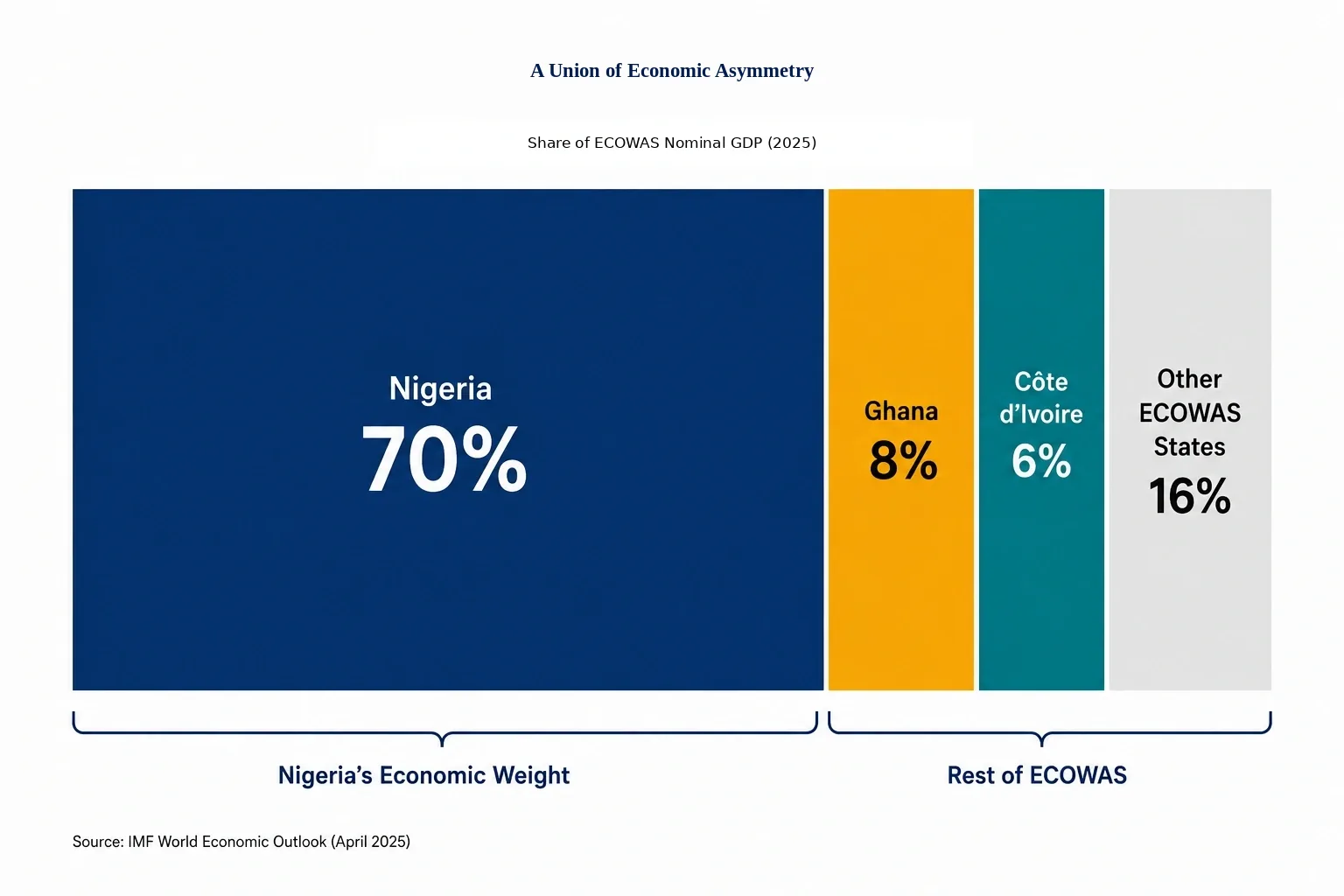
The 2024 ECOWAS Regional Economic Outlook attributes 62.7 per cent of regional GDP to Nigeria. An earlier Commission series placed Ghana and Côte d’Ivoire next, with average shares of 9.3 per cent and 7.8 per cent between 2010 and 2022. Nigeria would supply much of the currency zone’s economic weight, financial depth and external significance. An Eco without Nigeria could function but would have limited capacity to represent the regional economy or alter West Africa’s position in trade and finance. Nigeria’s participation would give its inflation, fiscal pressure and external balance exceptional importance for regional decisions, even when smaller economies require a different policy stance. Equal national votes would protect sovereign equality but could assign Nigeria obligations disproportionate to its influence. GDP-weighted votes would give Nigeria a determining position and intensify concern among smaller members. A mixed formula would still require agreement on the issues subject to equal voting, weighted voting or qualified majorities. The formula would determine influence and responsibility for regional support.
Economic size does not establish suitability as a monetary anchor. Nigeria has faced exchange rate pressure, high inflation, foreign exchange restrictions and fiscal demands. The IMF’s 2026 consultation reported stronger reserves and progress towards a more market-determined exchange rate, alongside continuing fiscal and price pressures. Nigeria would be expected to support the Union without directing it. Without Nigeria, the Eco lacks scale. With Nigeria, the Union must establish acceptable terms of leadership.
The Established System Nigeria Cannot Command
Economic scale and monetary capacity are located in different parts of West Africa. Nigeria is the largest economy, but WAMU possesses the region’s most developed common monetary system. The BCEAO issues the CFA franc, conducts monetary policy, manages official reserves, supports banking supervision and administers payment systems across eight states. WAMU’s Council of Ministers gives each member one vote and requires unanimity for its decisions. Smaller states can therefore regard the existing rule as protection against domination by the largest economy. Côte d’Ivoire, the largest economy in WAMU, also has a strong interest in the continuity of a system in which economic weight does not translate into overwhelming control.
Because the BCEAO framework already functions, it could supply much of the legal and administrative base for the Eco. The result could be Nigerian in economic mass but BCEAO in policy culture. A new central bank would still require agreement on headquarters, appointments, governing bodies, voting thresholds and the division of functions between regional and national authorities. These choices would influence information flows and policy assumptions. Abuja, Accra, Abidjan and Dakar are not interchangeable locations. Each reflects different state interests and monetary traditions. The Eco cannot choose between Nigerian weight and the WAMU system. It must constitute an authority regarded as legitimate by Nigeria and the WAMU states when their preferences conflict.
The Euro Question Remains
The 2019 reform altered the relationship between WAMU and France without ending its key provisions. It envisaged adoption of the name Eco when WAMU countries would join the ECOWAS currency, ended compulsory reserve deposits at the French Treasury and discontinued routine French representation in WAMU decision bodies. It retained the fixed parity of €1 to CFAF655.957 and France’s unlimited and unconditional guarantee of convertibility. The reform reduced direct French participation in governance while preserving the external support attached to the currency. The guarantee allows the BCEAO to obtain euros from France when its foreign exchange resources are insufficient to meet obligations at the fixed parity. For smaller WAMU economies, that commitment provides a source of protection against acute reserve pressure. Its value is both financial and political.
Retention of the parity and guarantee would reduce transition risk for WAMU members, but could present the Eco as a redesignation of the CFA framework. Ending them would increase regional monetary autonomy but require a credible substitute for reserve support, convertibility and foreign exchange liquidity. The choice concerns the capacity of regional authorities to perform functions now supported by an external commitment. The exchange rate decision would distribute adjustment differently. Continued euro parity would constrain flexibility and align the currency closely with the euro zone. A managed float or basket would provide greater discretion but increase reserve requirements and exchange rate risk.
Convergence Without Consent
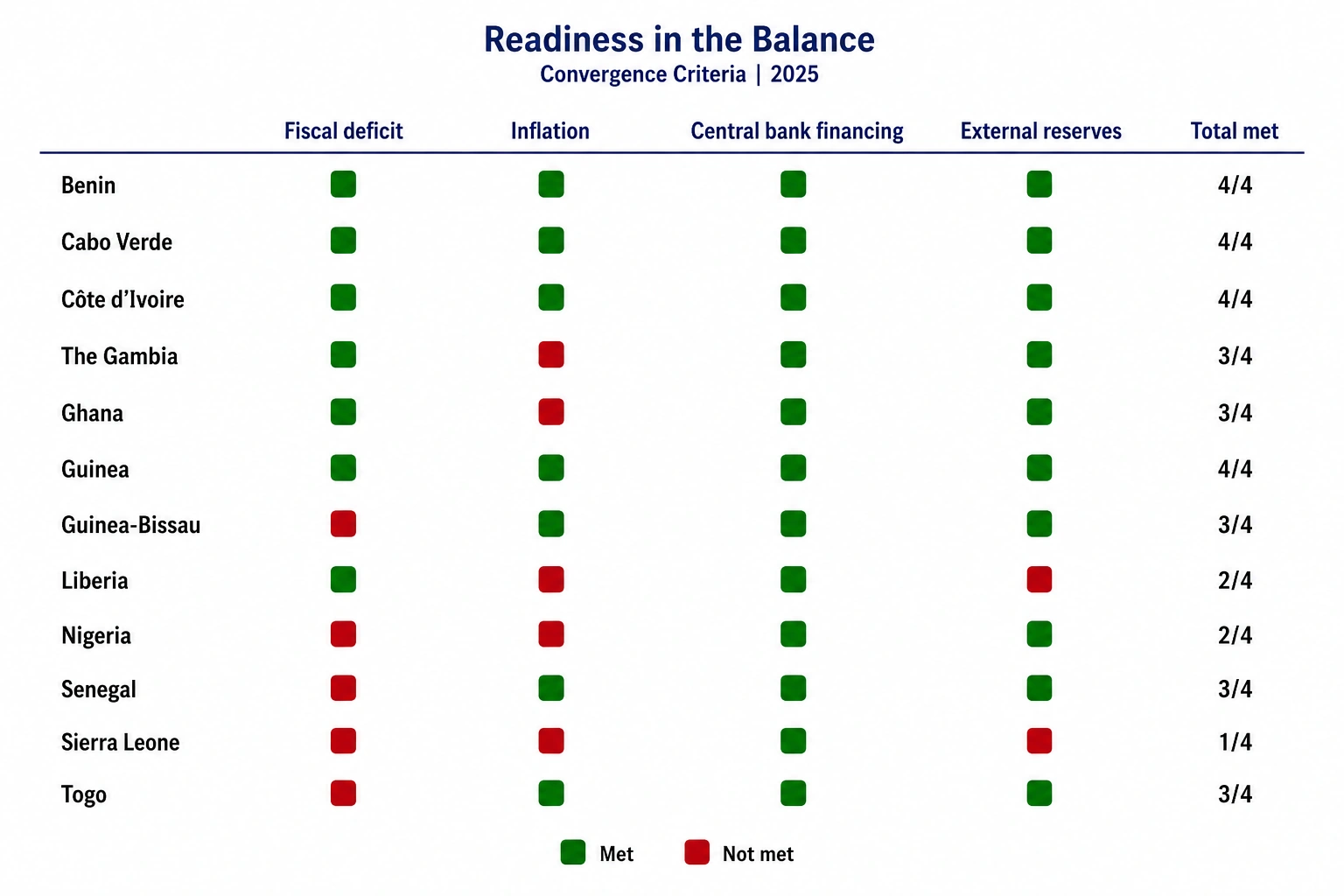
ECOWAS has specified four primary convergence criteria: a fiscal deficit, including grants and measured on a commitment basis, not exceeding 3 per cent of GDP; average annual inflation below 10 per cent; central bank financing of the fiscal deficit not exceeding 10 per cent of the previous year’s tax revenue and gross external reserves equivalent to at least three months of imports. The limits seek to contain fiscal dominance. The inflation threshold limits divergence in price conditions. The reserve requirement provides a minimum buffer for external payments and foreign exchange liquidity.
Compliance in one year does not establish convergence. Countries can satisfy the same thresholds while differing materially in financial depth, composition of trade, commodity dependence and capacity to absorb external shocks. A phased launch could therefore bring together states that meet the criteria but remain subject to different economic cycles and policy pressures. What matters is whether compliance can be maintained beyond the qualifying period, because monetary union converts temporary compliance into continuing obligations.
The criteria acquire force only through surveillance and consequences applicable to every member. A rule that cannot be enforced against a large state is not a regional constraint. A sanction that leaders will not apply is not a sanction. Convergence can identify a candidate state. It cannot supply the consent required for continuing compliance after accession.
The Authority the Union Has Yet to Constitute
The Eco requires a regional central bank established by treaty, with a defined mandate and operational independence. Its statutory functions would include issuance of currency, monetary policy, management of pooled official reserves, exchange rate policy, central bank liquidity, oversight of payment systems and limits on monetary financing. The allocation of banking supervision and resolution powers must also be stated in law. The statute would need to protect these functions from short-term political direction.
Existing regional bodies provide precedents, not a completed model. The West African Monetary Agency (WAMA) coordinates the ECOWAS Monetary Cooperation Programme, the West African Monetary Institute (WAMI) prepares for a common West African central bank, and the BCEAO already exercises monetary functions across WAMU. The unresolved task is to determine which powers, statutes and governance rules would apply to the Eco.
The founding treaty must prescribe the selection of the governor, term of office, grounds for dismissal, regional representation, voting thresholds and reporting duties. Equal voting protects sovereign equality. Economic weighting recognises differences in size. Rotating seats may broaden representation but weaken continuity. Any mixed formula must prevent both state control and persistent obstruction.
Accountability must extend beyond heads of state and finance ministers. National parliaments would transfer powers created under domestic law, while regional courts may resolve disputes between the bank and member governments. The treaty must specify the consequences of non-compliance, pressure for monetary financing and withdrawal. The Eco will constitute a monetary union only when its central bank can adopt a binding decision contrary to a government’s immediate preference and that government continues to comply.
The First Crisis Will Rewrite the Rules
The strength of the Eco would be established during financial distress. A financial panic would test central bank liquidity, deposit protection and bank resolution. Sovereign debt distress would test the boundary between monetary operations and fiscal assistance. A commodity price collapse would test mechanisms for responding to an external shock. Sustained reserve pressure would test access to foreign exchange liquidity and external support. WAMU provides a relevant comparator. The BCEAO conducts liquidity operations, the WAMU Banking Commission exercises supranational supervisory and resolution powers, and the regional deposit guarantee and resolution fund supports depositor protection and bank resolution. These bodies demonstrate that common supervision requires defined authority and financing for intervention. The Eco must establish whether equivalent powers would command equivalent funding.
The Eco treaty would need to assign responsibility among the regional central bank, national treasuries, a regional assistance mechanism, development finance bodies and international lenders. It must define acceptable collateral, conditions for support, national contributions and the treatment of a bank whose failure exceeds the capacity of its home state. It must also establish whether a sovereign can restructure debt while retaining membership.
Moral hazard does not determine whether members have consented to mutual support. Governments must decide whether taxpayers in one country can finance support for another and whether political conflict may affect access to assistance. Markets will infer the effective rules from the first rescue, restructuring or refusal. If those rules are unclear before launch, the first crisis will determine them under pressure.
A Monetary Union Cannot Substitute for an Open Market
The Eco could reduce conversion costs, improve price comparison, lower payment friction and limit exchange rate risk. These gains apply principally to transactions. They do not address delays in customs procedures, unauthorised checkpoints, border harassment, inconsistent product requirements, weak transport infrastructure or national restrictions on regional commerce. The currency could lower transaction costs while the underlying market remained fragmented.
ECOWAS has continued to report uneven application of its free movement rules and illegal checkpoints along major trade corridors. The July 2026 communiqué also warned that bilateral trade agreements concluded by individual member states could weaken the customs union and called for compliance with common regional obligations. These constraints arise from national policy and enforcement, not from the number of currencies in circulation.
The sequence is unfavourable. A common currency draws strength from a functioning market governed by rules that bind all participants. West Africa is asking monetary union to support a market that governments can interrupt through border closures, administrative restrictions or selective compliance with regional commitments. Currency union would not prevent those decisions.
The Pan-African Payment and Settlement System (PAPSS) offers a narrower means of lowering transaction costs through instant cross-border payments, pre-funding and net settlement in local currencies. It does not replicate monetary union, but shows that some commercial gains can be secured at lower cost. A shared currency can make an open market cheaper to use. It cannot compel governments to keep the market open.
The Sahel Rupture and the Future of WAMU
Burkina Faso, Mali and Niger have left ECOWAS but retain WAMU membership and participation in the BCEAO monetary system. The existing currency union therefore has a reach that ECOWAS no longer possesses, connecting five ECOWAS members with three Alliance of Sahel States members. The development has created both a bridge and a fault line. Its future therefore concerns regional cohesion as much as monetary administration.
Adoption of the Eco by the five ECOWAS members of WAMU would require reconstitution of the existing union. Participation by all eight WAMU members would require a treaty basis broader than ECOWAS membership. Continuation of WAMU beside a separate Eco would preserve competing currency systems.
Monetary cooperation has survived political disagreement. What remains uncertain is whether ECOWAS and the Sahel states regard the cooperation as an asset worth preserving. The rupture has increased the value of monetary ties while making the political basis of a wider union harder to establish.
The Eco and West Africa’s External Adjustment
The exchange rate regime would determine how global price, interest rate and financial shocks affect participating economies. Continued euro parity would preserve a stable external reference but constrain adjustment. A managed float would provide greater discretion while increasing reserve requirements and exchange rate risk. A basket could reflect broader trade patterns, but its composition and intervention rules would need to be transparent.
A regional currency would not automatically displace the dollar or euro from commodity exports, servicing external debt, investment contracts or major imports. Wider international use would depend on confidence in monetary policy, market liquidity, convertibility and the availability of financial instruments denominated in the Eco. Domestic confidence would also depend on whether the fiscal framework can command compliance.
Pooling reserves could strengthen protection against external pressure, but would require governments to transfer control over foreign exchange assets. The treaty would need to define ownership, contributions, investment authority and access during shortages. Strong fiscal rules could expand regional debt markets. Weak enforcement could cause the risks in one state to affect borrowing costs across the union.
The Eco could support African Continental Free Trade Area (AfCFTA) trade and reduce use of third-country currencies, but payment systems can secure part of that benefit without full monetary union. External powers would continue to influence the region through trade, debt, infrastructure finance and commodity demand. The external value of the Eco would reflect how West Africa intends to absorb global pressure, not merely select an exchange rate regime.
The Monetary System That 2027 Could Produce
The July 2026 decision permits a phased launch by states meeting the convergence criteria, but does not identify the founding participants or settle the major issues. Four outcomes remain possible.
- A limited Eco could be adopted by a small qualifying group. The gain would be preservation of the timetable and a test of common rules. The risk would be insufficient economic weight, trade connection or financial depth. Its meaning would be differentiated integration, not a currency representing ECOWAS as a whole.
- A WAMU-led Eco could use the CFA framework as its operational base. The gain would be the continuity of currency issuance, reserve management, supervision and exchange rate policy. The risk would be regional rebranding without a wider union. The currency could carry the name Eco while retaining the membership and policy character of the CFA area.
- A comprehensive Eco could include Nigeria, the principal WAMU economies and other qualifying states. This would provide scale, regional representation and the strongest prospect of affecting trade and external finance. It would require a central bank statute, voting formula, exchange rate regime, reserve rules, fiscal enforcement, financial support, domestic ratification and a legal relationship with WAMU. Without these decisions, broad membership would magnify uncertainty rather than strengthen the Union.
- Further deferral remains possible. Another postponement would weaken confidence in official commitments but could be preferable to issuing a currency whose authority, membership and policy framework remain unsettled. The relevant indicators are agreement among central bank governors, founding membership, the exchange rate decision, reserve rules, funding of common bodies and domestic ratification.
The Precedents the Eco Cannot Ignore
The survival of monetary unions has depended less on economic similarity than on the authority governing the currency, the allocation of losses during crises and the willingness of governments to accept common decisions when national preferences diverge. Failed unions show that a common currency can persist during stable periods while the powers required to sustain it remain national. The euro zone demonstrates both the capacity and the limits of monetary integration among sovereign states. The European Central Bank (ECB) established a single monetary policy, but the sovereign debt crisis exposed the consequences of combining the policy with nationally governed fiscal systems and, at the time, predominantly national responsibility for banking supervision and resolution. The subsequent creation of the European Stability Mechanism, common banking supervision and a regional bank resolution framework expanded the capacity of the union to address sovereign and financial distress. The euro has shown that monetary authority without sufficient capacity to manage banking failures, sovereign stress and cross-border financial transmission can force major changes after the currency has already been issued.
The eight members of the Eastern Caribbean Currency Union share the Eastern Caribbean dollar, a common monetary policy and a common exchange system administered by the Eastern Caribbean Central Bank. The currency has maintained a fixed rate of EC$2.70 to the United States dollar since 1976, while the central bank operates on principles resembling a currency board and maintains foreign exchange backing for its monetary liabilities. The experience demonstrates that small economies can sustain a common currency where reserve rules, monetary authority and the exchange rate commitment are clearly defined. The Latin Monetary Union, formalised in 1865, and the Scandinavian Monetary Union, established in 1873, maintained agreed relationships among national currencies for decades. Both eventually broke down after the First World War disrupted the conditions on which their common systems depended. Their agreed standards did not eliminate the capacity of national governments to pursue different responses when exceptional pressures arose.
After the dissolution of the Soviet Union, several newly sovereign states continued to use the ruble while pursuing independent monetary policies. Russia controlled the issuance of cash, but other participating central banks could expand credit, transmitting monetary expansion across the shared currency area. Attempts to coordinate policy encountered disputes over authority and voting rights, while inflation, payments restrictions and parallel currencies progressively divided what remained of the common monetary space. By 1993, the ruble area had begun to disintegrate as states adopted separate currencies. The failure arose from the absence of a monetary authority whose decisions bound all governments and central banks.
These precedents across different monetary systems have shown that a common currency remains viable only where the authority required to govern it remains effective when compliance becomes costly.
Implications for Firms and Policymakers
For firms, entry into the Ecozone would begin with redenomination. Every participating national currency would require an irrevocable conversion rate into the Eco. Bank deposits, domestic loans, wages, pensions, tax liabilities, invoices, contracts, accounting records and domestically issued government securities would have to migrate to the new unit of account. Conversion rules would need to preserve the nominal value of existing contracts while specifying rounding, settlement and the period during which old currencies remain exchangeable. For multinational firms, the burden would extend to payroll systems, enterprise resource planning, treasury systems, point-of-sale infrastructure, bank mandates and intercompany accounts. Under a phased Eco, firms operating simultaneously in founding and non-participating ECOWAS states would still maintain foreign exchange positions between the Eco and the adjacent currencies.
The disappearance of intra-union exchange rate volatility would reduce hedging costs, conversion charges and uncertainty over the domestic currency value of cross-border receivables. It would not eliminate macro-financial risk. The risk would migrate into interest rate differentials, sovereign spreads, banking conditions and fiscal adjustment. A common policy rate would not produce a common borrowing rate. Sovereign risk premia and domestic credit conditions would continue to differentiate the cost of capital among member states. Eurozone experience demonstrated that sovereign distress can alter the cost of capital and cause lending rates to diverge even under the same monetary policy. The loss of national exchange rate adjustment would also differ markedly across entrants. After accession, deterioration in a member’s external position could no longer be corrected through an independent nominal depreciation. Adjustment would instead pass through fiscal contraction and changes in domestic demand. Where the exchange rate is fixed at union level, adverse terms-of-trade shocks place greater demands on reserves and domestic adjustment.
The Eco would redistribute economic power between national governments and the common monetary authority. Domestic authorities would retain responsibility for public expenditure while surrendering control over the policy rate and money creation. This creates a potential responsibility-authority asymmetry. Governments may be held accountable for recessions or financing conditions they can no longer address through national monetary instruments. Where adjustment is prolonged, disputes over whose policies created the imbalance and who should bear the cost of correction can become as consequential as the original economic shock.
For policymakers, the relevant measure of success is whether the Union can absorb asymmetric shocks without converting them into sovereign distress, banking instability or unsustainable fiscal contraction. For firms, the gain is not simply the disappearance of foreign exchange conversion. It is whether the common currency lowers the total cost of capital after sovereign, banking and fiscal risks are taken into account.
The Eco would become a monetary union only through an irrevocable transfer of monetary sovereignty. Participating states would relinquish national control over exchange rate adjustment and discretionary monetary financing, while accepting a common authority whose decisions on monetary conditions remain binding even when the incidence of adjustment is asymmetric across member economies.
Disclaimer
The scope of this analysis may differ according to its intended use. Unless otherwise agreed in relation to a specific mandate, it was not prepared by reference to the circumstances or requirements of any particular audience. Nothing in it constitutes investment advice or a determination of its suitability or appropriateness for a particular recipient. The material reflects the evidence and conditions relevant to the period examined and may be affected by subsequent developments. Users are responsible for determining the relevance of its content to their circumstances and for obtaining appropriate advice where a decision requires specialist judgement.
About the Chief Analyst

Nsikan Nyauko is an economist and Chartered Management Consultant with decades of cross-industry experience and a range of postgraduate qualifications spanning Economics, Big Data and Analytics, International Affairs and Diplomacy, International Commercial Law, Digital Transformation, Project Management, Business and Management, and Public Health. He serves the Centre as Faculty, Executive Development and Lead Advisor, Group Regional Programme for EMEA, APAC and the Americas. He has built relationships across industry, government, international organisations, academia, think tanks and civil society and has developed policy and strategy papers to support decision-making by corporations and sovereign entities.
Associate Analysts Nadine Karam; Marek Zieliński; Yun-seo Han; Camila Arriagada; Elias Nordström; Graham Bellamy