

Revisiting the Discourse on Free Trade

International trade is constructed through overlapping commitments, national authority and economic power and iterated through successive negotiations over tariffs, discrimination, market access and the conditions under which national governments retain or exercise authority. The multilateral system depends less on the elimination of national discretion than on the rules that mediate its exercise.
What warrants reconsideration is the meaning attached to free trade. Much of the discourse still conceives trade openness as a movement along a single spectrum between liberalisation and protectionism. Governments operate within a web of multilateral commitments, regional agreements, domestic regulation, industrial policy, security policy and preferences that determine different conditions of market entry and competition, resulting in a system in which liberalisation, regulation and state intervention become intertwined. For developing economies, participation in a rules-based trading system does not determine the capacity to trade. Law, politics and economic power have continued to influence who benefits from international trade and on what terms.
Legal Basis of the World Trading System
The multilateral trading system has constrained trade policy through negotiated obligations rather than requiring the elimination of every instrument available to governments. The General Agreement on Tariffs and Trade 1994 (GATT 1994), the Agreement on Trade-Related Investment Measures (TRIMs Agreement), the General Agreement on Trade in Services (GATS) and the Agreement on Trade-Related Aspects of Intellectual Property Rights (TRIPS) have determined those constraints through treaties, schedules and commitments whose effect depends on the measure concerned. For trade in goods, most-favoured-nation (MFN) treatment requires any advantage, favour, privilege or immunity covered by the provision and granted to a product from one country to be accorded immediately and unconditionally to like products originating in all World Trade Organization (WTO) Members, as established under GATT Article I:1. Tariff bindings have imposed a different constraint on tariff policy by giving legal effect to the concessions recorded in each Member’s Schedule under Article II. Ordinary customs duties may not exceed the bound rates set out in that Schedule, although a Member may apply a lower MFN tariff. The resulting tariff overhang has preserved room to raise an applied rate without breaching the tariff binding, subject to other applicable WTO commitments. WTO jurisprudence gave this distinction concrete effect in Argentina — Measures Affecting Imports of Footwear, Textiles, Apparel and Other Items, where the Appellate Body confirmed the Schedule as the applicable legal reference and held that ordinary customs duties may not exceed the bound rate rather than being frozen at their prevailing applied level.
National treatment has constrained the use of internal taxation and regulation in ways that disadvantage imported products relative to domestic products. Its application differs from most-favoured-nation treatment because the relevant comparison concerns imported and domestic products competing within the same market rather than products originating in different foreign countries. In Japan — Taxes on Alcoholic Beverages, the Appellate Body treated equality of competitive conditions as integral to the national-treatment obligation and rejected the proposition that a complainant must demonstrate an actual reduction in import volumes before the obligation can be engaged. Internal measures have accordingly been capable of breaching national treatment through their effect on competitive conditions even where discrimination is not expressed in overtly protectionist terms.
The TRIMs Agreement applies to measures related to trade in goods and has prohibited measures inconsistent with GATT Articles III or XI. Its List includes local content requirements inconsistent with national treatment and measures restricting imports by reference to an enterprise’s local production or exports. WTO jurisprudence has applied these obligations to domestic content requirements, including in India — Certain Measures Relating to Solar Cells and Solar Modules, where the Appellate Body upheld findings of inconsistency with GATT Article III:4 and Article 2.1 of the TRIMs Agreement.
General exceptions have preserved regulatory authority where a measure that would otherwise conflict with a GATT obligation pursues a recognised policy objective and satisfies the conditions governing its application. GATT Article XX has set out exceptions including measures necessary to protect human, animal or plant life or health, and measures relating to the conservation of exhaustible natural resources. Justification requires that the measure fall within one of the exceptions set out in Article XX and satisfy the chapeau, which has prohibited arbitrary or unjustifiable discrimination between countries where the same conditions prevail and disguised restrictions on international trade. In United States — Standards for Reformulated and Conventional Gasoline and United States — Import Prohibition of Certain Shrimp and Shrimp Products, the Appellate Body confirmed these requirements as cumulative rather than interchangeable. A measure may satisfy the requirements associated with a recognised policy objective yet remain unjustified because the manner of its application fails the chapeau. The general exceptions have preserved regulatory authority without making the objectives listed in Article XX automatic exclusions from GATT obligations.
The security exception has preserved considerable governmental discretion over measures taken to protect essential security interests without placing every invocation beyond WTO review. GATT Article XXI has permitted Members to act when they consider necessary for the protection of essential security interests in the circumstances identified in the provision, including war or other emergency in international relations. In Russia — Measures Concerning Traffic in Transit, the adopted panel report rejected the proposition that the security exception was wholly self-judging. The existence of war or another emergency in international relations remained susceptible to objective review, while the identification of essential security interests and the assessment of measures considered necessary retained considerable Member discretion subject to good faith. The ruling preserved latitude over security policy while establishing that invocation of national security does not remove a measure from legal scrutiny. The United States steel and aluminium disputes have shown the importance of procedural status when Article XXI is invoked. The panels found inconsistencies with GATT Articles I and II and rejected the claimed Article XXI(b)(iii) justification on the facts before them.
Trade remedies have qualified liberalisation commitments by permitting restrictive action only when the legal and evidentiary conditions governing each instrument are satisfied. Anti-dumping action requires an investigating authority to establish dumping, material injury or threat of material injury, and a causal relationship between the dumped imports and the injury through procedures consistent with the Anti-Dumping Agreement. Countervailing action has addressed subsidised imports and requires the existence of a subsidy and specificity under the Agreement on Subsidies and Countervailing Measures (SCM), which prohibits subsidies contingent upon export performance and the use of domestic over imported goods. Safeguards apply where increased imports cause or threaten serious injury, subject to investigation, causation and non-attribution requirements governing temporary emergency action. WTO jurisprudence in Korea — Definitive Safeguard Measure on Imports of Certain Dairy Products, United States — Definitive Safeguard Measures on Imports of Wheat Gluten from the European Communities and United States — Safeguard Measures on Imports of Fresh, Chilled or Frozen Lamb Meat from New Zealand and Australia has confirmed that safeguard action depends on an evidence satisfying the requirements of the Safeguards Agreement rather than assertions of pressure on the domestic industry. Anti-dumping action depends on a finding that the export price has fallen below normal value and that the dumped imports cause material injury or threaten such injury. Countervailing measures have addressed injury caused by subsidised imports where the subsidy involves a financial contribution, confers a benefit and is specific within the context of the Agreement on Subsidies and Countervailing Measures. Safeguards have applied to increased imports causing or threatening serious injury, independently of any finding of dumping or subsidisation. Their effect on market access may be restrictive in each case, but the legal and economic predicate differs materially, with safeguards capable of restricting unsubsidised trade.
Services liberalisation under GATS has proceeded through scheduled commitments rather than a general presumption of market access. Trade in services has been organised through different modes including cross-border supply, consumption abroad, commercial presence and presence of natural persons. Members have undertaken commitments on a positive-list basis, with the extent of market access and national treatment determined by the sectors and modes provided in their Schedules. Market access commitments have constrained the use of quantitative limitations where a commitment exists, subject to limitations recorded in the Schedule, while national treatment commitments require treatment no less favourable than that accorded to like domestic services and service suppliers, subject to scheduled conditions and qualifications.
The Schedule has remained indispensable to legal assessment because the treaty establishes the form of the obligation while the Schedule determines its application to the sector and measure concerned. In United States — Measures Affecting the Cross-Border Supply of Gambling and Betting Services, the Appellate Body confirmed that market access commitments can extend to measures operating as prohibited quantitative limitations where the service has been committed. Services liberalisation under GATS consequently depends on the interaction between scheduled commitments, scheduled limitations and applicable exceptions rather than on a uniform obligation to maintain unrestricted market access.
TRIPS has established minimum standards for the protection of intellectual property rights while preserving flexibilities available to Members for the protection of public health. The Agreement governs the availability, scope and use of intellectual property rights, together with enforcement and dispute settlement. The Doha Declaration on the TRIPS Agreement and Public Health affirmed that TRIPS should be interpreted and implemented in a manner supportive of Members’ right to protect public health and promote access to medicines. It also reaffirmed the right of Members to use the flexibilities provided by the Agreement. The application of TRIPS flexibilities therefore depends on the obligation concerned and the conditions attached to the flexibility invoked.
The Dispute Settlement Understanding (DSU) governs the adjudication and implementation of WTO obligations while preserving the rights and obligations agreed by Members. Consultations and panel proceedings have remained part of the dispute settlement process, while implementation procedures, compliance review and authorised suspension of concessions provide the means by which an adopted ruling can proceed from adjudication to compliance. DSU Article 25 has permitted arbitration by agreement between Members. The Appellate Body has remained unable to hear appeals because its vacancies have not been filled, and an appealed panel report cannot be considered for adoption until appellate review is completed. The resulting possibility of appeal into the void has prevented an appealed panel report from acquiring adopted status where appellate review cannot proceed. WTO adjudication has nevertheless continued through panels, negotiated settlement, implementation surveillance, compliance proceedings and consensual Article 25 arbitration, even though standing appellate review has remained unavailable.
The Multi-Party Interim Appeal Arbitration Arrangement (MPIA) was established in 2020 pursuant to Article 25 of the DSU to provide consensual interim appellate review between participating WTO Members through arbitration. WTO records include appellate awards issued through the MPIA, and Cambodia was welcomed as its newest participant at the Dispute Settlement Body meeting of 25 September 2026. MPIA appeal awards have been issued in Colombia — Anti-Dumping Duties on French Fries from Belgium, Germany and the Netherlands (DS591) and China — Enforcement of Intellectual Property Rights (DS611), while Article 25 has also been used for appeal arbitration outside the MPIA, including Türkiye — Certain Measures concerning the Production, Importation and Marketing of Pharmaceutical Products (DS583). Access to MPIA review has consequently provided an appellate route for participating Members without restoring the standing appellate function previously available through the Appellate Body.
| Obligation | Major WTO provisions | Related provisions | Dispute settlement |
|---|---|---|---|
| Trade in goods | GATT I MFN treatment; GATT II tariff bindings and Schedules; GATT III national treatment | GATT XX general exceptions; GATT XXI security exceptions; TRIMs; Anti-Dumping Agreement; SCM Agreement; Agreement on Safeguards | DSU consultations and panels; Article 21 implementation; Article 22 compensation and suspension |
| Trade in services | GATS II MFN treatment; GATS XVI market access; GATS XVII national treatment; Schedules of Specific Commitments | GATS XIV general exceptions; GATS XIV bis security exceptions | DSU consultations and panels; Article 25 arbitration |
| Intellectual property | TRIPS minimum standards; protection and enforcement of intellectual property rights | Doha Declaration on TRIPS and Public Health; public health flexibilities | DSU procedures |
| Appellate review | DSU Article 17 appellate review | Appellate Body unable to hear appeals; MPIA under DSU Article 25 | Pending appeal defers adoption; Article 25 appeal arbitration by agreement |
Source: WTO legal texts, the Dispute Settlement Understanding, dispute settlement records and Article 25 arbitration records as at September 2026. Disclaimer: WTO rules, dispute settlement proceedings and participation may change over time. Procedural status should be confirmed with reference to the latest WTO notifications.
Tariff Structure: Bindings, Applied Rates and Gaps
Bound tariffs establish the maximum rates inscribed in WTO Schedules of Concessions, while MFN applied tariffs are the duties charged to imports receiving most-favoured-nation treatment. The difference between the bound and applied rates constitutes tariff overhang, often described as tariff water, and represents the margin available between the bound and applied tariffs rather than evidence of an intention to increase tariffs.
The global simple average MFN applied tariff declined from 13.1 per cent in 1996 to 8.9 per cent in 2024, while the trade-weighted MFN average fell from 7.0 per cent to 3.9 per cent. Over the same period, the trade-weighted average of effective applied tariffs, which incorporates preferential rates under the WTO methodology, declined from 6.8 per cent to 2.2 per cent.
In 2026, simple average bound and MFN applied tariffs are 5.0 and 4.3 per cent respectively in the European Union, compared with 36.2 and 11.1 per cent in Mexico. The corresponding tariff overhang is 0.7 percentage points in the European Union and 25.1 percentage points in Mexico. South Africa’s rates are 19.0 and 7.8 per cent, against 79.4 and 7.8 per cent in Lesotho. Georgia’s rates are 7.1 and 1.5 per cent respectively, while Saudi Arabia’s are 11.2 and 6.3 per cent. South Africa’s 93.8 per cent binding coverage has limited direct comparison with Members whose tariff lines are fully bound.

Source: WTO Tariff and Trade Data member profiles, accessed September 2026.
Tariff peaks may persist even where national averages are comparatively low. In WTO tariff analysis, rates of 15 per cent or more are commonly used to identify international tariff peaks, although the threshold does not constitute a rule of general application. Agricultural products carry higher bound rates across many tariff schedules, while product-level peaks can be concealed by aggregate averages.
World Tariff Profiles 2024 examined cobalt, graphite and lithium across five stages of the electric vehicle value chain, from raw minerals through processing and battery production to electric vehicles. More than three quarters of the economies surveyed applied higher tariffs at at the final stage in nearly all cases. UN Trade and Development reported in March 2025 that exporters from developing economies continued to face higher tariffs on finished goods than on raw materials, a pattern of tariff escalation that discourages domestic processing and limits their ability to compete in international markets for manufactured products.
Tariff rate quotas permit imports within the quota quantity at the in-quota tariff rate, while imports above the quota limit face the applicable out-of-quota rate. WTO notifications have provided the tariff quota quantity, in-quota imports, fill rates and administration methods for Members with tariff rate quota commitments in their Schedules. The fill rate measures in-quota imports as a proportion of the tariff quota quantity. Under the Bali Decision on tariff rate quota administration, a fill rate below 65 per cent, or failure to notify the fill rate, allows a Member to raise a specific concern concerning the tariff quota commitment in the Committee on Agriculture.
A low fill rate does not establish that tariff quota administration has caused the underfill. The Bali Decision requires consideration of market circumstances and the manner in which the tariff quota is administered, including whether administrative features contribute to underfill. Prices, production, demand and supply conditions, sanitary and phytosanitary measures and other factors affecting trade may also explain underfill.
A preference margin is the difference between the MFN tariff and the preferential rate available to an eligible exporter. The margin may narrow as MFN duties decline, competing preference schemes expand or beneficiary status changes, while little preferential advantage arises where the MFN rate is already zero or close to zero.
The European Union’s Everything But Arms (EBA) scheme has granted least developed countries (LDCs) duty-free and quota-free access for all goods except arms and ammunition. Imports entering the European Union under the Generalised Scheme of Preferences (GSP) reached EUR 60 billion in 2024, with 51 per cent originating from LDCs benefiting from EBA. A new GSP regime was approved in April 2026 for application from 1 January 2027, while EBA is to continue without a fixed end date.
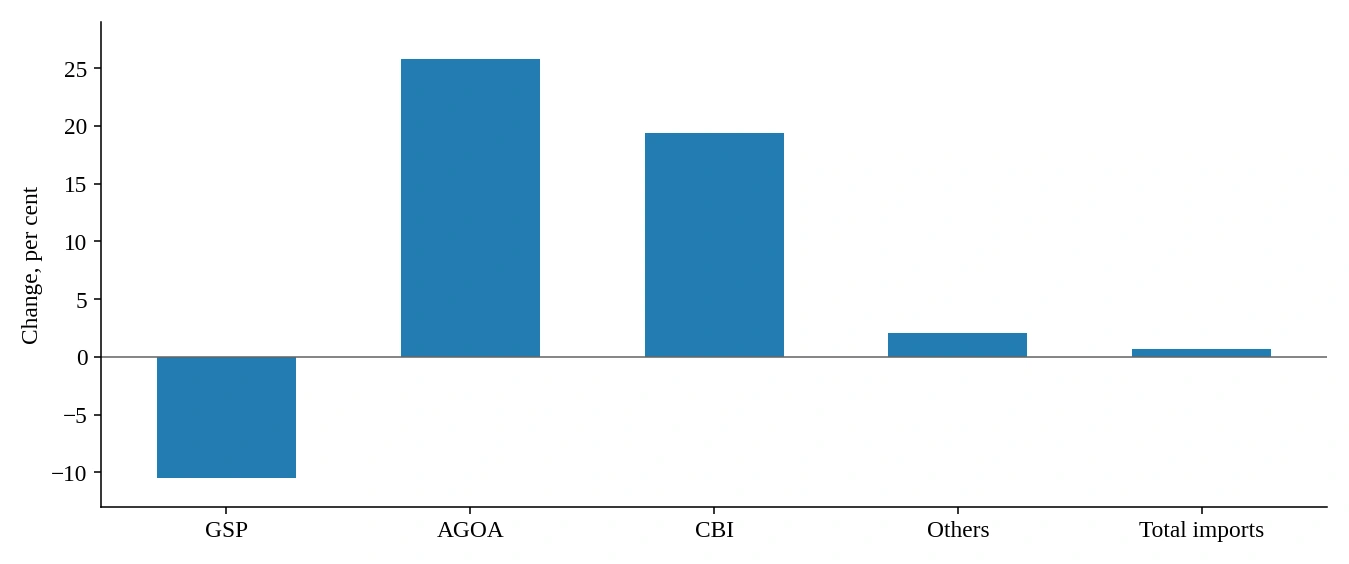
The African Growth and Opportunity Act (AGOA) was reauthorised on 3 February 2026 through 31 December 2026, with retroactive effect to 30 September 2025. The Office of the United States Trade Representative (USTR) states that eligible sub-Saharan African economies have received duty-free treatment for more than 1,800 products beyond products covered by the United States GSP programme. Between 2019 and 2023, US imports from GSP-eligible economies declined by 10.5 per cent under GSP, while imports under AGOA increased by 25.8 per cent, Caribbean Basin Initiative imports by 19.4 per cent and imports under other preference programmes by 2.1 per cent. Total US imports from GSP-eligible economies increased by 0.7 per cent. The distribution of these changes is more consistent with movement among preference programmes following the loss of GSP treatment than with erosion of the tariff margin.
Source: UN Trade and Development, Trade Preferences Outlook 2025, published 2026.
Applied MFN tariffs, bound rates, tariff overhang, tariff peaks, tariff escalation, TRQ fill rates and preference margins are not interchangeable measures of market access. Comparison is valid only where the relevant denominator, tariff-line coverage, reference period and legal basis are compatible.
Non-Tariff Measures and Technical Barriers
Non-tariff measures (NTMs) are measures other than ordinary customs tariffs that may have an effect on international trade in goods. In May 2026, UN Trade and Development (UNCTAD) reported that NTM-related export costs exceeded tariff costs in 88 per cent of countries, with a particularly high burden among smaller developing countries and least developed countries. Most NTMs are technical measures directed principally at public health or environmental objectives, although compliance may entail information, procedural and other compliance costs.
UNCTAD measures NTM incidence through three related indicators that capture different dimensions of exposure to regulation. The frequency index identifies the share of traded product lines subject to at least one NTM, while the coverage ratio shows the proportion of trade value affected and the prevalence score indicates the average number of distinct measures applying to regulated products. UNCTAD estimates published in 2022, based on its Trade Analysis Information System (TRAINS) database, indicate that the global frequency index for import NTMs exceeded 40 per cent, the coverage ratio approached 80 per cent and the prevalence score stood at approximately 2.2 measures per regulated product.
UNCTAD calculations published in 2024, based on the TRAINS database, show markedly higher sanitary and phytosanitary (SPS) and technical barriers to trade (TBT) frequencies in agri-food products than in manufacturing. For agri-food products, the global SPS frequency index is 97 per cent, compared with 94 per cent in Africa, while the corresponding TBT figures are 85 per cent and 68.2 per cent. In manufacturing, SPS frequencies are 13.7 per cent globally and 8.9 per cent in Africa, while TBT frequencies are 56.7 per cent and 32.9 per cent respectively.

Source: UN Trade and Development, NTM analysis based on TRAINS data, published 2024.
The World Trade Organization (WTO) Agreement on the Application of Sanitary and Phytosanitary (SPS) Measures applies to measures protecting human, animal or plant life or health from the risks defined in the Agreement. The Agreement on Technical Barriers to Trade (TBT) governs technical regulations, standards and conformity assessment procedures outside the scope of sanitary and phytosanitary measures. Both agreements have provisions under which Members can notify relevant measures and changes, with separate procedures operating through the sanitary and phytosanitary and technical barriers to trade committees.
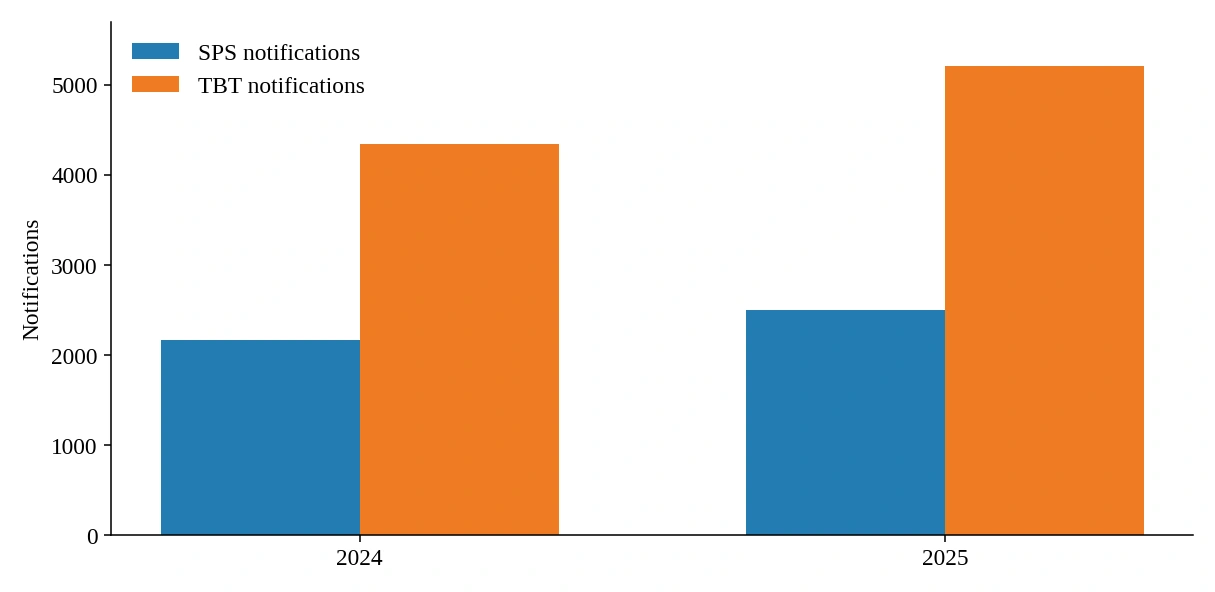
WTO Members submitted 2,496 SPS notifications in 2025, the highest annual total in the WTO transparency series. Food safety accounted for 63 per cent of regular notifications, while animal health represented 94 per cent of emergency notifications. TBT notifications concerning product requirements also reached their highest annual level in 2025, with Africa accounting for the largest regional contribution to submissions.
Source: WTO SPS Annual Transparency Report and WTO TBT 2025 Annual Review.
Specific trade concerns (STCs) provide a mechanism through which WTO Members raise concerns regarding proposed or existing measures before the relevant committees. At its March 2026 meeting, the SPS Committee considered 76 STCs. During the same month, the TBT Committee considered 70 concerns covering cybersecurity, pharmaceuticals, tyres, food traceability and labelling, and energy efficiency.
Rules of origin determine the country attributed to goods for the application of trade measures. WTO has distinguished preferential rules, which determine eligibility for reciprocal or non-reciprocal tariff preferences, from non-preferential rules applicable where no preference is granted. Non-preferential origin may determine the treatment of goods for most-favoured-nation purposes, anti-dumping and countervailing duties, safeguard measures, origin marking, quantitative restrictions, tariff quotas, government procurement and trade statistics.
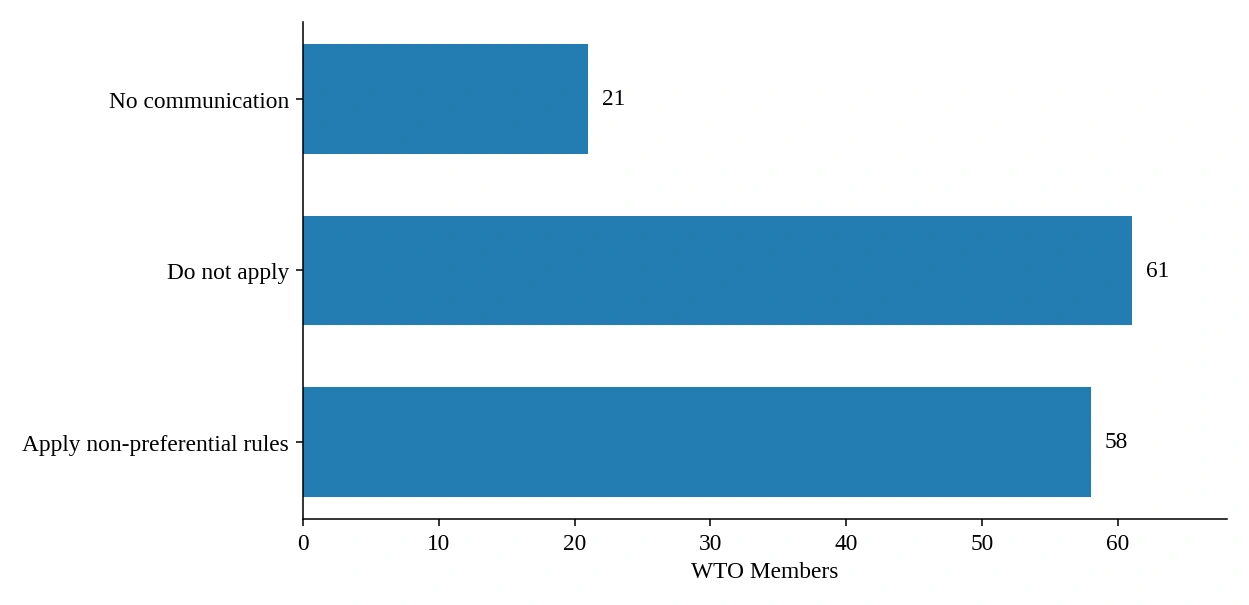
The WTO harmonization programme for non-preferential rules of origin has not been concluded. At its May 2026 meeting, the Committee on Rules of Origin reviewed the application of non-preferential rules across the WTO membership. The Secretariat reported that 58 Members applied non-preferential rules of origin while 61 Members had no such rules in force. Twenty-one Members had yet to communicate their position. The Committee also considered preferential rules of origin, including ad valorem percentage calculations, proof of origin and cumulation.
Source: WTO Secretariat (2026).
Preferential rules of origin establish the conditions under which goods may qualify for preferential treatment. Origin may be determined through a change in tariff classification, an ad valorem criterion or prescribed manufacturing or processing operations, with proof of origin and cumulation governing the administration of preference claims. An ad valorem equivalent (AVE) expresses the trade effect of a non-tariff measure as the tariff rate that would generate an equivalent effect on imports.
Trade and Contingency Measures
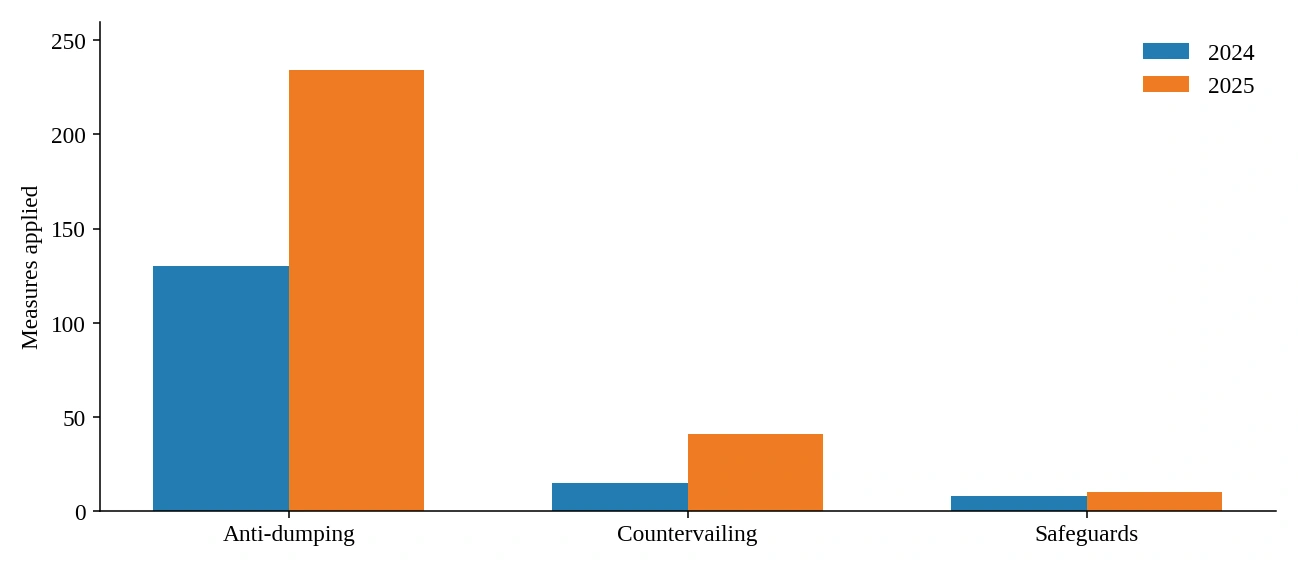
Anti-dumping duties may be imposed where an investigation establishes dumping, material injury or threat of material injury, and causation. Countervailing duties address injury attributable to subsidised imports, subject to the subsidy and specificity requirements of the SCM Agreement. Safeguards do not require a finding of dumping or subsidisation and may be applied where increased imports cause or threaten serious injury. Anti-dumping measures increased from 130 in 2024 to 234 in 2025 while countervailing measures increased from 15 in 2024 to 41 over the same period.
Source: WTO anti-dumping, countervailing and safeguards sector statistics updated through 31 December 2025.
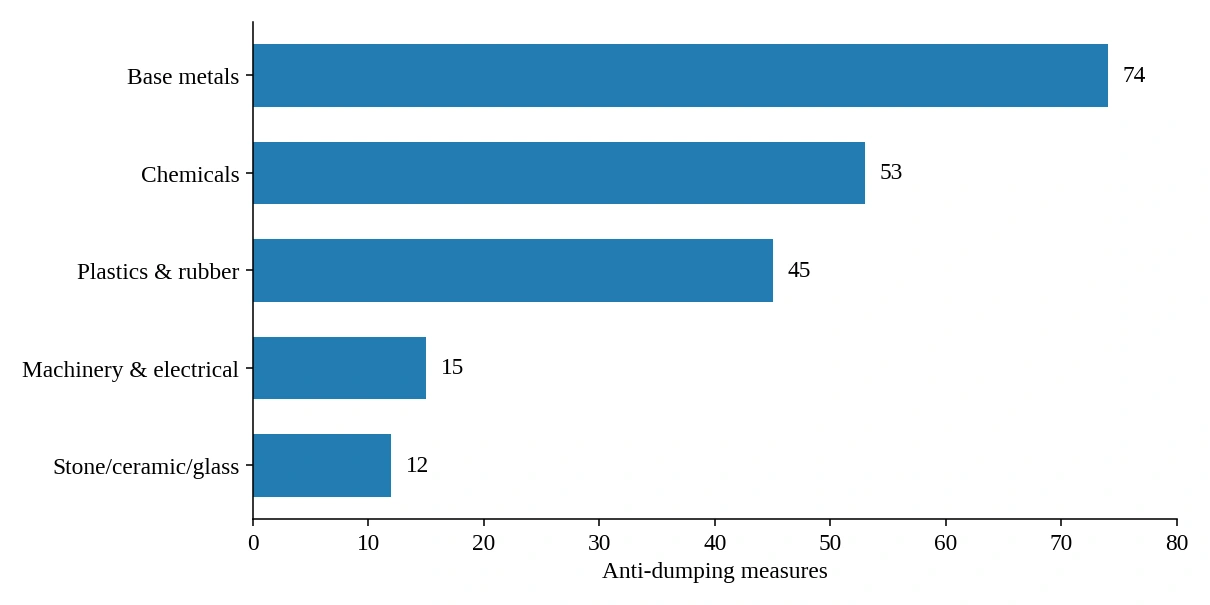
Source: WTO, Anti-Dumping Measures by Sector, 2025.
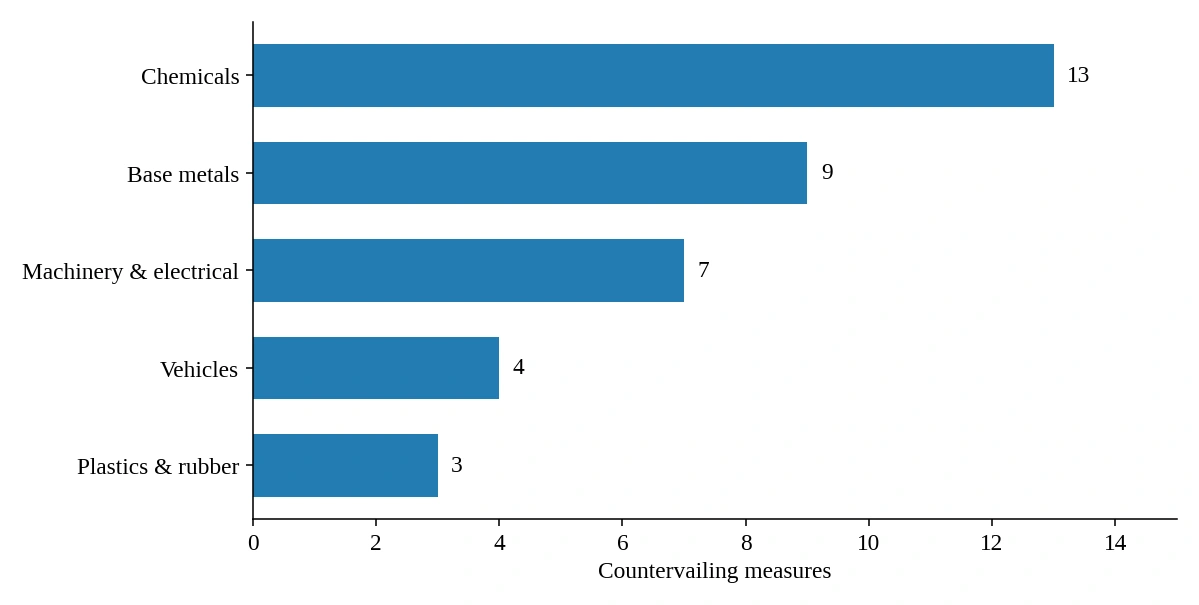
Source: WTO, Countervailing Measures by Sector, 2025.
WTO report in June 2026 found anti-dumping and countervailing activity in 2025 above earlier levels across the number of Members initiating proceedings, investigations initiated and measures applied. The Agreement on Safeguards permits action where increased imports cause or threaten serious injury to the domestic industry producing like or competitive products. Serious injury means a significant overall impairment in the position of a domestic industry, while a threat of serious injury must be imminent and based on facts rather than allegation, conjecture or remote possibility. The authorities must establish a causal link between increased imports and serious injury or threat and must not attribute injury caused by other factors to increased imports.
Ten safeguard measures were applied in 2025, compared with eight in 2024. Notifications during the year concerned base metals, chemicals, plastics, textiles, mineral products, animal and vegetable fats, wood products, and stone or glass products. The adopted reports in Korea — Definitive Safeguard Measure on Imports of Certain Dairy Products, United States — Definitive Safeguard Measures on Imports of Wheat Gluten from the European Communities and United States — Safeguard Measures on Imports of Fresh, Chilled or Frozen Lamb Meat from New Zealand and Australia have addressed increased imports, serious injury, causation and non-attribution.
United States measures on steel and aluminium imposed pursuant to Section 232 of the Trade Expansion Act 1962 were challenged under GATT 1994. Panel reports circulated in December 2022 found duties exceeding the United States bound tariff rates inconsistent with Article II:1 and certain country exemptions inconsistent with most-favoured-nation treatment. The panels also found that the circumstances before them did not satisfy Article XXI(b)(iii), concerning action taken in time of war or other emergency in international relations. On 12 March 2025, the United States terminated the duty-free import quota system applying to steel imports from several trading partners and imposed additional tariffs of 25 per cent on steel and aluminium imports, subject to stated exceptions. The rates increased to 50 per cent on 4 June 2025, except for imports from the United Kingdom.
GATT Article XI:1 prohibits import or export prohibitions or restrictions other than duties, taxes or other charges. Article XI:2(a) permits temporary export prohibitions or restrictions applied to prevent or relieve critical shortages of foodstuffs or other products essential to the exporting Member. Article XX(g) concerns measures relating to the conservation of exhaustible natural resources when made effective in conjunction with restrictions on domestic production or consumption. Article XX(j) concerns products in general or local short supply subject to the conditions contained in the provision.
In China — Measures Related to the Exportation of Various Raw Materials, the adopted reports found export quotas on certain raw materials inconsistent with WTO obligations and upheld the conclusion that China had not demonstrated that its export quota on refractory-grade bauxite was temporarily applied to prevent or relieve a critical shortage within Article XI:2(a). The Appellate Body interpreted a temporary restriction within the provision as one applied for a limited period to address extraordinary conditions rather than an indefinite measure. China — Measures Related to the Exportation of Rare Earths, Tungsten and Molybdenum concerned export duties, export quotas and restrictions on trading rights affecting rare earths, tungsten and molybdenum. The Appellate Body upheld the findings that the export quotas were not justified under Article XX(g), and the reports were adopted by the Dispute Settlement Body in August 2014.
WTO analysis published in July 2026 estimated that export licences, restrictions and bans introduced after the conflict in the Persian Gulf could affect up to 15 per cent of world fertilizer exports, measured against trade before the closure of the Strait of Hormuz. A second estimate placed the potentially affected share at 23.3 per cent on the assumption that fertilizer exports from Gulf economies were prevented by the closure. The WTO presented 23.3 per cent as an upper bound rather than an estimate of trade losses because licensing requirements did not prohibit exports in every case and some shipments continued through alternative routes.
Subsidies and the Return of Industrial Policy
Under the Agreement on Subsidies and Countervailing Measures (SCM Agreement), a subsidy exists where a government or public body provides a financial contribution, or where there is income or price support, and a benefit is thereby conferred. The subsidy must also be specific within the context of Article 2 for the provisions concerning prohibited subsidies, actionable subsidies and countervailing measures to apply. Subsidies contingent upon export performance and the use of domestic over imported goods are prohibited. Other specific subsidies may give rise to action where they cause adverse effects to the interests of another Member. Countervailing measures may be imposed following an investigation establishing the existence of a countervailable subsidy, injury to the domestic industry and a causal relationship between the subsidised imports and the injury. The provisions on non-actionable subsidies, which covered certain research activities, assistance to disadvantaged regions and assistance for adaptation to new environmental requirements, ceased to apply at the end of 1999.
By January 2025, the Creating Helpful Incentives to Produce Semiconductors (CHIPS) for America programme had awarded more than USD 33 billion from over USD 36 billion in proposed incentives funding. Semiconductor and electronics companies have announced nearly USD 450 billion in private investment during the period. The European Chips Act has set an objective of mobilising more than EUR 43 billion in public and private investment. Under the SCM Agreement, the characterisation of support provided through these programmes depends on whether a measure involves a financial contribution, confers a benefit and is specific within the context of the Agreement, as well as whether any prohibited contingency applies.
The Airbus–Boeing rivalry began as a dispute over market distortion but became a referendum on economic models as the two national champions were the wings through which states sought altitude for their ambitions. The adopted reports in EC and Certain Member States — Measures Affecting Trade in Large Civil Aircraft and United States — Measures Affecting Trade in Large Civil Aircraft — Second Complaint examined government support to Airbus and Boeing. The measures included launch aid or member State financing, infrastructure support, research and development funding, tax measures, equity infusions and programmes administered by the National Aeronautics and Space Administration (NASA) and the United States Department of Defense (DoD). The findings addressed specific subsidies, benefit, prejudice, displacement or impedance, price suppression and lost sales under the SCM Agreement. The Airbus-Boeing contest will continue to be a reckoning with the political character of global business and has defined how subsidies are understood, how competitive harm is demonstrated, and how states justify countermeasures in trade conflicts. What is at stake in China’s Commercial Aircraft Corporation of China, Ltd. (COMAC) is whether global aviation can accommodate a third pole of legitimacy. Airbus once proved Europe could enter the system while COMAC confronts an airspace less accommodating.
China requested consultations in November 2024 concerning European Union countervailing duties on new battery electric vehicles from China and the investigation underlying the duties. China’s claims concern provisions governing the existence of a subsidy, specificity, initiation and conduct of investigations, calculation of benefit, injury, countervailing duties and related procedural requirements. In India — Certain Measures Relating to Solar Cells and Solar Modules, the adopted reports found that domestic content requirements under India’s National Solar Mission accorded less favourable treatment to imported solar cells and modules, contrary to Article III:4 of GATT 1994 and Article 2.1 of the Agreement on Trade-Related Investment Measures (TRIMs). The measures required the use of domestically manufactured cells and modules as a condition of electricity procurement. United States — Certain Tax Credits Under the Inflation Reduction Act concerned domestic content bonus credits available under renewable energy tax provisions. The panel report circulated on 30 January 2026 found the challenged bonus credits inconsistent with Article III:4 of the General Agreement on Tariffs and Trade 1994, Article 2.1 of the Agreement on Trade-Related Investment Measures, and Articles 3.1(b) and 3.2 of the SCM Agreement. The Agreement on Fisheries Subsidies entered into force on 15 September 2025 and has prohibited subsidies to vessels or operators engaged in illegal, unreported and unregulated fishing following a determination by an authorised entity. Subsidies concerning an overfished stock are prohibited unless support or other measures are implemented to rebuild the stock to a biologically sustainable level, while subsidies for fishing or fishing-related activities outside coastal jurisdiction and beyond the competence of a relevant regional fisheries management organisation are also prohibited.
| Sector | Measure or dispute | WTO reference | Status |
|---|---|---|---|
| Semiconductors | CHIPS for America | SCM Arts 1–2 | Domestic programme |
| Aerospace | EC — Large Civil Aircraft / US — Large Civil Aircraft | SCM Agreement | Adopted reports |
| Electric vehicles | DS630 | SCM Agreement, GATT VI | Panel proceedings |
| Green energy | DS623 | SCM 3.1(b), GATT III:4, TRIMs 2.1 | Appealed, unadopted |
| Fisheries | Agreement on Fisheries Subsidies | Fisheries subsidies | In force since Sep 2025 |
Sources: WTO dispute settlement records, Agreement on Fisheries Subsidies, United States Department of Commerce and European Commission.
Special Economic Zones and Free Trade
UN Trade and Development reported 5,383 special economic zones (SEZs) spanning 147 economies, using 2018 reference data published in the World Investment Report 2019. Developing economies accounted for 4,772 zones, developed economies 374 and transition economies 237. Free trade zones, export processing zones, large scale economic zones, free ports and bonded logistics parks are among the forms included within special economic zones, with their customs and other legal provisions determined by the legislation applicable in each economy.
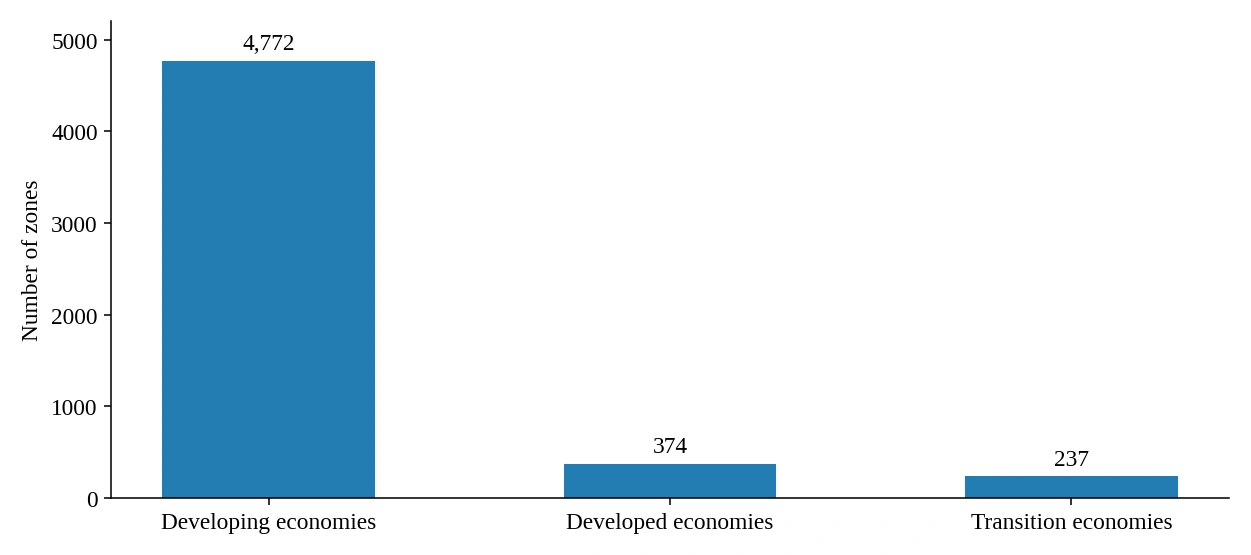
Source: UN Trade and Development, World Investment Report 2019.
The number of SEZs increased from 79 in 29 economies in 1975 to 176 in 47 economies by 1986. By 1995, 500 zones operated in 73 economies, rising to 845 in 93 economies in 1997. UN Trade and Development reported 3,000 zones in 116 economies in 2002 and 3,500 in 130 economies by 2006. The total reached 5,383 in 147 economies by 2018. The World Investment Report 2019 also listed 507 planned zones, with 2018 serving as the reference year for the global inventory.
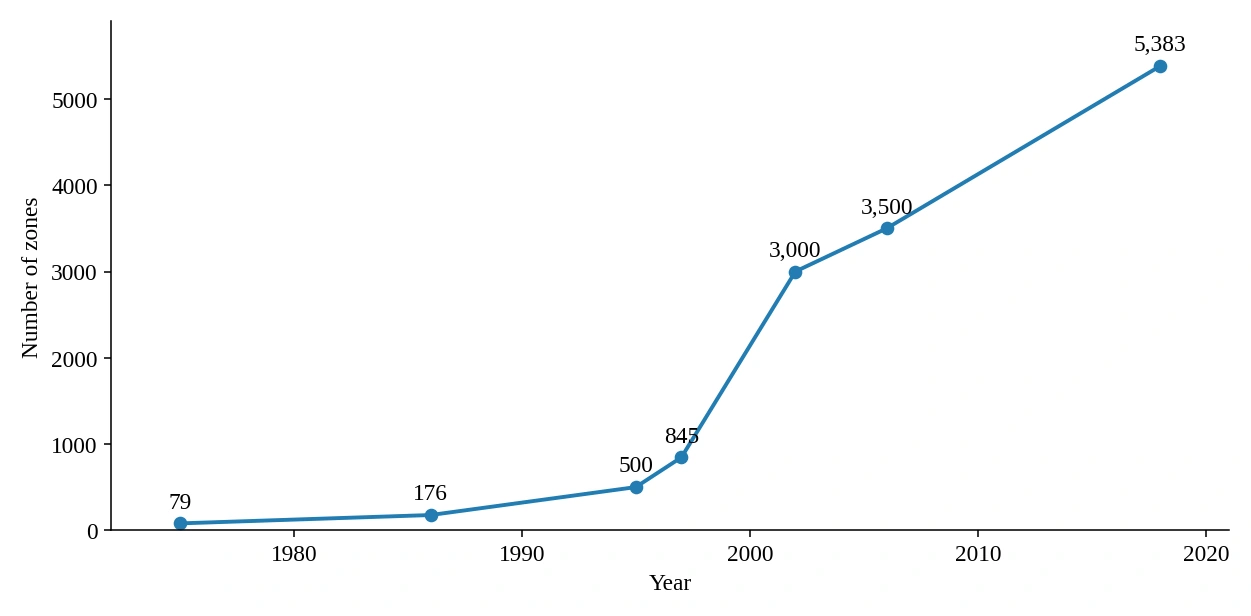
Source: UN Trade and Development, World Investment Report 2019.
Free zones remain part of the customs territory of the Member concerned, although goods admitted to a free zone may be subject to customs rules different from those applying under the ordinary import regime. Duty suspension, duty exemption, customs warehousing, inward processing and re-export depend on national customs law and applicable World Trade Organization (WTO) obligations. Goods released from a zone into the domestic customs territory may become subject to ordinary customs duties and requirements, while customs status does not determine preferential origin.
The Agreement on Subsidies and Countervailing Measures (SCM Agreement) has prohibited subsidies contingent upon either export performance or the use of domestic over imported goods. Export orientation is not sufficient to establish export contingency. Tax relief, customs concessions, infrastructure support and other SEZ measures fall within the SCM Agreement where the requirements for a subsidy and specificity are met. India — Export Related Measures concerned customs and tax concessions provided through India’s Special Economic Zones Scheme, Export Oriented Units Scheme and other programmes. The panel report of 2019 found that the subsidy under the Special Economic Zones Scheme was contingent in law upon export performance and inconsistent with Articles 3.1(a) and 3.2 of the SCM Agreement.
The Common Declaration with Regard to Preferential Rules of Origin permits origin requirements based on a change in tariff classification, an ad valorem criterion or a manufacturing or processing operation. Production within an SEZ qualifies for preferential treatment only where the applicable rule of origin is satisfied, including any regional value content, change in tariff classification, processing or cumulation requirement established under the relevant preferential agreement.
Services and Digital Trade
The General Agreement on Trade in Services (GATS) provides for market access and national treatment through specific commitments entered in each Member’s Schedule. Market access applies according to the terms, limitations and conditions inscribed for the relevant sector and mode of supply, while national treatment is subject to the conditions and qualifications specified in the Schedule. Most-favoured-nation (MFN) treatment is a general obligation applying to measures covered by GATS, subject to exemptions listed by the Member.
The World Trade Organization (WTO) I-TIP Services database presents GATS commitments, MFN exemptions, preferences notified under the least developed country Services Waiver, services commitments in regional trade agreements, applied measures and services statistics. For comparison with current policy conditions, the joint World Bank and WTO Services Trade Policy Database reports trade policies and regulations for 144 economies in 34 service sectors, while the Organisation for Economic Co-operation and Development (OECD) Services Trade Restrictiveness Index (STRI) measures restrictions across 51 countries and 22 sectors. Digital services are assessed separately through the OECD Digital Services Trade Restrictiveness Index (Digital STRI), which includes 129 economies.
The OECD’s 2026 Services Trade Restrictiveness Index (STRI) results showed that regulatory changes introduced during 2025 were more restrictive than liberalising. Average services trade restrictiveness in non-OECD economies remained 55 per cent above the OECD country average. The Digital Services Trade Restrictiveness Index assesses measures affecting digitally-enabled services across five areas comprising infrastructure and connectivity, electronic transactions, payment systems, intellectual property rights and other barriers affecting digital trade.
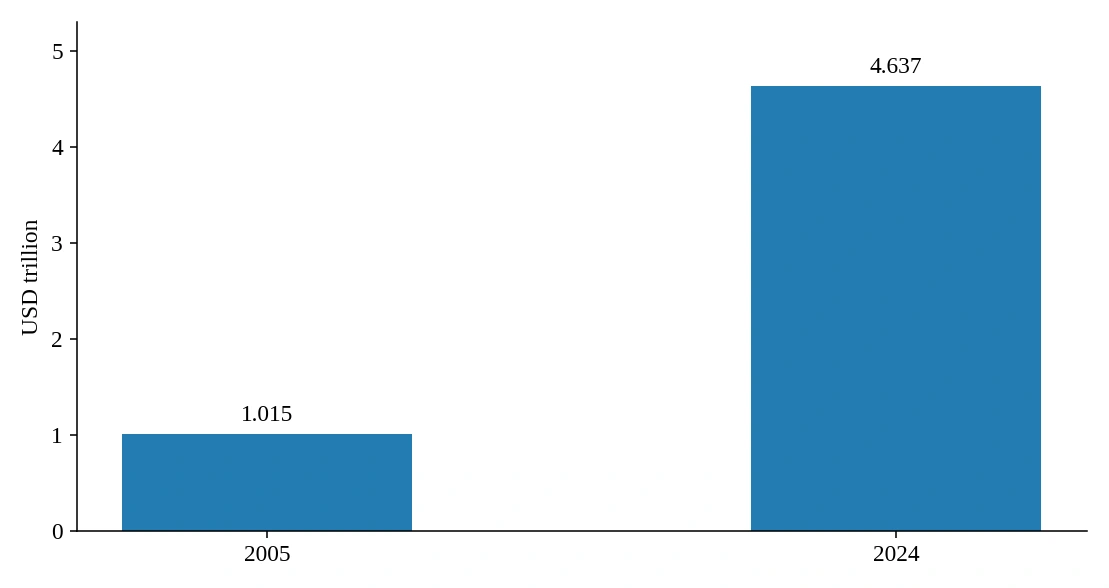
Exports of digitally delivered services increased from USD 1.015 trillion in 2005 to USD 4.637 trillion in 2024, accounting for 52 per cent of global services exports in 2024. The World Trade Report 2026 reported a further 10 per cent increase in digitally delivered services exports during 2025, when commercial services accounted for 27.6 per cent of world trade.
Sources: WTO and UN Trade and Development statistics
Measures affecting cross-border data transfers address privacy and data protection, cybersecurity, access by public authorities, and local data storage and processing requirements. The OECD Digital STRI identifies data localisation restrictions in 46 of the 129 economies covered in 2025. Under GATS, the application of market access and national treatment obligations depends on the service and mode of supply, the commitments inscribed in the Member’s Schedule, any limitations attached to those commitments and the availability of an exception under the Agreement.
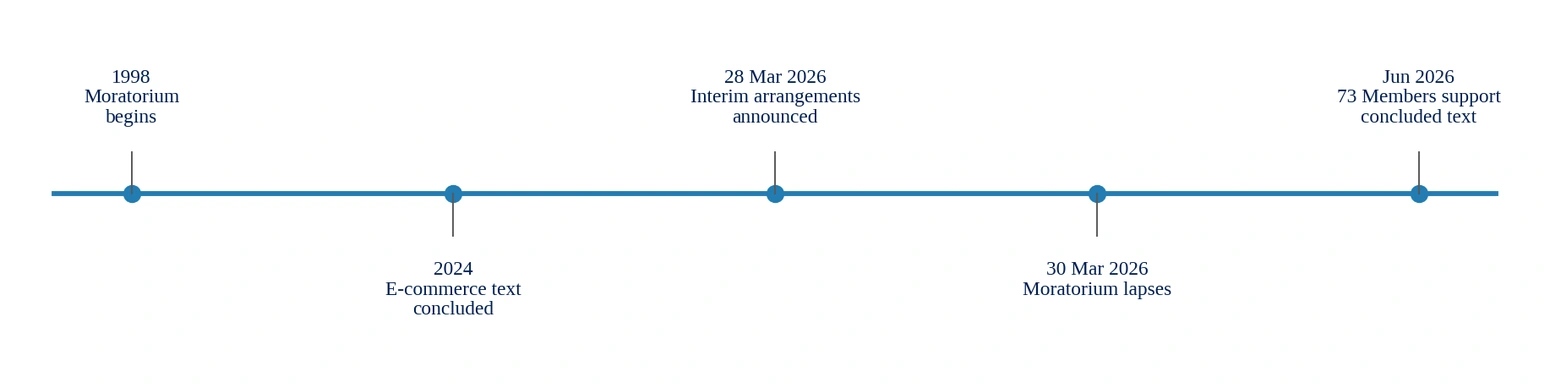
Negotiations under the Joint Statement Initiative on Electronic Commerce were concluded in 2024. At the Fourteenth WTO Ministerial Conference in March 2026, 67 Members representing approximately 70 per cent of global trade declared their intention to implement the Agreement on Electronic Commerce on an interim basis pending its incorporation into the WTO legal framework. By June 2026, support for the concluded text had increased to 73 Members. The Agreement will enter into force 30 days after the deposit of the forty-fifth instrument of acceptance, with 45 acceptances required for entry into force. The Agreement on Electronic Commerce includes provisions on electronic transactions, electronic authentication and electronic signatures, paperless trading, online consumer protection and customs duties on electronic transmissions. Cross-border data flows, data localisation and source code were not included in the concluded text circulated in 2024.
WTO Members maintained the moratorium on customs duties on electronic transmissions from 1998 until the Fourteenth Ministerial Conference. The decision adopted at the Thirteenth Ministerial Conference extended the moratorium until the Fourteenth Ministerial Conference or 31 March 2026, whichever occurred earlier. No consensus was reached on a further extension in March 2026. Since 8 May 2026, a group of Members have committed not to impose customs duties on electronic transmissions between participating Members.
Source: World Trade Organization (2024; 2026).
The United Kingdom Digital Services Tax has applied at a rate of 2 per cent since 1 April 2020. Liability arises where worldwide revenues from digital services activities exceed GBP 500 million. An annual allowance of GBP 25 million applies to revenue attributable to United Kingdom users. Comparable measures have been adopted in other jurisdictions, including France, Italy, Austria and Türkiye, although the tax base, rate and scope differ across jurisdictions.
| Measure | WTO reference | Position |
|---|---|---|
| GATS market access | Article XVI and Schedule | Applies where committed |
| GATS national treatment | Article XVII and Schedule | Subject to scheduled limitations |
| Data localisation | GATS | Depends on service, mode and Schedule |
| Agreement on Electronic Commerce | Concluded text | 45 acceptances required |
| Customs duties on electronic transmissions | Ministerial moratorium | Multilateral moratorium ended in March 2026 |
| United Kingdom Digital Services Tax | Domestic tax measure | GATS assessment depends on applicable commitments |
Sources: WTO legal texts and schedules, WTO electronic commerce documentation, OECD digital services sources and United Kingdom government guidance.
Regionalism, Preferential Agreements and the Erosion of Multilateralism
The General Agreement on Tariffs and Trade 1994 (GATT 1994), the General Agreement on Trade in Services (GATS) and the Enabling Clause have provided the basis for preferential trade agreements that depart from most-favoured-nation treatment. GATT Article XXIV applies to customs unions and free trade areas in goods, while GATS Article V governs economic integration agreements in services. The Enabling Clause permits preferential trade among developing economies subject to the conditions contained in the Decision. WTO notification documents the agreement and the legal provision under which it has been notified.
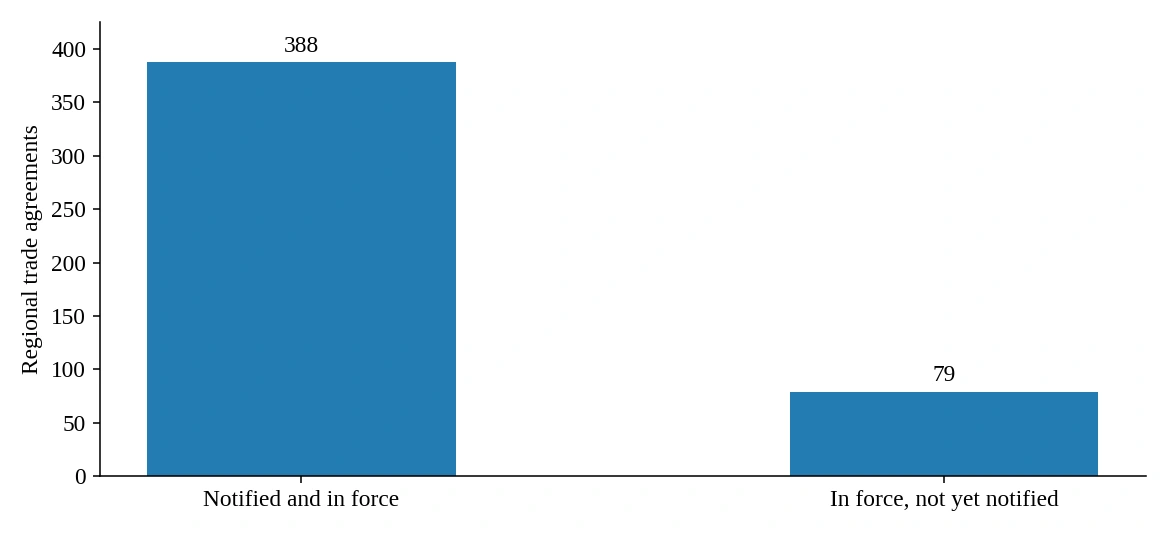
The WTO Regional Trade Agreements (RTAs) Tracker has listed 388 notified regional trade agreements in force and 79 agreements known to be in force but not yet notified. The WTO Regional Trade Agreements gateway reported 384 agreements in force as at 30 June 2026. As goods, services and accessions may be notified separately, the number of notifications has exceeded the number of agreements.
.
Source: WTO Regional Trade Agreements Tracker, accessed 27 September 2026.
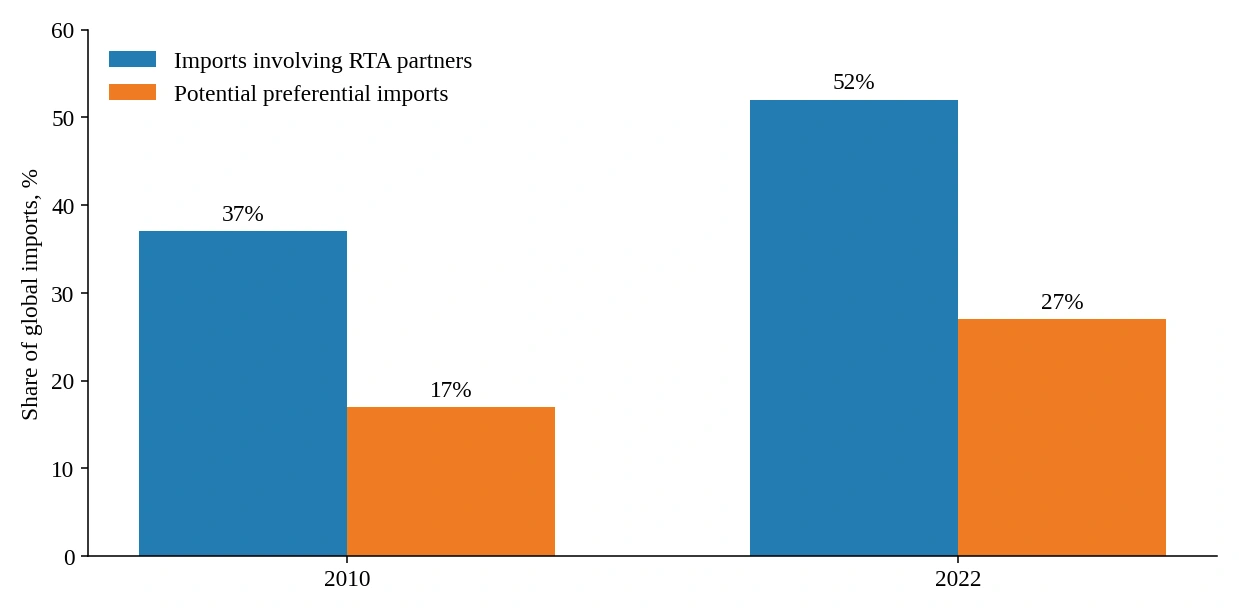
WTO analysis covering 157 customs territories found that the share of global imports involving RTA partners increased from 37 per cent in 2010 to 52 per cent in 2022, while potential preferential imports rose from almost 17 per cent to 23 per cent. Over the same period, most imports not receiving RTA preferences continued to trade on most-favoured-nation terms, with the expansion of duty free most-favoured-nation treatment limiting the scope for preferential imports.
Source: WTO Staff Working Paper ERSD-2025-03.
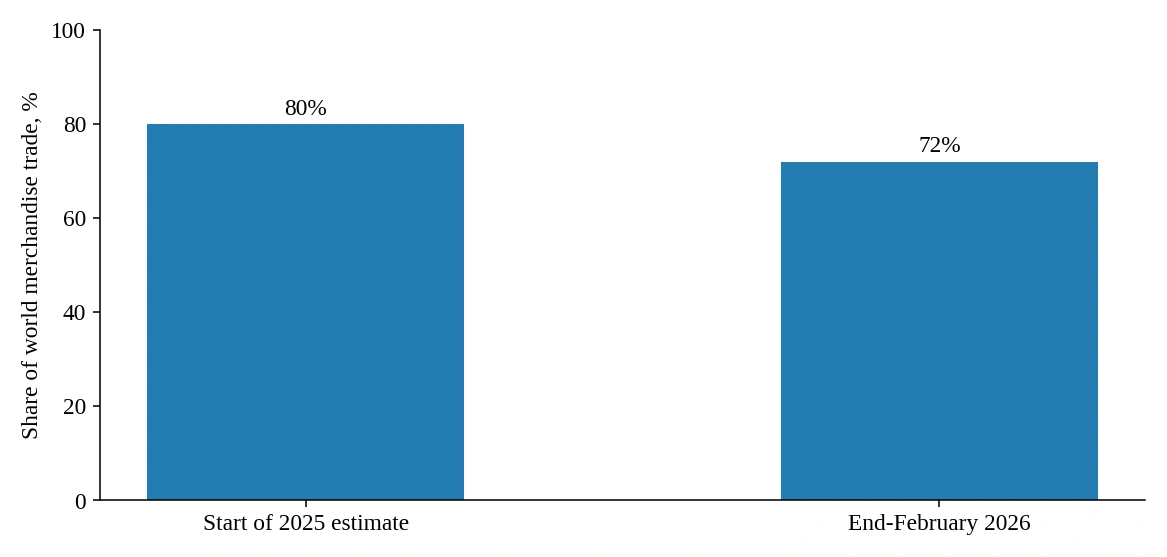
By the end of February 2026, approximately 72 per cent of world merchandise trade remained on most-favoured-nation terms. The WTO estimate was based on tariff measures in effect through February 2026 and trade conducted within and outside regional trade agreements.
Source: WTO, Global Trade Outlook and Statistics, March 2026.
The World Bank Deep Trade Agreements Database maps 52 policy areas in 400 preferential trade agreements in force and notified to the WTO. The 52 policy areas encompass services, investment, intellectual property, government procurement, competition policy, labour, environment, state-owned enterprises, digital trade and regulatory cooperation. WTO-plus provisions have established commitments beyond existing multilateral obligations in policy areas already governed by WTO agreements, while WTO-extra provisions address policy areas outside existing WTO agreements.
Preferential rules of origin determine eligibility for tariff preferences under an RTA. Agreements may apply different requirements concerning change in tariff classification, regional value content, de minimis thresholds, cumulation and proof of origin to the same product. Utilisation of preferential tariffs depends on compliance with the applicable rule of origin and completion of the prescribed origin procedures.
The Comprehensive and Progressive Agreement for Trans-Pacific Partnership (CPTPP), Regional Comprehensive Economic Partnership (RCEP), United States-Mexico-Canada Agreement (USMCA), European Union agreements, Southern Common Market (MERCOSUR) agreements and the African Continental Free Trade Area (AfCFTA) differ in membership, tariff commitments, services schedules, rules of origin, legal provisions and coverage. Labour, environment, investment, public procurement, state-owned enterprises and digital trade provisions also differ in scope and legal formulation between agreements.
CPTPP entered into force on 30 December 2018, RCEP on 1 January 2022 and USMCA, the successor of North American Free Trade Agreement (NAFTA), on 1 July 2020. The AfCFTA entered into force on 30 May 2019 and was notified to the WTO on 18 June 2025 under the Enabling Clause as a free trade agreement covering goods. Article 19 of the Agreement Establishing the African Continental Free Trade Area provides that the AfCFTA prevails to the extent of any inconsistency with regional agreements, while members of regional economic communities, regional trading agreements and customs unions that have attained higher levels of regional integration maintain such levels among themselves.
Trade creation and trade diversion require comparison with trade flows that would have prevailed in the absence of preferential treatment. Estimates depend on the agreement examined, reference period and product coverage. The available evidence does not provide one harmonised estimate covering CPTPP, RCEP, USMCA, European Union agreements, MERCOSUR and AfCFTA.
| Agreement | WTO notification basis | Principal provisions | Rules of origin |
|---|---|---|---|
| CPTPP | GATT Article XXIV and GATS Article V | Goods, services, investment, labour, environment, state-owned enterprises | Regional cumulation and product rules |
| RCEP | GATT Article XXIV and GATS Article V | Goods, services, investment, intellectual property, electronic commerce | Regional rules of origin |
| USMCA | GATT Article XXIV and GATS Article V | Goods, services, investment, labour, environment, digital trade, state-owned enterprises | Product-specific rules |
| European Union agreements | GATT Article XXIV and GATS Article V, where applicable | Varies by agreement and may include procurement, labour, environment, competition and regulatory cooperation | Agreement-specific origin protocols |
| AfCFTA | Enabling Clause for trade in goods | Trade in goods, with additional protocols | Rules of origin with regional economic communities’ interaction |
Sources: WTO RTA Database, notified agreement texts and African Union AfCFTA Agreement.
Special and Differential Treatment and Developing Countries
WTO agreements provide more than 150 measures on special and differential treatment for developing Members, including least developed countries (LDCs). They address longer implementation periods, increased trading opportunities, technical assistance, safeguards for developing country interests and treatment accorded specifically to LDCs. Application depends on the agreement and the terms governing each measure.
The WTO agreements do not classify Members as developed or developing countries. Members can indicate whether they regard themselves as developing countries, although another Member may contest recourse to special and differential treatment available to developing Members. Developing country status at the WTO does not determine eligibility under another Member’s Generalized System of Preferences (GSP), where beneficiary and product coverage are determined by the terms of the scheme.
The Doha Ministerial Declaration mandated a review of special and differential treatment provisions with a view to strengthening their operation and making the provisions more effective and operational. At the Fourteenth Ministerial Conference, Members adopted a decision on implementation of special and differential treatment under the Agreement on the Application of Sanitary and Phytosanitary Measures and the Agreement on Technical Barriers to Trade. Proposals under other WTO agreements remain under negotiation, including LDC graduation and Article 66.2 of the Agreement on Trade-Related Aspects of Intellectual Property Rights (TRIPS).
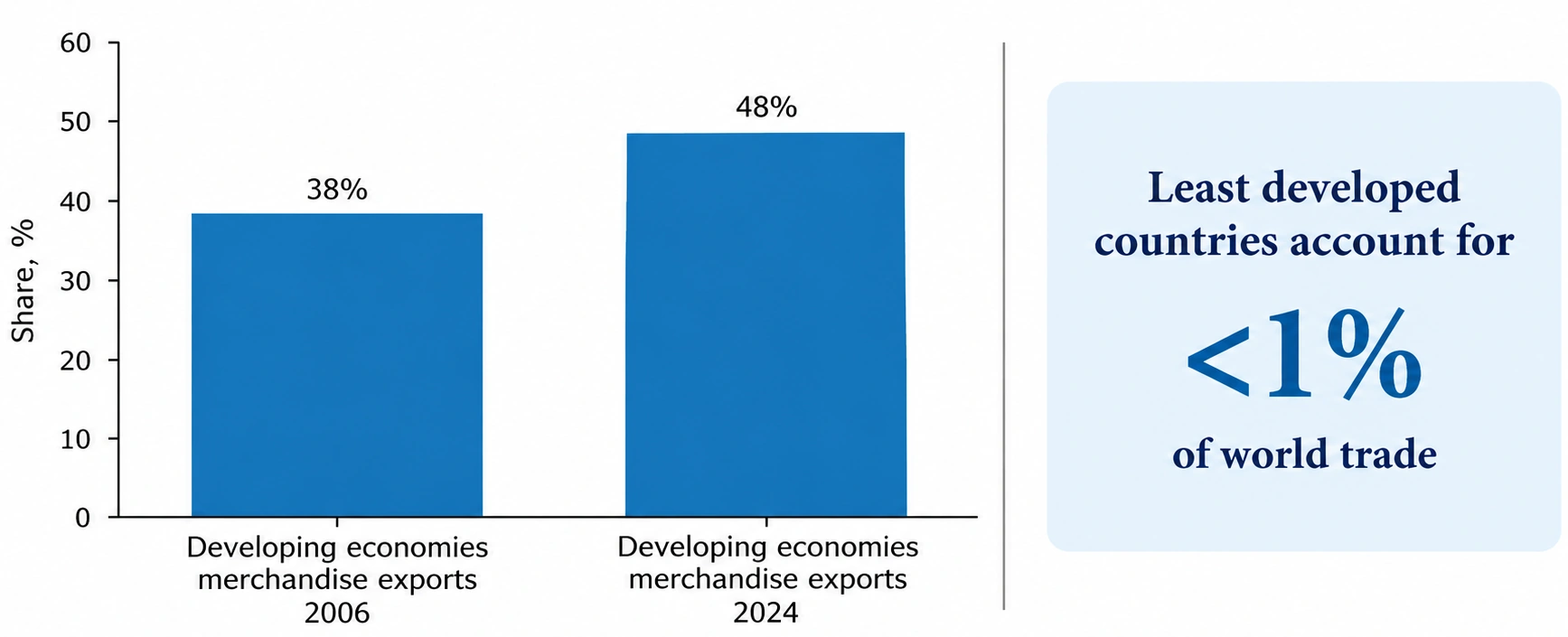
The United Nations currently recognises 44 least developed countries (LDCs), 37 of which are WTO Members. The World Trade Report 2026 reports that LDCs account for less than 1 per cent of world trade and incur trade costs in manufacturing and services approximately 50 per cent above the levels prevailing in high-income economies. Developing economies increased their share of world merchandise exports from 38 per cent in 2006 to 48 per cent in 2024, while their share of global commercial services exports increased from 25 per cent to 33 per cent over the same period.
Sources: WTO Development Week news item, 6 July 2026; World Trade Report 2026.
The 2013 Bali Decision reaffirmed the objective of duty-free and quota-free (DFQF) market access for products originating in least developed countries (LDCs). Developed country Members providing DFQF treatment for fewer than 97 per cent of LDC products were called upon to improve existing coverage, while developing country Members in a position to extend DFQF access were encouraged to provide or expand comparable treatment. Eligibility for preferential entry has continued to depend on the products included in the applicable scheme, compliance with its rules of origin and fulfilment of the required customs procedures.
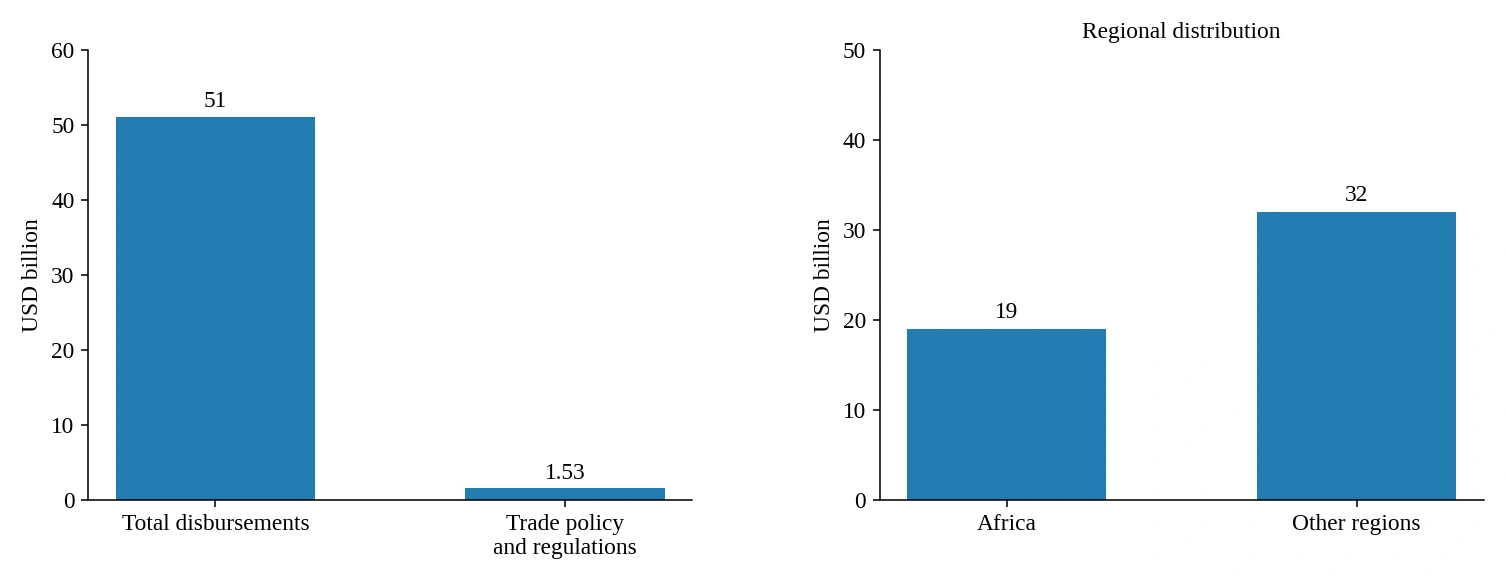
Special and differential treatment has also been supported by Aid for Trade, which assists developing economies, particularly LDCs, in addressing trade-related infrastructure and productive capacity constraints that can limit access to export markets. Aid for Trade disbursements reached USD 51 billion in 2024, an increase of 2 per cent from 2023. Over 2006–2024, Africa and Asia accounted for 37 per cent and 35 per cent of Aid for Trade financing respectively. Cumulative Aid for Trade disbursements amounted to USD 794 billion over 2006–2024, with 156 recipient economies, including 44 LDCs. Economic infrastructure and productive capacity accounted for 97 per cent of cumulative support, while trade policy and regulations represented the remaining 3 per cent.
Sources: WTO Aid for Trade reporting and OECD Aid for Trade data, 2026.
| Measure | Beneficiaries | Principal provisions | Position |
|---|---|---|---|
| Special and differential treatment | Developing Members and LDCs | Longer implementation periods, technical assistance and LDC-specific treatment | More than 150 provisions |
| Generalized System of Preferences (GSP) | Designated beneficiary countries | Non-reciprocal tariff preferences under the Enabling Clause | Beneficiary status determined by preference-granting Members |
| Duty-free and quota-free market access | LDC beneficiaries | Duty-free and quota-free treatment subject to product coverage and rules of origin | Bali benchmark of at least 97 per cent product coverage |
| Aid for Trade | Developing economies and LDCs | Infrastructure, productive capacity, trade policy and regulations | USD 51 billion disbursed in 2024 |
| International Trade Centre services | Exporters, enterprises and trade support institutions | Market intelligence, market access information and training | Trade Map, Market Access Map, Rules of Origin Facilitator and SME Trade Academy |
Sources: WTO legal texts and decisions, WTO–OECD Aid for Trade reporting and International Trade Centre programme information. Disclaimer: Current position should be confirmed with reference to the latest WTO notifications, preference schemes and programme updates.
Free trade has never existed outside political choice. States have accepted limits on the pursuit of national advantage even as the terms of exchange have changed. As trade becomes more closely bound to security and industrial policy, the multilateral system will be judged by whether restraint can still hold when national power fights hardest against it.
Disclaimer
The scope of this analysis may differ according to its intended use. Unless otherwise agreed in relation to a specific mandate, it was not prepared by reference to the circumstances or requirements of any particular audience. Nothing in it constitutes investment advice or a determination of its suitability or appropriateness for a particular recipient. The material reflects the evidence and conditions relevant to the period examined and may be affected by subsequent developments. Users are responsible for determining the relevance of its content to their circumstances and for obtaining appropriate advice where a decision requires specialist judgement.
About the Chief Analyst

Nsikan Nyauko is an economist and Chartered Management Consultant with decades of cross-industry experience and a range of postgraduate qualifications spanning Economics, Big Data and Analytics, International Affairs and Diplomacy, International Commercial Law, Digital Transformation, Project Management, Business and Management, and Public Health. He serves the Centre as Faculty, Executive Development and Lead Advisor, Group Regional Programme for EMEA, APAC and the Americas. He has built relationships across industry, government, international organisations, academia, think tanks and civil society and has developed policy and strategy papers to support decision-making by corporations and sovereign entities.
Associate Analysts Nadine Karam; Marek Zieliński; Yun-seo Han; Camila Arriagada; Elias Nordström; Graham Bellamy