
Nigeria Country Assessment, H1 2026
By mid-2026, Nigeria’s external position was stronger and growth firmer than in the early periods of the 2023 currency reforms and fuel subsidy removal, but the improvement remains uneven across the state, households and firms. Reserves have increased, the current account remains in surplus, domestic refining has reduced part of the petroleum import burden and sovereign ratings have improved. Those gains coexist with weak public revenue, high debt service pressure, restrictive financing conditions, persistent insecurity and household purchasing power that has not recovered from the preceding price shock. Political authority remains concentrated as the 2027 electoral cycle gathers force, while terrorism, kidnapping and communal violence have continued to impose costs across regions. The business environment has offered scale, opportunity and increasing depth in the capital market, yet infrastructure constraints and ambiguities in regulations have continued to constrain investment. Capital inflows have recovered markedly, but their concentration in portfolio instruments means Nigeria has not yet translated improved macroeconomic conditions into foreign direct investment on a comparable scale.
Economic Environment
Output and Growth Performance
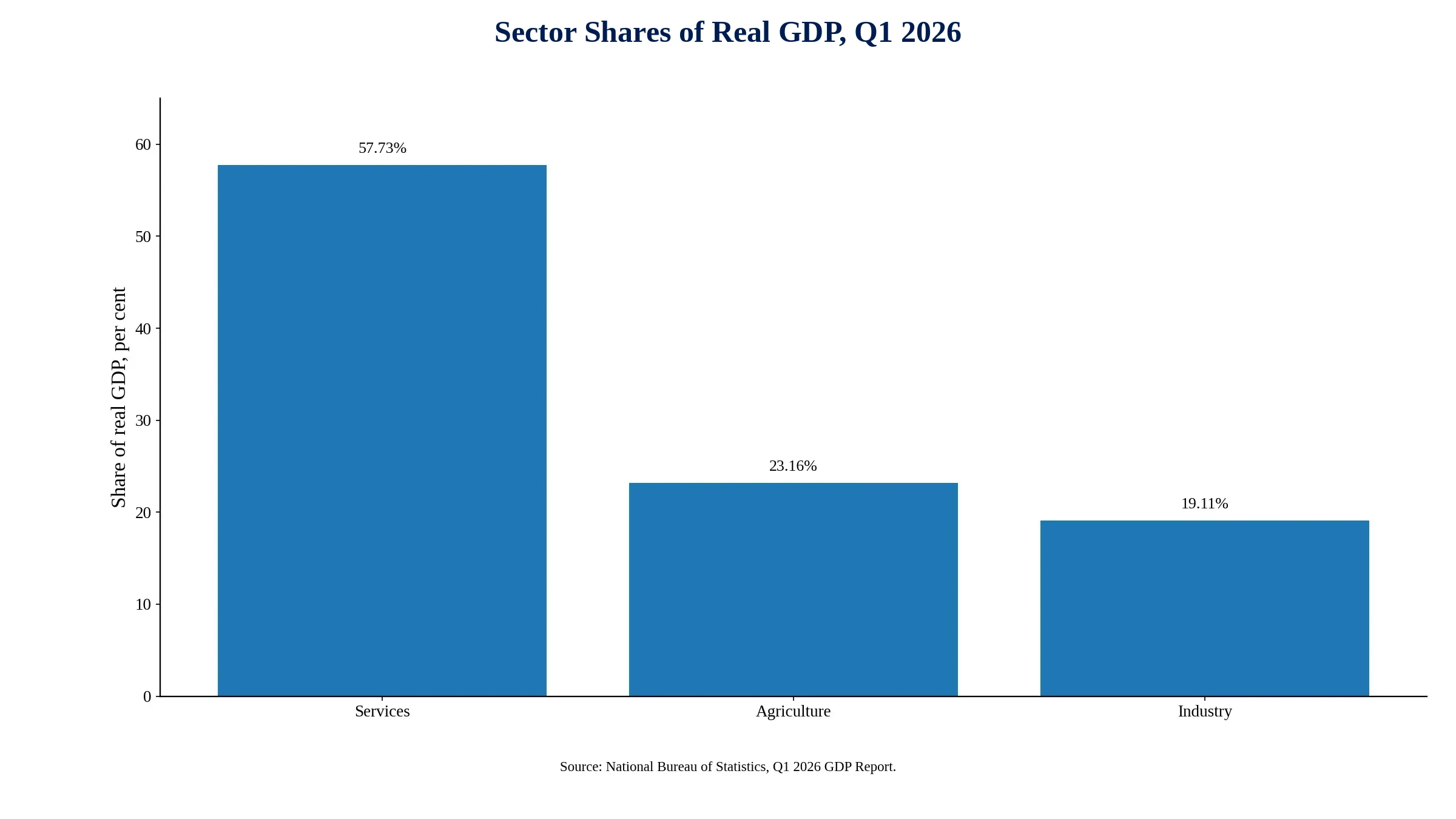
Nigeria recorded real GDP growth of 3.87 per cent in 2025, compared with 3.38 per cent in 2024. Growth was 4.07 per cent year-on-year in Q4 2025 and 3.89 per cent in Q1 2026. The Q1 result was higher than the 3.13 per cent recorded in the corresponding quarter of 2025. The non-oil economy represented 96.08 per cent of real GDP in Q1 2026. Services represented 57.73 per cent, agriculture 23.16 per cent and industry 19.11 per cent.
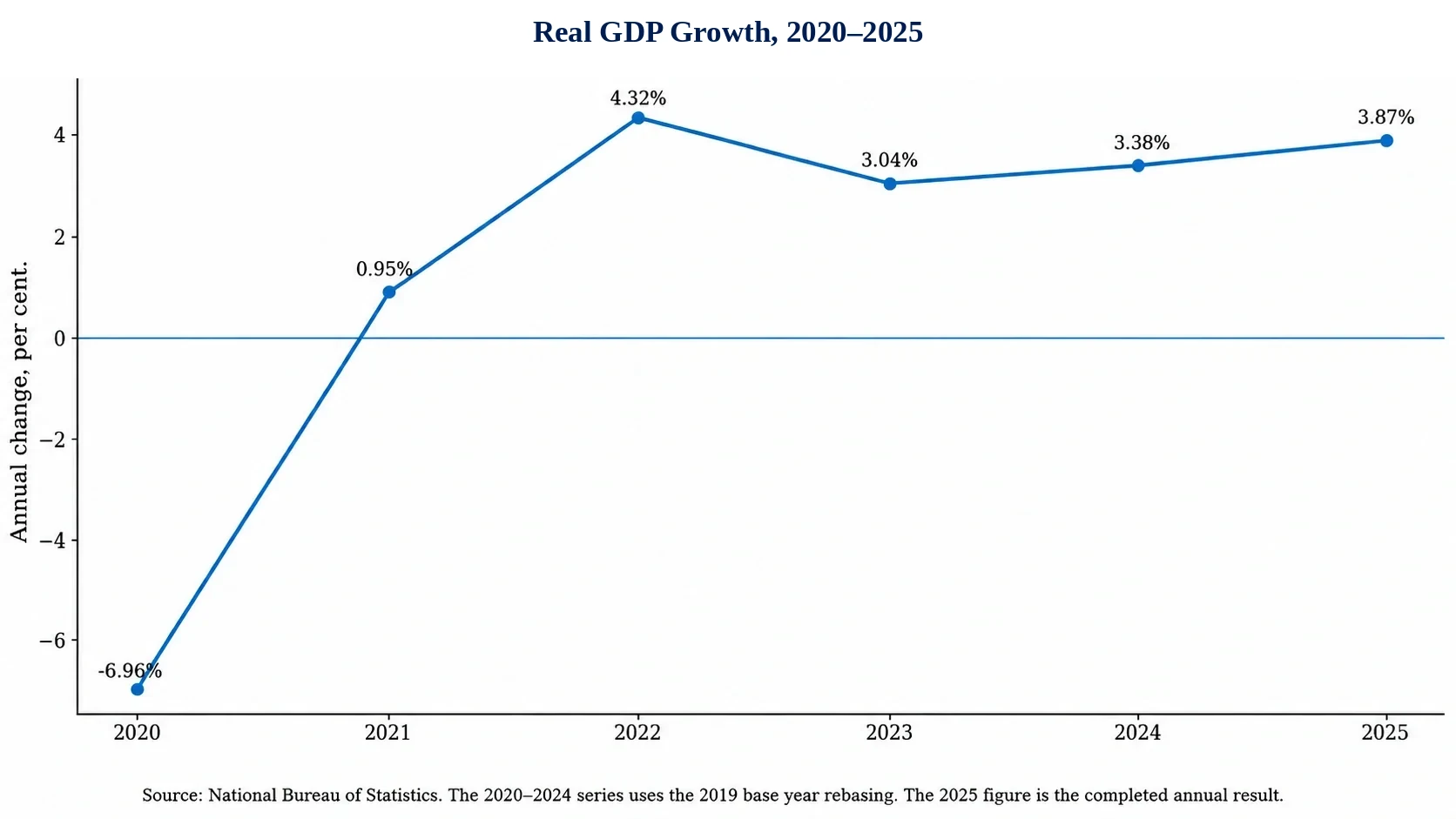
The economy has expanded in each year since the 2020 contraction. The 2025 result was the strongest annual growth since 2022. The improvement reflected stronger oil output, continued growth in gains across several non-oil activities. The IMF projected 4.1 per cent growth for 2026, compared with 4.3 per cent for sub–Saharan Africa.
Income and Domestic Demand
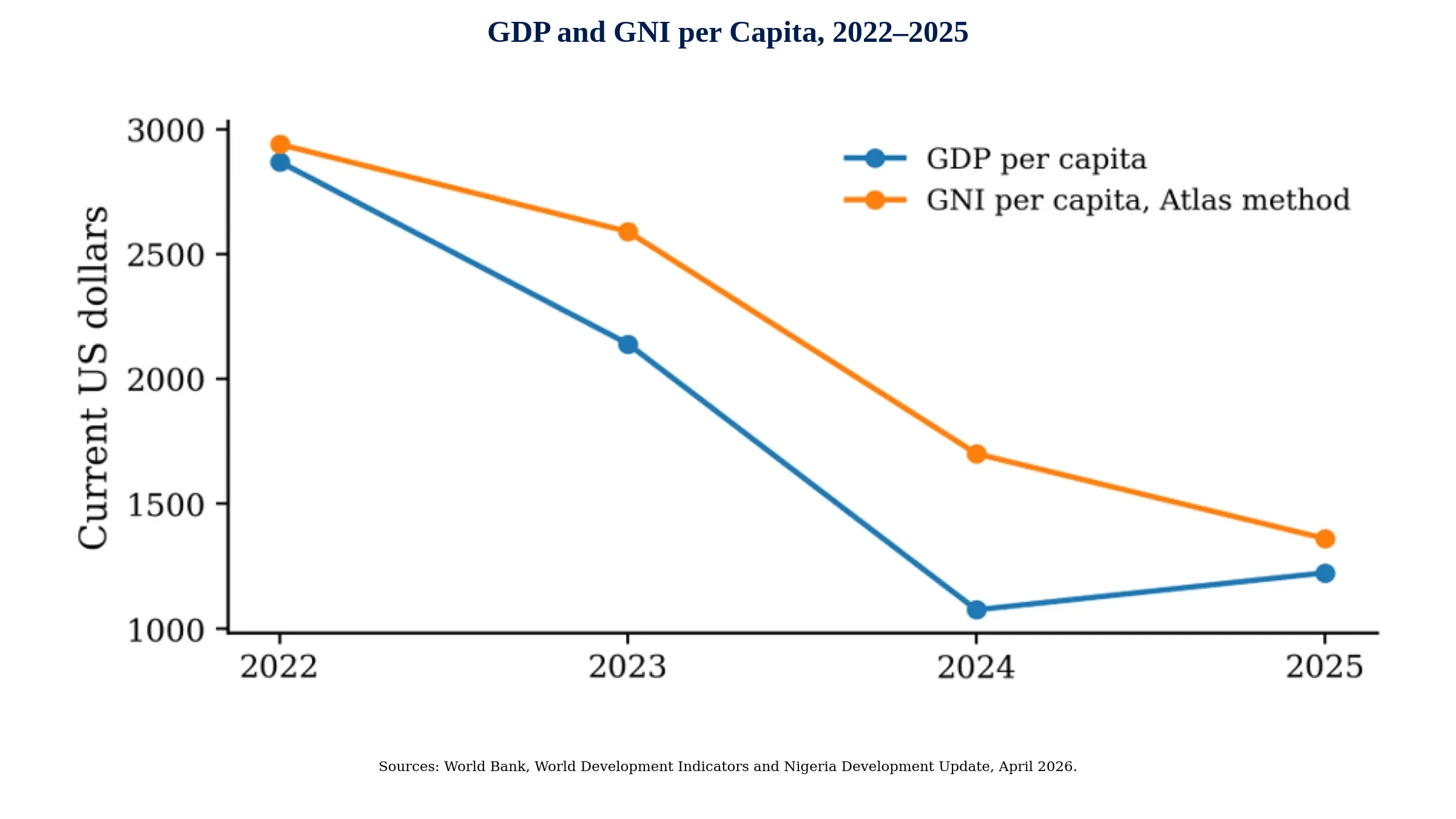
World Bank estimates placed GDP per capita at US$1,223 in 2025, compared with US$1,075 in 2024. Atlas method GNI per capita fell from approximately US$2,940 in 2022 to US$1,360 in 2025.
Household demand remains constrained by the cumulative increase in prices since 2023. Petrol subsidy removal raised transport and distribution costs, while exchange rate unification increased the naira price of imported goods. The national average petrol price rose from ₦238.11 per litre in May 2023 to ₦545.83 in June 2023 and ₦1,596.25 in May 2026. Population growth has also diluted gains in national output. The IMF estimated gross national savings at 22.0 per cent of GDP in 2025, but the measure has not established an improvement in household disposable income.
Trade Relations
Nigeria recorded merchandise trade of ₦34.79 trillion in Q1 2026. Exports amounted to ₦21.17 trillion, imports were ₦13.62 trillion and the trade surplus was ₦7.55 trillion. Crude oil represented 52.92 per cent of merchandise exports. The aggregate surplus therefore coexisted with continuing dependence on foreign suppliers for machinery and manufactured inputs.
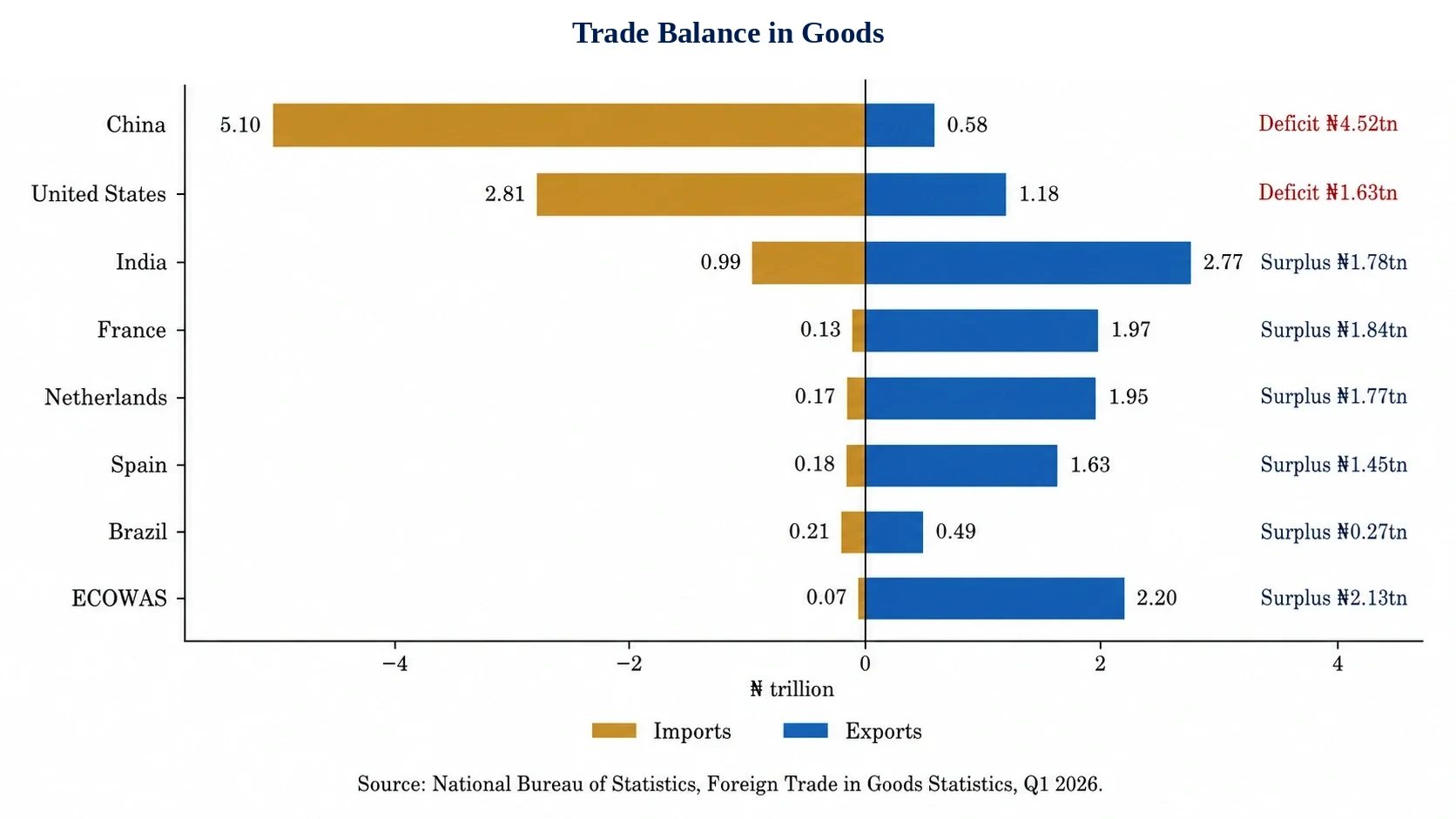
China was Nigeria’s largest source of imports and the largest bilateral trading partner in the quarter. Imports from China were approximately ₦5.10 trillion, while exports were about ₦582 billion, producing a deficit of approximately ₦4.52 trillion. China accounted for more than one third of merchandise imports. The United States also produced a bilateral deficit. Imports were approximately ₦2.81 trillion and exports were ₦1.18 trillion, leaving a deficit of about ₦1.63 trillion. India generated a large bilateral surplus. Exports were approximately ₦2.77 trillion and imports were ₦993 billion, producing a surplus of about ₦1.78 trillion. Nigerian exports to India were concentrated in crude oil, liquefied natural gas and agricultural commodities, while India supplied pharmaceuticals and manufactured products.
Nigeria recorded large surpluses with France, the Netherlands and Spain. The surplus was approximately ₦1.84 trillion with France, ₦1.78 trillion with the Netherlands and ₦1.45 trillion with Spain. Petroleum and other commodities accounted for much of the export value.
Trade with Brazil produced a smaller surplus and connected Nigerian fertiliser exports with imports of wheat, sugar and other agricultural products. South Africa was an important African source of vehicles, industrial materials and manufactured goods.
Nigeria exported approximately ₦2.20 trillion of goods to ECOWAS members and imported about ₦65.91 billion, producing a regional surplus of approximately ₦2.14 trillion. Cigarettes, accumulators, cement clinker and solid minerals were among the exported products. The balance shows that neighbouring markets obtain processed and manufactured goods from Nigeria, while Nigerian producers obtain revenue from regional demand. Nigeria’s position is divided between large commodity-led surpluses, large deficits with suppliers of machinery and manufactured products and a substantial regional surplus supported by processed goods. The principal exposure is the concentration of receipts, suppliers and products, the availability of alternatives and the cost and time required to change a market or supplier. These conditions affect costs of imported inputs and demand for foreign exchange.
Fiscal Position
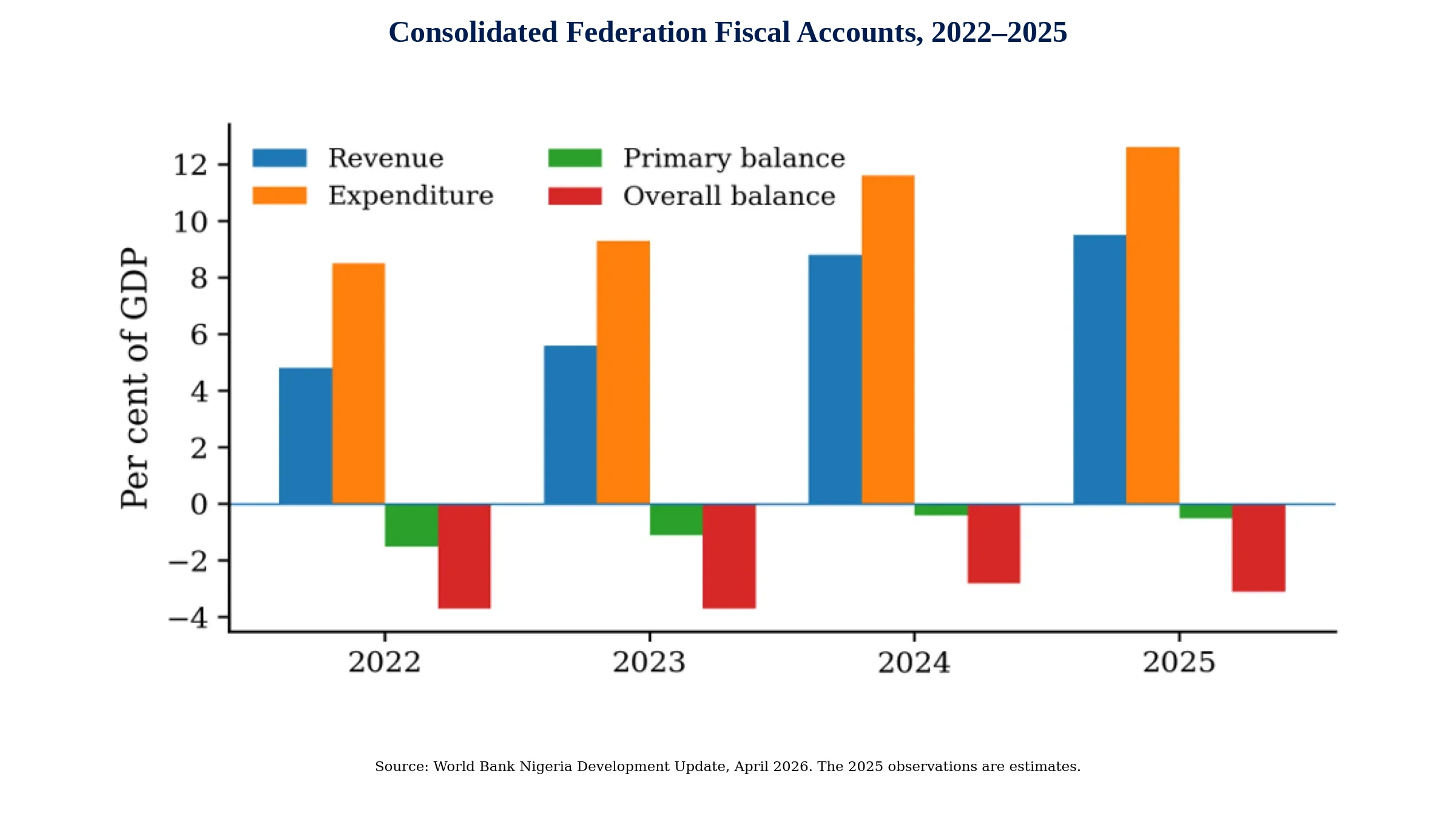
The latest comparable consolidated Federation accounts available by 30 June 2026 were estimates compiled by the World Bank from national sources. Revenue increased from 8.8 per cent of GDP in 2024 to 9.5 per cent in 2025, while expenditure increased from 11.6 per cent to 12.6 per cent. The deficit widened from 0.4 per cent to 0.5 per cent of GDP, and the overall deficit widened from 2.8 per cent to 3.1 per cent.
The IMF estimated a 2025 consolidated deficit of 1.8 per cent of GDP from recorded government operations but 4.4 per cent from the financing side. It identified a discrepancy of 2.7 per cent of GDP, interpreted as possible expenditure outside the accounts maintained by the Office of the Accountant General of the Federation. The financing-based deficit provides an indication of corporate and sovereign exposure because it reflects the borrowing required to fund activity not captured in recorded expenditure.
Non-oil revenue has improved, supported by company income tax and VAT. Oil revenue remains below budget expectations. Expenditure has increased through public investment and interest payments. The IMF also reported that expected fiscal savings from the removal of the petrol subsidy were not visible in the 2025 budget outcome. The IMF estimated the completed removal at up to 2 per cent of GDP. The absence of public reconciliation means that higher Federation revenue cannot be attributed to subsidy savings. The report therefore considers subsidy removal as a correction to petroleum pricing, but not as proven fiscal space until a complete account of the savings, remittances and expenditure funded from them is published.
Debt Burden and Debt Service
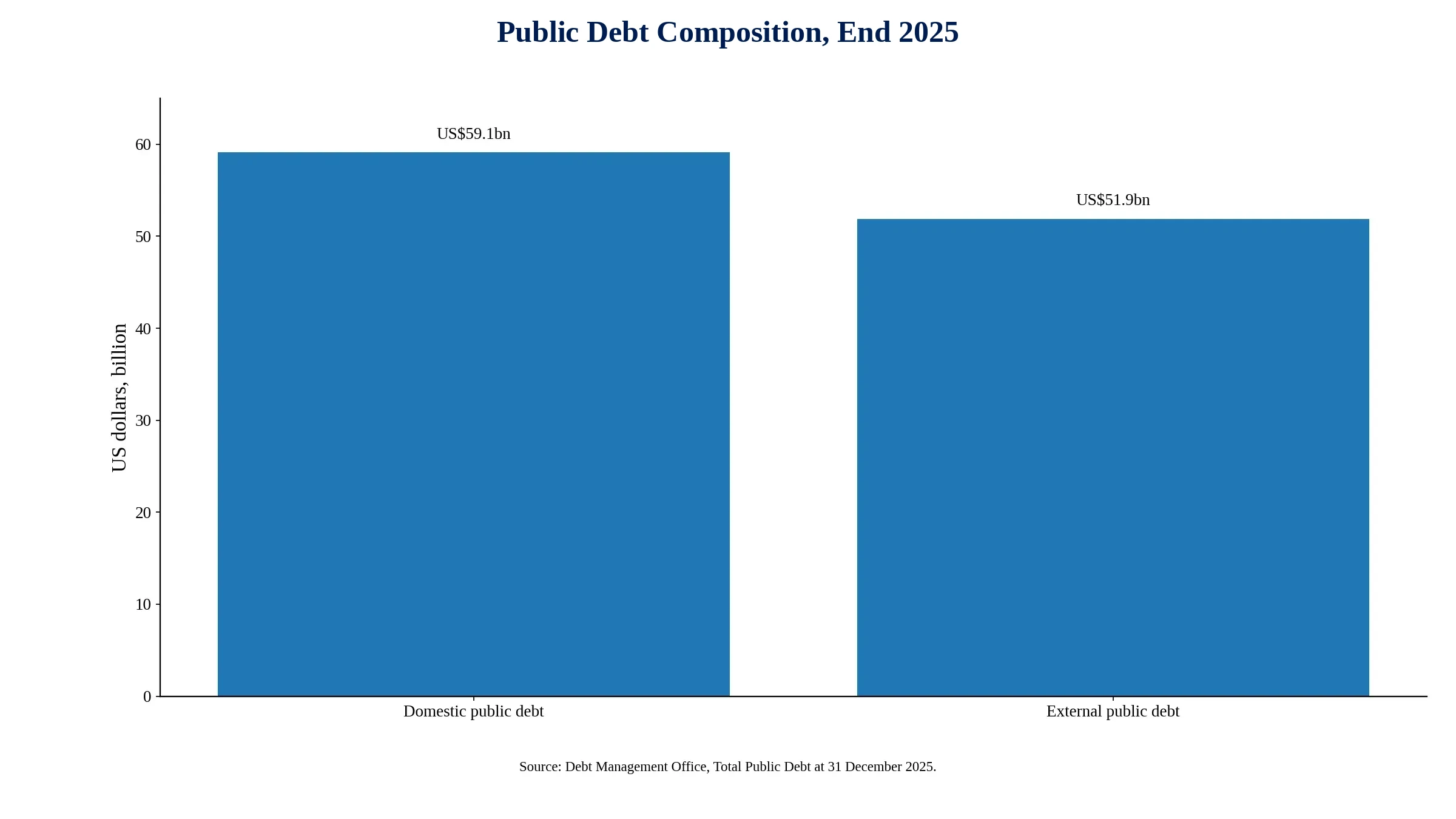
The Debt Management Office (DMO) reported provisional public debt of ₦159.276 trillion, equivalent to US$110.974 billion, at 31 December 2025. Domestic public debt represented 53.27 per cent of the total and external public debt 46.73 per cent. The IMF estimated public gross debt at 36.1 per cent of GDP in 2025. The ratio is moderate following the GDP rebasing.
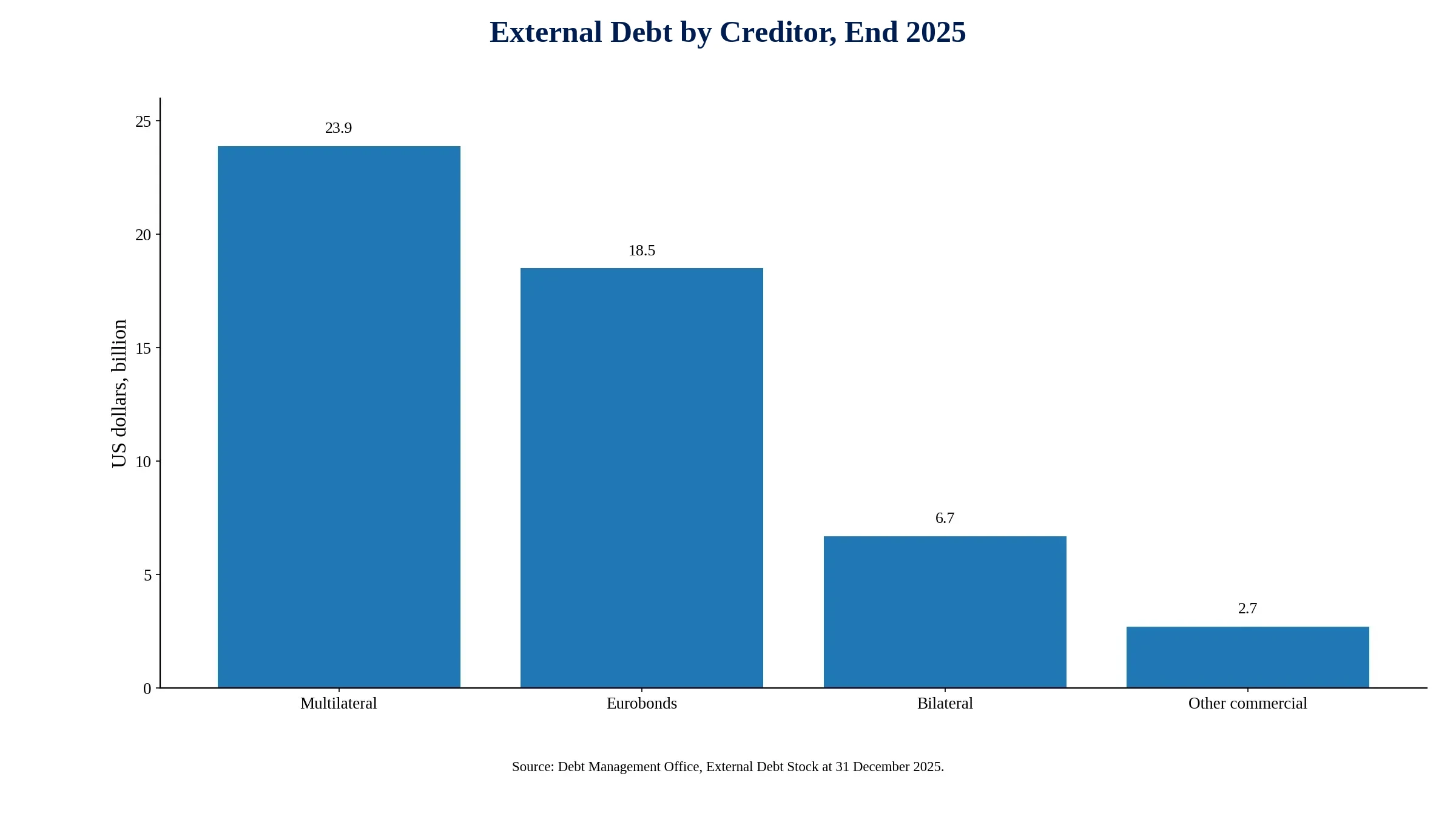
Service of external public debt amounted to US$5.151 billion in 2025, comprising US$3.057 billion in principal, US$2.034 billion in interest and US$59 million in other charges. Eurobond payments accounted for approximately US$2.494 billion. The IMF estimated Federal Government interest payments at 53.2 per cent of Federal Government revenue in 2025 and projected 53.7 per cent in 2026. These ratios are based on the federal revenue perimeter and should not be combined with consolidated Federation revenue.
External Account Position
Nigeria recorded a provisional current account surplus of US$14.0 billion, equal to 4.8 per cent of GDP, in 2025. The trade balance increased to US$14.5 billion. Exports of goods and services were 21.5 per cent of GDP, while imports were 21.6 per cent. Net foreign direct investment improved to US$2.8 billion but remained below 1 per cent of GDP. The net international investment position was minus 31 per cent of GDP at the end of 2025.
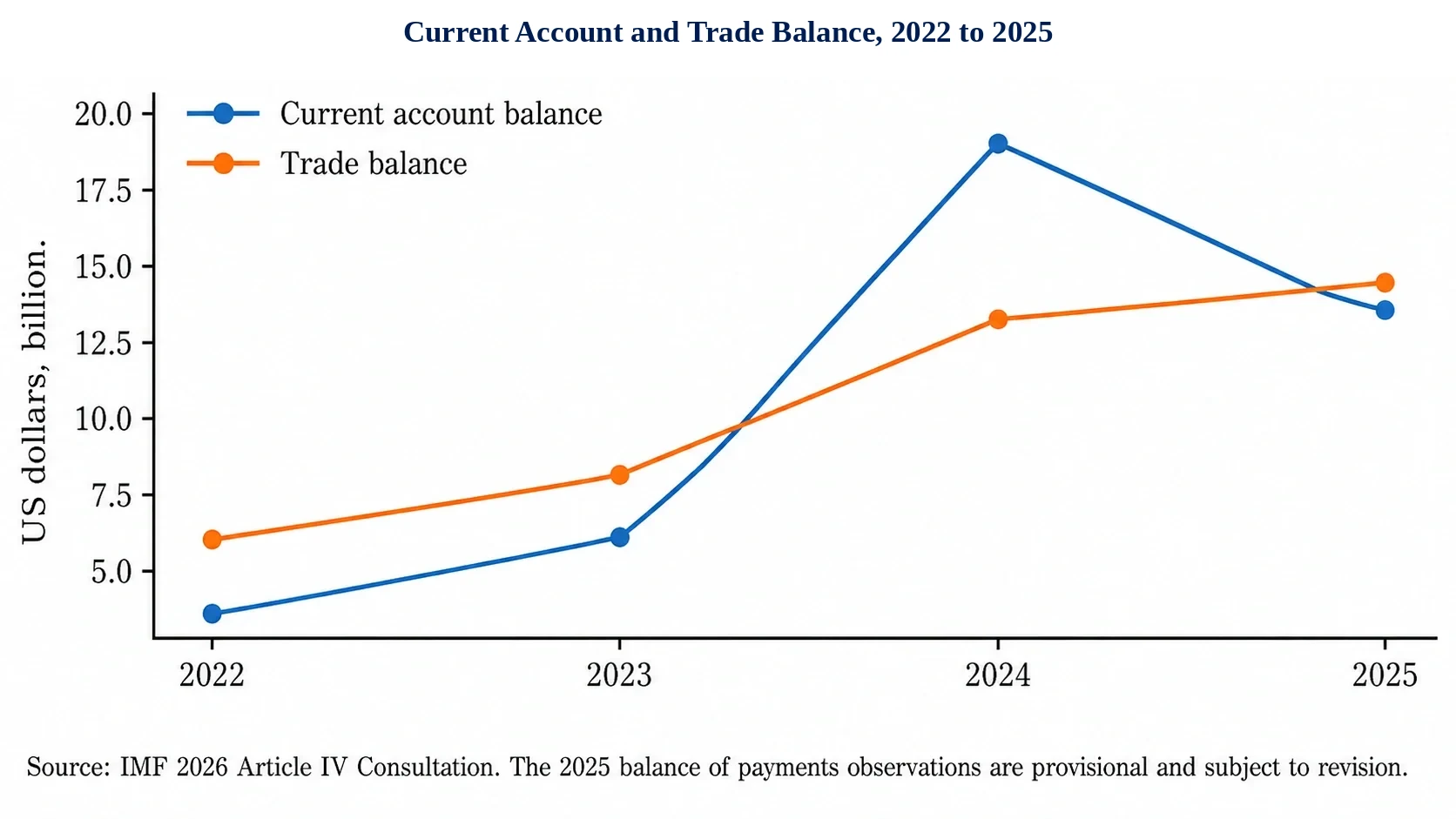
The current account surplus narrowed from the exceptional 2024 result but remained large. Higher oil and gas exports, lower refined petroleum imports and remittance inflows supported the external account. Domestic refining reduced part of the former import bill. Foreign exchange reform also improved the relative return from official remittance channels and helped move more inflows into the recorded market. These gains have remained exposed to oil prices, refinery output, import recovery and the willingness of investors and remitters to use official channels.
Reserve Adequacy and External Liquidity
Gross reserves increased from US$40.2 billion at the end of 2024 to US$45.8 billion at the end of 2025. Import cover increased from 7.7 to 8.1 months of the following year imports. Central Bank data showed gross reserves above US$51 billion during June 2026. Net reserves were US$34.8 billion at the end of 2025, compared with US$23.1 billion a year earlier.
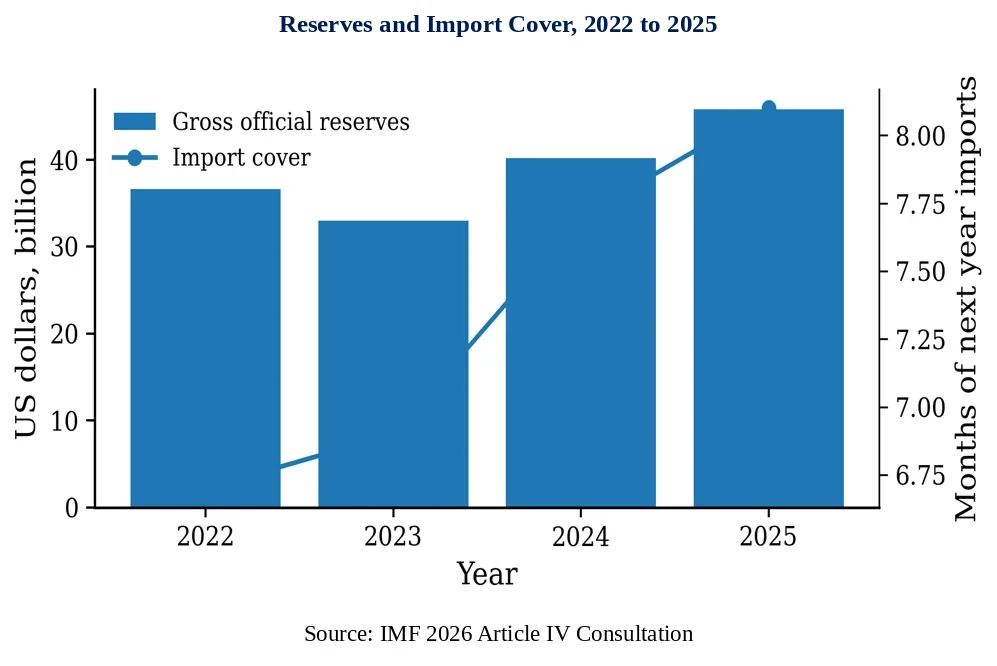
The IMF assessed end-2025 gross reserves at 157 per cent of its Assessing Reserve Adequacy metric, above the 100 to 150 per cent range considered adequate for precautionary purposes. The IMF reported that close to US$8 billion of reserves were pledged under a securities lending agreement or related transactions and would be excluded from gross international reserves under its definition. The composition and usability of the reserve stock are therefore as important as the headline total.
Inflation and Monetary Conditions
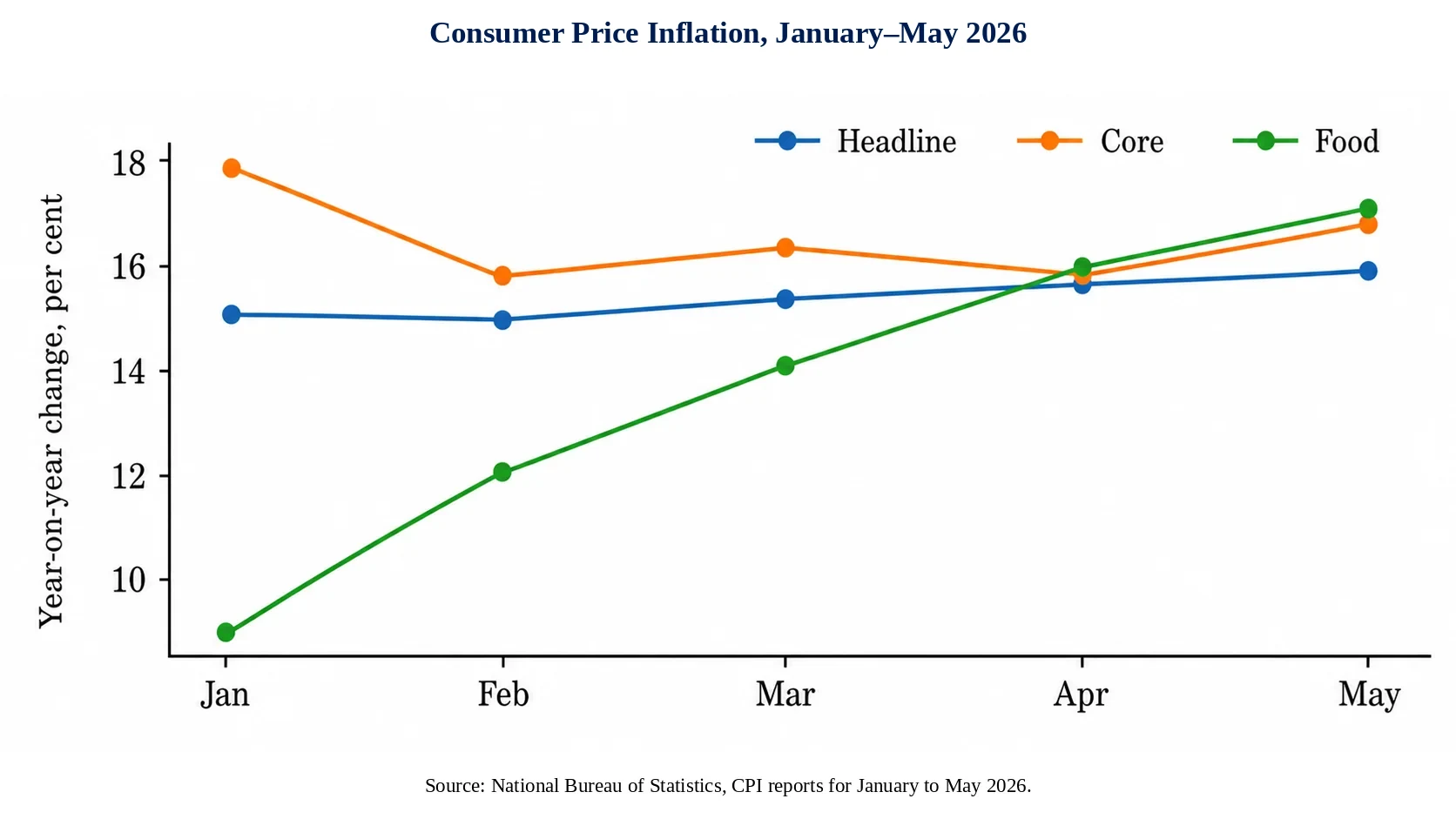
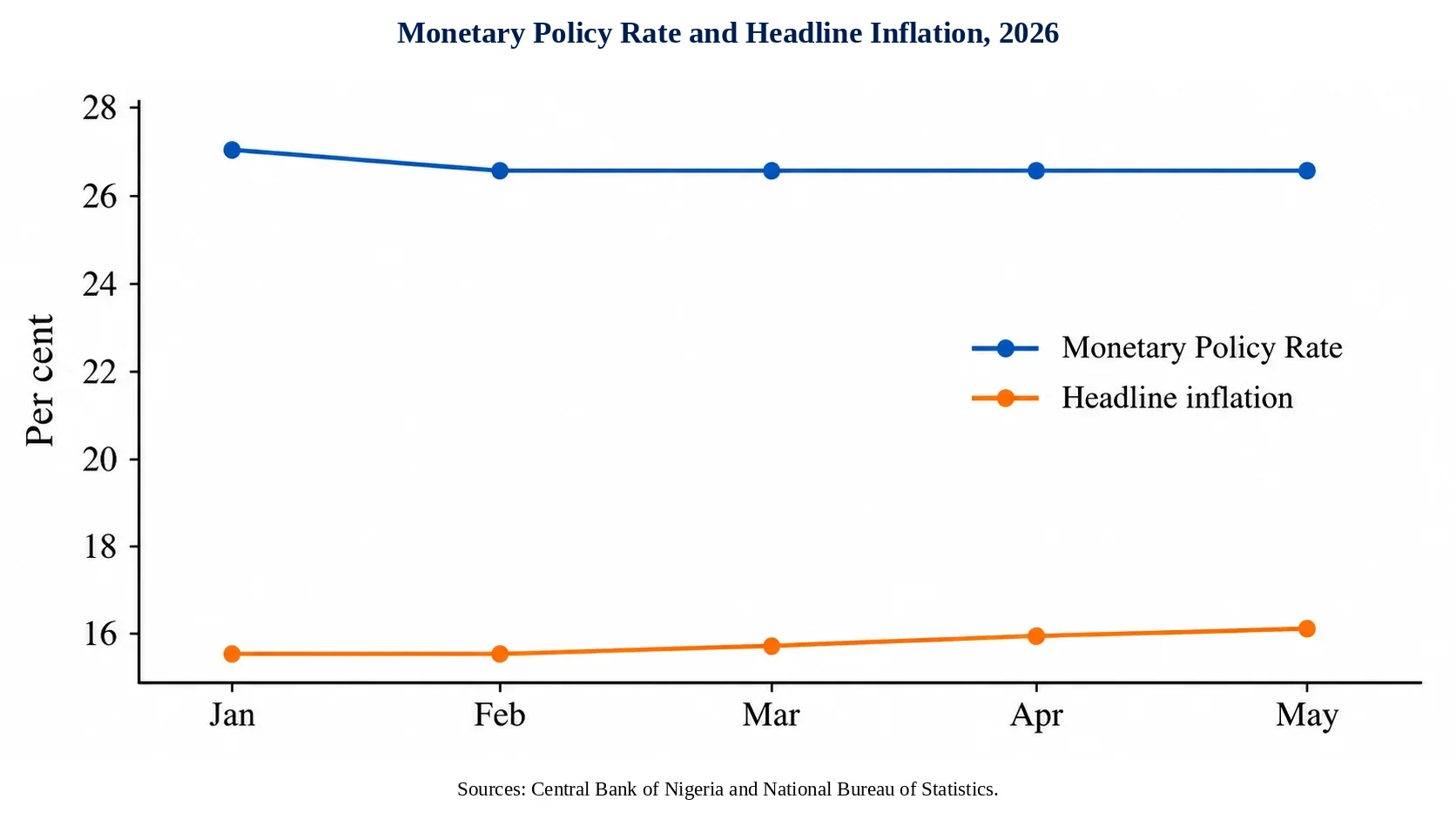
Headline inflation increased from 15.06 per cent in February to 15.38 per cent in March, 15.69 per cent in April and 15.93 per cent in May 2026. Food inflation rose from 8.89 per cent in January to 16.96 per cent in May. Core inflation was 16.82 per cent in May. The latest data available at 30 June 2026 therefore showed renewed annual price pressure, led by food and underlying non-food components.
The Central Bank reduced the Monetary Policy Rate (MPR) from 27.0 per cent to 26.5 per cent in February 2026 and retained it at 26.5 per cent in May. The Cash Reserve Ratio (CRR) for deposit money banks remained 45 per cent and the liquidity ratio 30 per cent. Broad money growth slowed to an IMF estimated 14.6 per cent at the end of 2025, compared with 50.3 per cent in 2024.
Exchange Rate Conditions
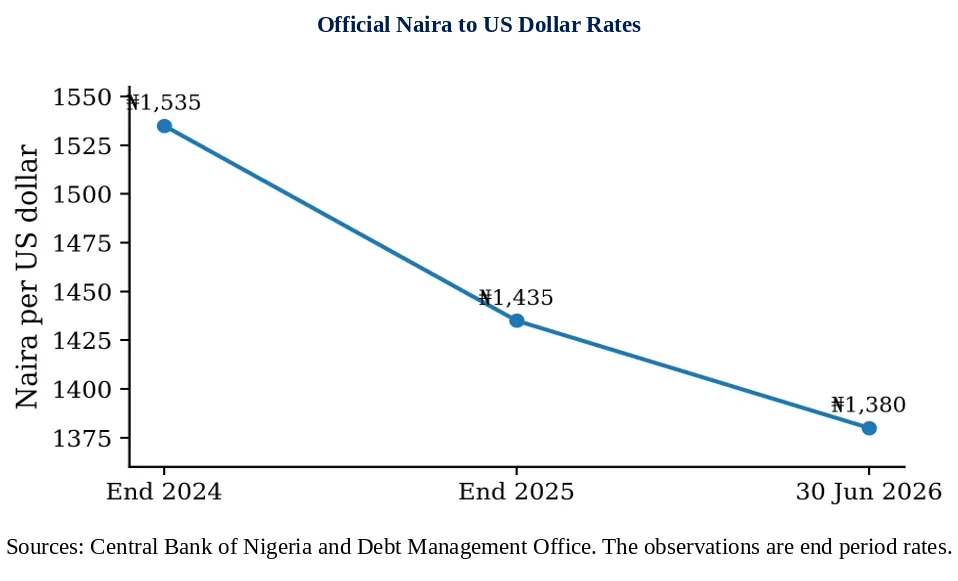
Nigeria adopted the current exchange rate regime on 14 June 2023, when the Central Bank introduced the willing buyer, willing seller model and collapsed the former official market segments into the Investors and Exporters window, now the Nigerian Foreign Exchange Market. The reform replaced administrative rates with price discovery through recorded transactions. After the initial depreciation, the Nigerian Foreign Exchange Market rate was ₦1,379.6842 per US dollar on 30 June 2026. The daily range was ₦1,370 to ₦1,384, and total market turnover was approximately US$1.067 billion. The end-2025 rate used by the Debt Management Office was ₦1,435.2571 per US dollar.
The IMF classified the de facto regime as floating in 2025 and found that foreign exchange market conditions had improved. One restriction affecting international oil company export proceeds was removed in March 2026, but three outflow restrictions remained. The IMF also identified two multiple currency practices involving rates used in Central Bank transactions with ministries, departments, agencies and oil companies.
Labour Market Conditions
The latest complete Nigeria Labour Force Survey available by 30 June 2026 covered the second quarter of 2024. It reported unemployment of 4.3 per cent, labour force participation of 79.5 per cent and an employment to population ratio of 76.1 per cent. Informal employment was 93.0 per cent, while time-related underemployment was 9.2 per cent. Youth unemployment for people aged 15-24 was 6.5 per cent.
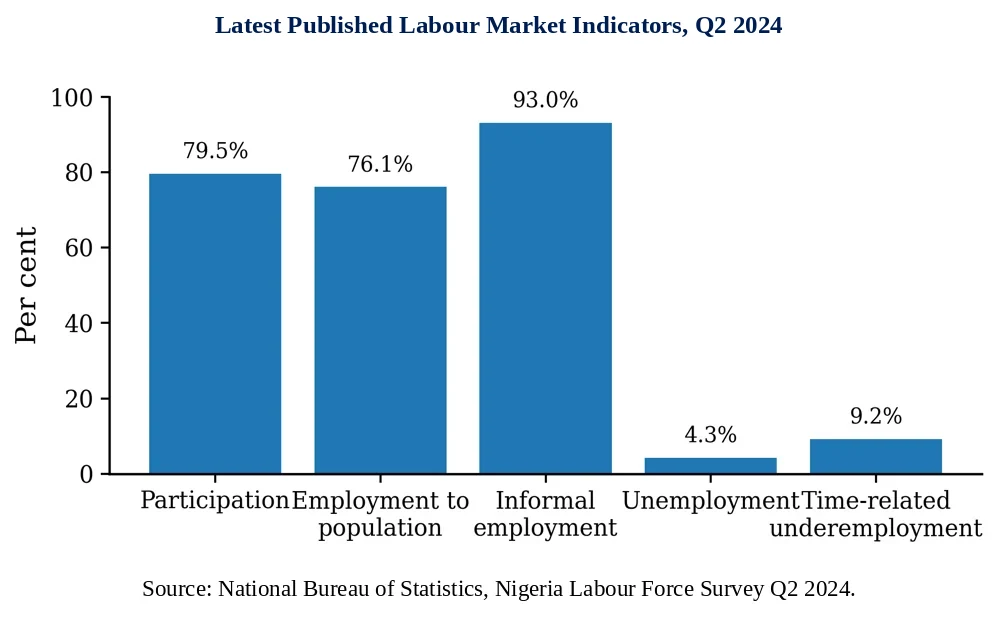
The low unemployment rate should not be read as evidence of widespread and productive employment. The high informal employment and underemployment rates show that many people considered employed have low earnings or no formal employment relationship. The present method follows revised international definition and is not comparable with the former unemployment series.
Financial Sector Indicators
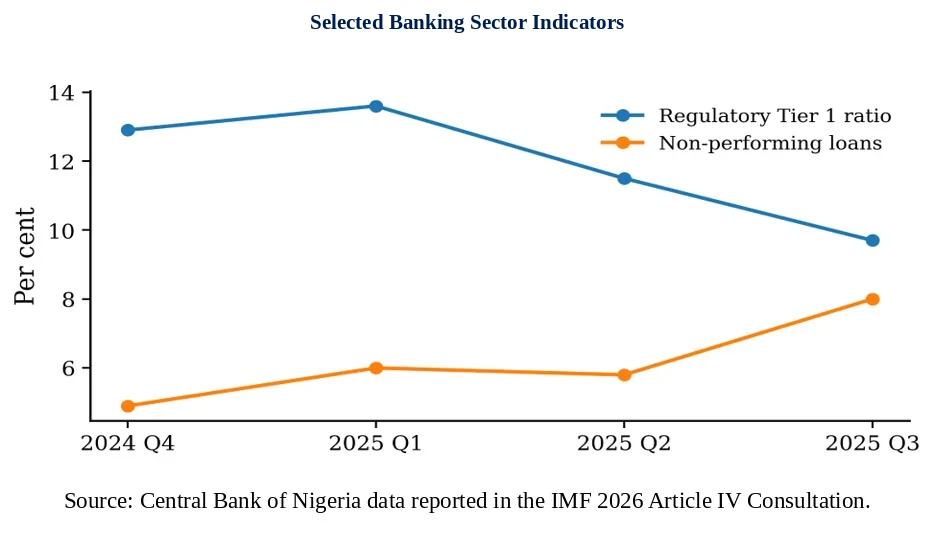
Bank profitability remained positive during 2025, but asset quality and the regulatory Tier 1 ratio weakened. Non-performing loans increased from 4.9 per cent of gross loans in Q4 2024 to 8.0 per cent in Q3 2025. The regulatory Tier 1 ratio fell from 12.9 per cent to 9.7 per cent. Return on assets was 3.0 per cent and return on equity 27.5 per cent in Q3 2025. Liquid assets represented 24.0 per cent of total assets and 57.6 per cent of short-term liabilities.
IMF data showed private sector credit contracting by 1.2 per cent in 2025 after nominal growth in 2024. Government securities represented a large share of bank assets. High sovereign yields, the policy rate and rising non-performing loans support cautious bank lending. The bank recapitalisation programme may improve loss absorption, but it has not improved borrowing conditions.
Political Environment
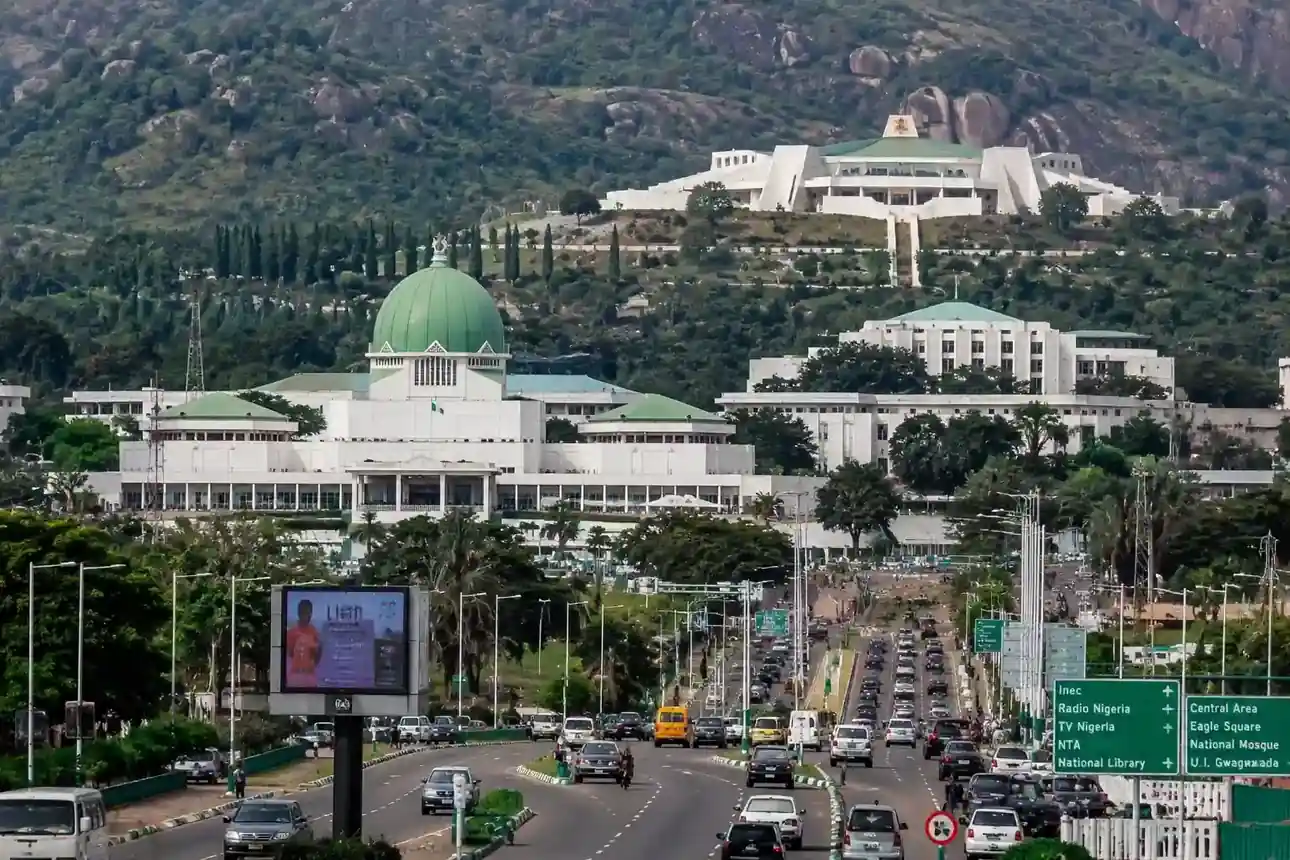
Nigeria is constitutionally a federal republic. The president is head of state and head of government. The National Assembly comprises a 109-member Senate and a 360-member House of Representatives. The federation consists of 36 states and the Federal Capital Territory. The Constitution recognises 774 local government areas, but the independence of the third tier is the weakest part of the federal structure.
The national system remains civilian and electoral. No successful coup had removed a federal government since the 1999 transition. Freedom House nevertheless classified Nigeria as Partly Free with 44 points out of 100. The score reflects a system in which opposition parties compete and courts sometimes rule against government, but public institutions have not constrained office holders or protected political rights.
The Supreme Court judgment of 11 July 2024 was the most important decision concerning the structure of government. It held that allocations due to local councils should be paid directly, declared it unlawful for governors to retain those funds and rejected the use of caretaker committees in place of elected councils. The judgment did not amend the constitutional provisions establishing State Joint Local Government Accounts, which left governors and federal authorities arguing over the conditions for implementation.
Nigeria has maintained civilian succession since 1999, including the defeat of an incumbent party in 2015. At the subnational level, however, governors have repeatedly dissolved councils, appointed caretaker committees, withheld funds or used state electoral commissions to their advantage. The direction is therefore mixed. Constitutional government exists in principle, while local democratic government remains conditional on state power.
Nigeria has performed better than the military governed states in parts of West Africa because federal and state leaders still derive office through elections and constitutional rules. It performs less strongly than African federal or decentralised systems where local governments have independent revenue, credible electoral bodies and protected tenure.
Concentration of Power
Power is concentrated around the presidency, ruling party and state governors. The National Assembly remains legally independent, but major executive measures are often received with no resistance once the Senate and House leadership reach agreement with the presidency. Governors retain strong control over state legislatures, state electoral commissions and local councils. The 2025 World Justice Project Rule of Law Index ranked Nigeria 93 of 143 for constraints on government powers, while BTI described stronger executive dominance than the separation of powers would suggest. Nigeria’s overall Rule of Law Index ranking was 120 of 143.
President Tinubu declared emergency rule on 18 March 2025 during the conflict between Governor Fubara of Rivers State and the state legislature faction associated with former governor and FCT Minister Nyesom Wike. The proclamation suspended the governor, deputy governor and legislators and appointed retired Vice Admiral Ibok-Ete Ibas to administer the state for six months. The elected institutions returned on 18 September 2025 after political truce among the principal actors. The episode showed that state autonomy could be interrupted when the presidency presented a political crisis as a national security. The action differed from the 2013 emergency rule in Borno, Yobe and Adamawa, when elected governors remained in office.
The Electoral Act 2026 demonstrated one of the different forms of legislative opacity. In the electoral law process, public backlash pressured the Senate to accommodate real-time transmission provision after it had initially rejected it. The reversal showed that public pressure could constrain the chamber. It also exposed how a provision essential to transparency in the 2027 election could change after almost two years of consultations.
The public debate over houses and vehicles for judges concerned who should provide personal benefits to serving judicial officers. In June 2026, the Federal Government commissioned ten housing units for Federal High Court judges in Katampe, Abuja. President Tinubu described housing as a panacea for judicial independence. The Socio-Economic Rights and Accountability Project (SERAP) and the Nigerian Bar Association (NBA) argued that houses and vehicles supplied by executives who appear before the courts created dependence or, at minimum, the appearance of dependence.
Cost of Governance
The cost of governance debate in Nigeria often mixes civil service pay, elected office, security votes to elected officials, official travel, public agencies and development projects. The 2026 Appropriation Act allocated N535.42 billion to the Presidency group of institutions. These are appropriations, not audited expenditure.
The appropriation schedules also revealed the difficulty of defining the functions of different offices. The Presidency group contain institutions with functions that overlap with established ministries or agencies. New councils, commissions and special offices can be created without a public account of the functions they duplicate or the results they deliver. There is no current, reconciled national count of ministries, departments and agencies across the federation, or a single figure for the number and cost of political office holders.
The pressure to reduce administrative cost remains high because households face higher living costs while federal and state office holders retain large administrative budgets. The tax reform debate increased scrutiny of government spending. Public resistance was strong where citizens believed that reforms were being imposed without an equivalent reduction in cost of governance.
Elite and Patronage Networks
Political opportunity in Nigeria remains affected by access to ruling elites and politically connected intermediaries. The network differs by state and sector, but the recurring feature is that access to public authority is personal as well as institutional. The APC entered 2026 with the presidency, National Assembly leadership and most governorships. High profile defections from opposition parties have strengthened the perception that access to federal power and protection encourage office holders to join the ruling party. Opposition leaders have described the trend as shift towards a one-party state, while the ruling APC presented it as voluntary support for the administration.
Local government elections provide another evidence of patronage network. State independent electoral commissions are appointed and funded by state authorities. The result is a structure in which local government chairmen often owe their nomination and continued tenure to the governor, and not the electorates. That relationship weakens the ability of local government councils to resist the state even where the Supreme Court has recognised financial autonomy.
Military Influence
Nigeria has remained under civilian government since 1999. Military and security institutions nevertheless remain involved in domestic governance because the police lack the capacity to manage insurgency, banditry, communal violence, separatist violence, election security and major public disorder without military support.
In April 2026, federal prosecutors charged six former security officials with treason, terrorism and terrorism financing over an alleged plot to overthrow President Tinubu. Though the accused pleaded not guilty, the case showed that coup allegations remain a concern in a region where neighbouring governments had been overthrown.
The state police amendment bill responded to the failure of a centrally controlled police force to provide adequate local security. Supporters argued that local recruitment and command would improve intelligence and response. Critics warned that governors who already influence state electoral commissions and local councils could use state police against opponents or communities. The bill attempted to address this through federal intervention, Senate oversight and judicial review. Whether those protections would operate impartially remain untested.
Repression of Opposition
Nigeria retains a lively press, opposition parties, civil society organisations and regular public criticism of government. The same environment harbours arrests of journalists, criminal defamation and cybercrime cases, restrictions on protest, security force violence and regulatory pressure on broadcasters. Freedom House's Freedom in the World 2026 report awarded Nigeria 24 of 60 points for civil liberties and specifically identified harassment and arrest of journalists covering politically sensitive issues.
In April 2026, the National Broadcasting Commission (NBC) announced stricter enforcement of rules against presenters expressing personal opinions, denying opposing views a fair hearing or airing divisive and unverified political content. The Commission argued that violations had increased and that neutrality rules were necessary before the election. Atiku Abubakar, SERAP and Amnesty International warned that the notice could produce censorship and self- censorship, especially because broadcasters depend on NBC licensing and sanctions.
The handling of the 2024 End Bad Governance protests remains relevant to the mid-2026 assessment because it established the government response to a cost of living mobilisation. Amnesty International reported lethal force and mass detention. The sight of undernourished minors collapsing in a Federal High Court during treason proceedings created public backlash leading to a discontinuation of the charges.
Opposition parties have also faced hurdles. On 15 June 2026, a Federal High Court ordered the Independent National Electoral Commission (INEC) to deregister the African Democratic Congress (ADC) and four other parties for failure to meet constitutional requirements. The timing and potential removal of major opposition platforms made judicial and regulatory independence worrisome to the electoral process.
Election Manipulation and Disputes
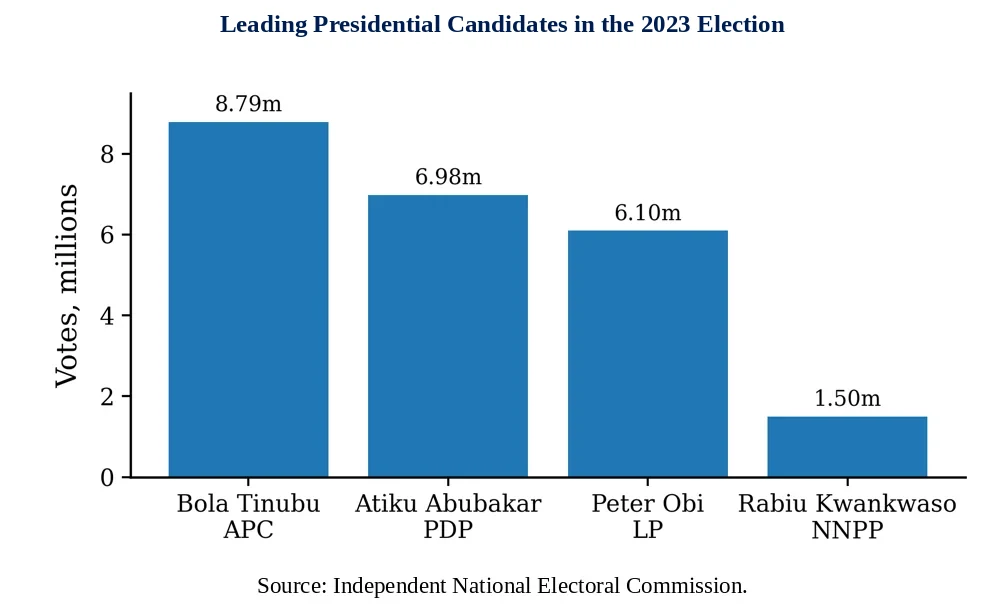
The 2027 election is already the organising fact of national politics in 2026. Party defections, coalition negotiations, electoral legislation and state elections are being assessed for their effect on the upcoming 2027 elections. The 2023 result remains the benchmark. Bola Tinubu won with 8.79 million votes, Atiku Abubakar received 6.98 million, Peter Obi 6.10 million and Rabiu Kwankwaso 1.50 million. Tinubu won with about 36.6 per cent of valid votes.
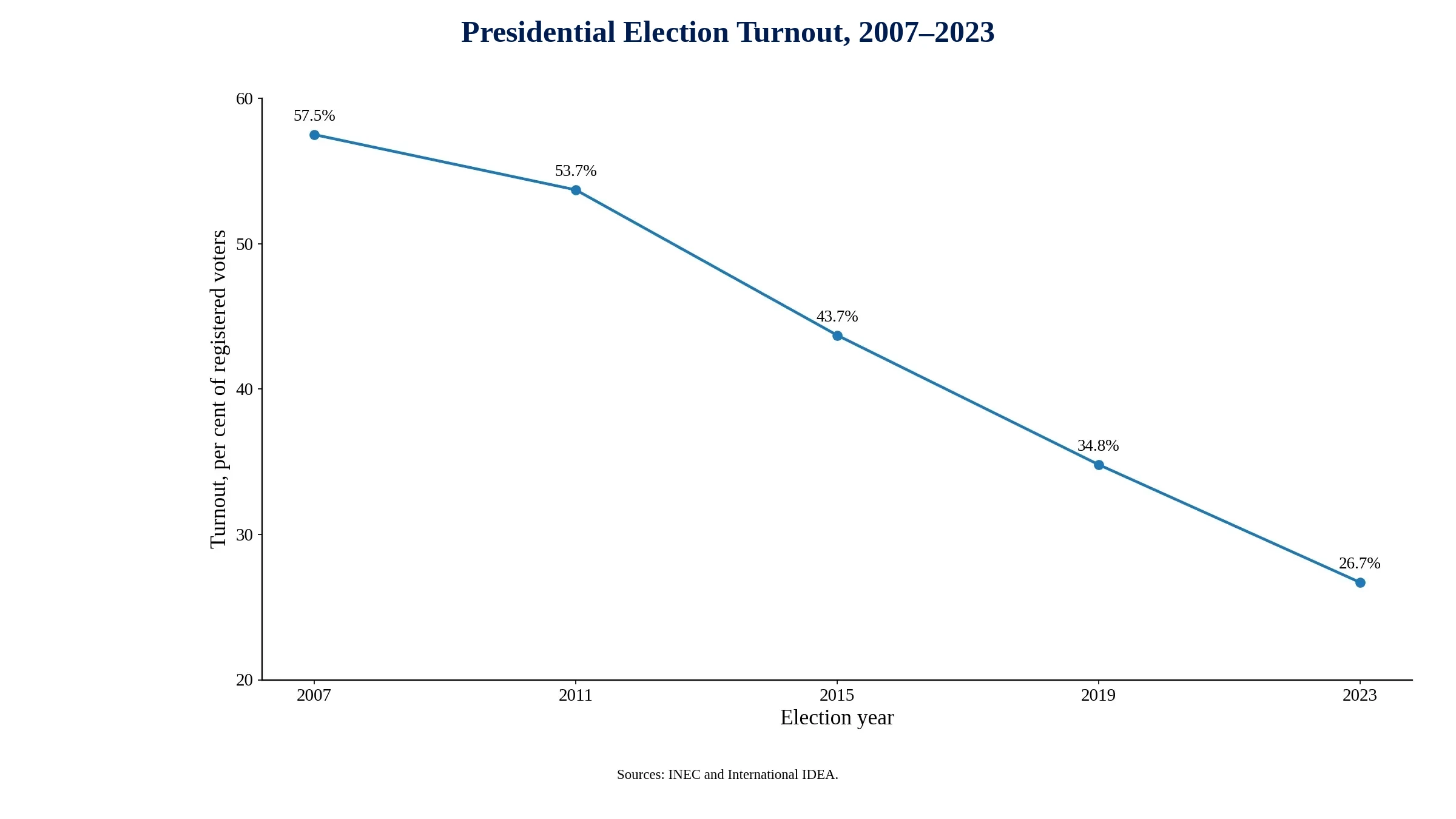
Voter apathy appears a warning sign. Turnout fell to 26.72 per cent in 2023, continuing a decline from 57.5 per cent in 2007. Low turnout signals the importance of confidence in the electoral process. It also indicates that a party can prevail without support from a majority of registered voters.
The demand for real-time transmission of results at polling units by a cross-section of voters could not be isolated from fears of manipulating the collation process. The Independent National Electoral Commission (INEC) is constitutionally responsible for federal and state elections, but local government elections outside the Federal Capital Territory remain under state commissions. Local council elections are administered by bodies appointed and funded by governors, with repeated one-party sweeps. The legitimacy problem at local level therefore extends beyond election day to the institution conducting the election.
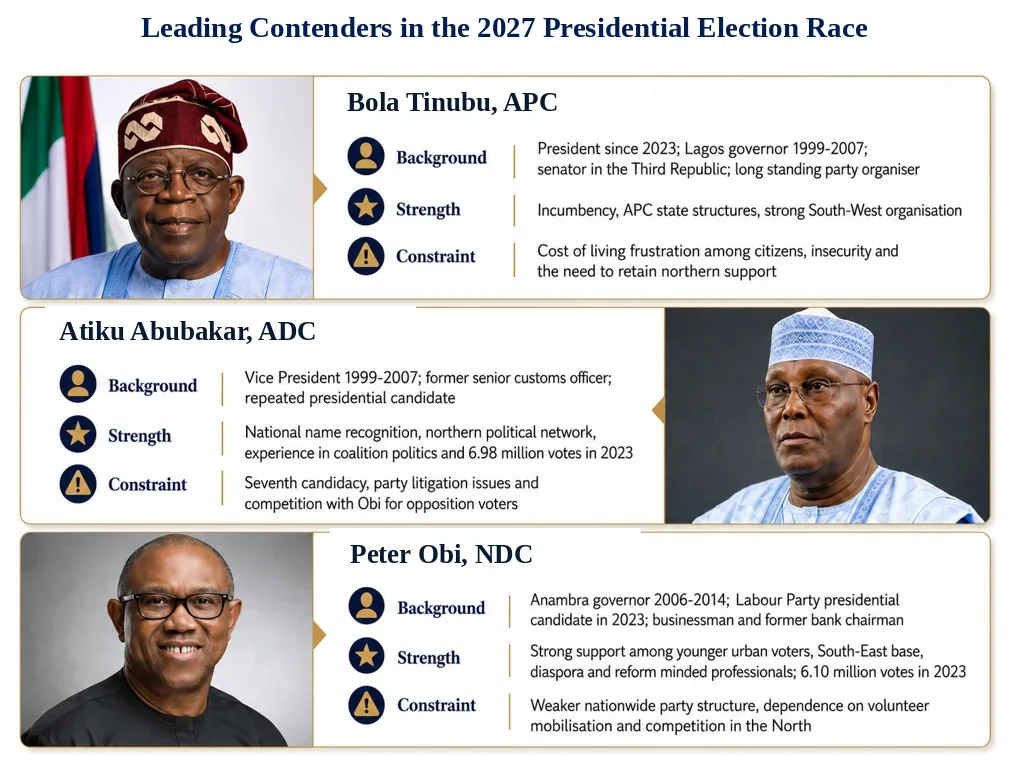
Nigeria has improved from the high election violence of earlier decades, but intimidation, vote buying, result disputes and localised violence remain material. The most persistent weaknesses are compromised security forces, opaque collation, compromised electoral commissions and officers and slow litigation. The 2023 presidential petitions ended with the Supreme Court judgment of October 2023, long after the government had taken office. The 2026 reforms attempted to move some disputes earlier, but their operation had not yet been tested in a general election.
Conflict, Security and Social Indicators
Armed Conflict and Terrorism
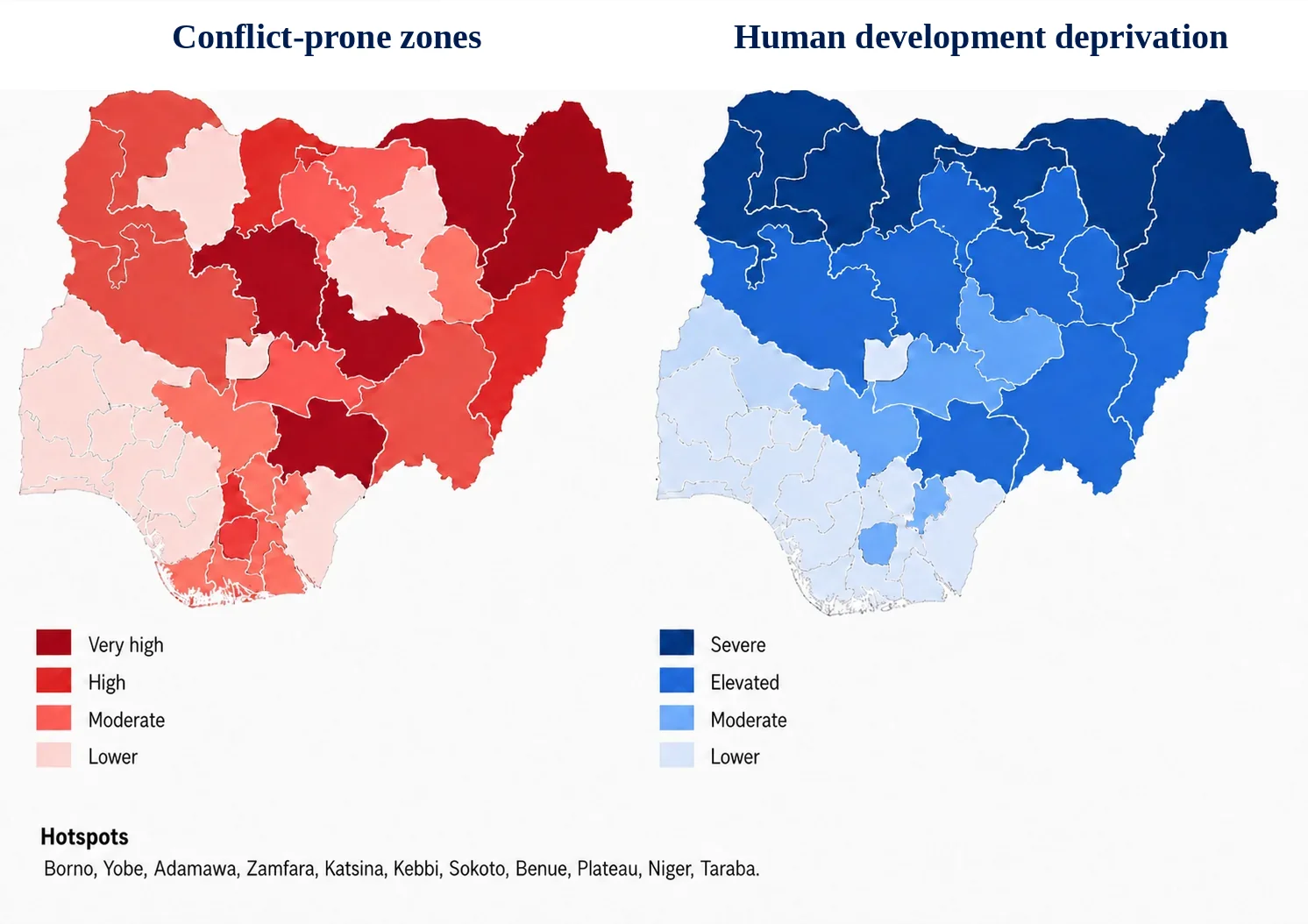
Armed conflict remains geographically dispersed at 30 June 2026. The North-East has continued to face violence involving Islamic State West Africa Province (ISWAP) and Boko Haram. The North-West has remained affected by armed organisations involved in attacks on communities, kidnapping and conflict with security forces. Plateau, Benue and parts of neighbouring North-Central states have remained exposed to attacks on rural communities. The South-East has continued to experience separatist violence, attacks on public institutions and security operations.
The Global Terrorism Index 2026 recorded 171 terrorist incidents and 750 deaths in Nigeria during 2025 and placed the country fourth among the countries most affected by terrorism. Incidents increased from 120 in 2024 to 171 in 2025, while deaths increased by 46 per cent. Islamic State West Africa Province and Boko Haram together accounted for 80 per cent of terrorism deaths recorded in the country.
The conflict situation was not limited to confrontations between armed organisations and security forces. Violence against civilians has remained a major feature of the national security condition. Armed Conflict Location & Event Data (ACLED) reported that attacks against civilians represented almost 60 per cent of political violence incidents in Plateau State in April 2026. It also recorded the highest number of political violence incidents in the state since its coverage began in 1997.
Nigeria remains in a stronger security footing than during the Boko Haram expansion of 2014 and 2015, when the organisation controlled extensive towns and rural areas. Armed organisations nevertheless retain access to forests, border areas, Lake Chad islands and rural routes from which they can attack communities, security formations and transport corridors.
Capacity of State Security
The capacity of Nigeria’s military, police, intelligence and paramilitary institutions remains uneven across threats and territories. The armed forces remain engaged against insurgency in the North-East, armed organisations in the North-West, communal conflict in the North-Central states and separatist violence in the South-East. Security forces have prevented insurgent organisations from returning to the territorial occupation recorded during 2014 and 2015.
Regional cooperation remains important to security in the Lake Chad Basin. The Global Terrorism Index reported that Niger curtailed formal cooperation with Nigeria after the July 2023 coup, while Cameroon remains the most consistent regional partner. United States security cooperation became prominent during the first half of 2026. In January, Nigeria and the United States reaffirmed counter-terrorism cooperation through the first session of their joint working group. The deployment followed a United States airstrike against Islamic State targets in Sokoto State in December 2025, carried out in coordination with Nigerian authorities.
Civil and Industrial Unrest
Public protests and industrial action remain connected to costs of living, wages, taxation, fuel prices, and political decisions. The cumulative increase in costs of living since 2023 has continued to provide grounds for civic and labour mobilisation. Public pressure nevertheless remains capable of altering official decisions.
Migration Pressure
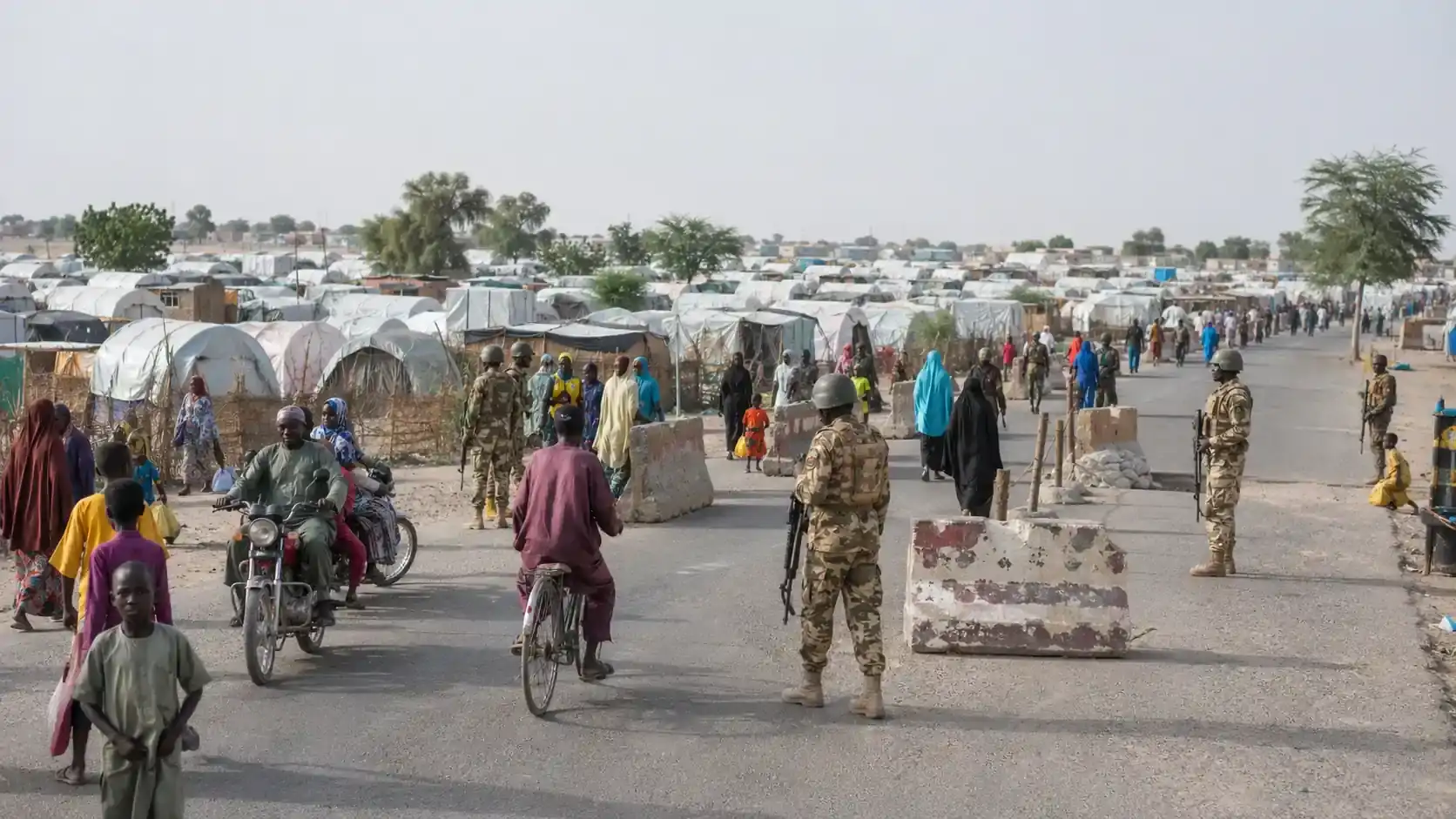
Nigeria remains a country of internal displacement, refugee origin and refugee reception. UNHCR reported approximately 3.6 million internally displaced persons and more than 400,000 Nigerian refugees in Niger, Chad and Cameroon. Nigeria also hosts more than 140,000 refugees and asylum seekers from more than 40 countries. The North-East continues to harbour the largest internally displaced population, with approximately 2.2 million people displaced in the region. Displacement also affects the North-West and North-Central states through armed violence and communal conflict. Displacement has increased demand for housing, health care, education, water, food aid and employment in host communities. It has also reduced agricultural production where displaced households cannot safely return to farms or rural settlements.
Attacks on Critical Infrastructure
Electricity transmission lines, petroleum pipelines, rail assets, telecommunications facilities and public buildings remain exposed to vandalism, theft, sabotage and conflict-related attack. Petroleum infrastructure remain exposed to theft and vandalism. Nigerian National Petroleum Company Limited (NNPC Limited) reported 19 cases in 2025 and the theft of approximately nine kilometres of pipeline sections along the Enugu-Makurdi-Yola route and between Piri and Izom on the Warri-Suleja route.
Human Development Indicators
Human development conditions remain weak and unequal across regions, states and rural and urban populations. Poverty, informal employment, displacement and weak access to services have reduced the ability of households to absorb price, income and security shocks.
The Nigeria Multidimensional Poverty Index found that 63 per cent of the population was multidimensionally poor. The proportion was 72 per cent in rural areas and 42 per cent in urban areas. The results were based on the 2021 to 2022 survey and should not be presented as a new household measurement for 2026. The Human Development Report 2025 recorded an HDI value of 0.560 for Nigeria in 2023, placing the country 164th. Life expectancy at birth was 54.5 years, expected years of schooling 10.5 years, mean years of schooling 7.6 years and gross national income per person US$5,569 in 2021 purchasing power parity terms. The national Multidimensional Poverty Index and the global Multidimensional Poverty Index use different indicators, thresholds and weights. They are not presented as equivalent figures.
Poverty and weak access to basic services do not establish that unrest will occur. They increase household vulnerability and can intensify the consequences of economic pressure, conflict and displacement.
Geopolitical Exposure
Sanctions
Nigeria is not subject to a country-wide sanctions programme imposed by the United Nations, United States, European Union or United Kingdom. Nigerian institutions, banks and general merchandise are therefore not barred from international markets due to sanctions. This distinguishes Nigeria from states whose financial systems, exports, shipping or public institutions are restricted by one or more major sanctioning states.
The absence of country-wide sanctions has not eliminated exposure to sanctions. Boko Haram and Islamic State West Africa Province (ISWAP) remain listed under the United Nations sanctions regime concerning Islamic State in Iraq and the Levant and Al-Qaeda. The listings require member states to apply asset freezes, travel bans and arms restrictions to the listed organisations and associated persons or entities. Nigerian banks, therefore, screen transactions connected with terrorism financing, designated beneficial owners and controlled entities. The principal exposure is the risk that transactions could be delayed, rejected, frozen or investigated because of a designated counterparty, terrorism financing concern, restricted end use or connection to a sanctioned market.
Great Power and External Pressure
On 31 October 2025, the United States designated Nigeria a Country of Particular Concern under the International Religious Freedom Act. The designation created a basis for the United States government to demand remedial action and consider further measures. It also promoted religious tolerance and protection of affected communities in the bilateral relations. The assessment therefore remains dependent on whether the United States considers Nigeria’s actions sufficient and whether Washington applies additional measures under the Act.
The European Union has used investment, economic cooperation and security engagement to create market opportunities, but it has, also, increased the importance of European requirements relating to procurement, migration, product standards, sustainability and public accountability. China and Russia have expanded bilateral engagement with Nigeria without publicly imposing coercive measures on Nigeria during the period.
Nigeria’s size and influence have given it room to negotiate with several partners, but the instruments available to the partners are unequal. The United States and European Union have retained greater influence over dollar and euro payments, technology, development finance, market standards and travel. China has influence through trade, infrastructure and industrial growth. Russia’s relationship is narrower but important in defence, energy and technical cooperation. External pressure is therefore most likely to appear through a specific issue, programme or diplomatic dispute rather than through the whole relationship.
Geopolitical Alignment
Nigeria’s external posture remains multi-directional. The country joined BRICS as a partner country in 2025, but has not become a full member. Partner status gives Nigeria access to consultations and selected BRICS activities. The Presidency stated that participation in BRICS would not be at the expense of relations with the European Union, United Kingdom, France, Germany and United States.
The BRICS decision widened Nigeria’s diplomatic options. China, India, Russia, Brazil and South Africa are important commercial or political partners, and the expanded group includes several energy producers and African states. Participation may support Nigeria’s demand for greater representation in global institutions. It also increases scrutiny from governments that regard some BRICS initiatives as a challenge to Western influence.
Nigeria has not entered a formal defence alliance with the United States, China, Russia or the European Union. Security cooperation remains partner specific. West Africa and the African Union remain the main setting for Nigeria’s regional diplomacy. Nigeria’s role in the Economic Community of West African States (ECOWAS) connects foreign policy to border management, trade, sanctions adopted by the regional body, constitutional crises and security cooperation. Tension with military-led neighbours can weaken joint action against armed groups and disrupt cross-border trade even where Nigeria maintains cordial relations with major powers outside Africa.
Supply Chain Vulnerability
Nigeria’s exposure to supply disruption is transmitted principally through imported goods, maritime transport, foreign technology and international payments. The latest available National Bureau of Statistics report identified China as the leading source of imports, followed by India, the United States, the Netherlands and Belgium. The concentration shows that decisions affecting a small number of major suppliers can influence manufactured goods and intermediate inputs available in Nigeria.
The route is as important as the country of origin. Most long-distance merchandise reaches Nigeria by sea. Cargo from Asia and parts of the Middle East can be affected by conditions in the Strait of Hormuz, Bab el-Mandeb, Red Sea and Suez Canal even where Nigeria is not a party to the conflict causing the disruption. Rerouting vessels around southern Africa increases voyage time, insurance and freight charges. Those costs are transmitted through import prices, port charges, inventory requirements and delayed production. The March 2026 disruption in the Strait of Hormuz demonstrated the scale with which a distant conflict can affect developing economies. United Nations Trade and Development reported that the strait carries around one quarter of global seaborne oil trade and significant volumes of liquefied natural gas and fertilizer.
Export controls are a separate source of vulnerability. United States controls apply to dual-use goods, military items, software and technology according to product classification and end use. Controls imposed in the rivalry between the United States and China can affect access to advanced semiconductors, AI hardware, telecommunications equipment and related services even where Nigeria is not the target. Nigerian firms may face restricted availability, delays or higher costs when suppliers must comply with foreign rules.
Business Environment
Tax Administration
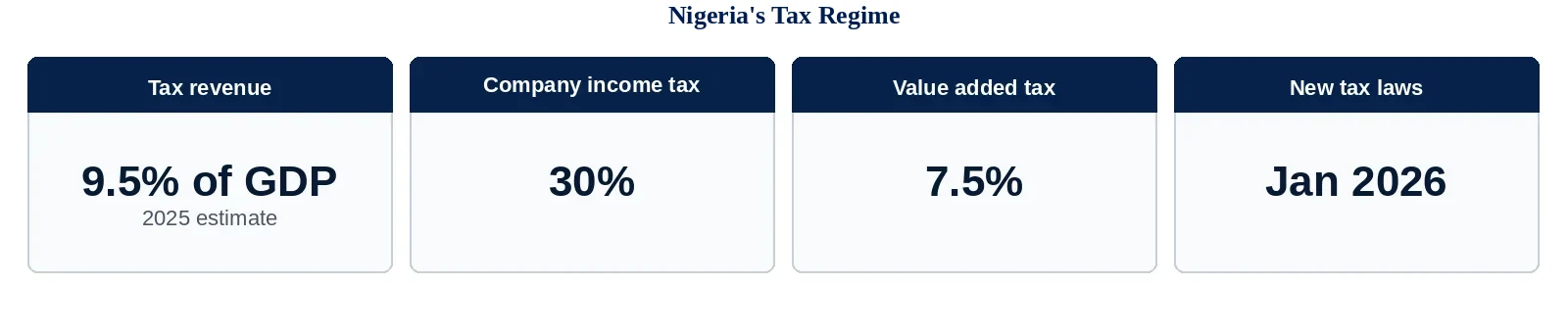
Nigeria began 2026 under a revised tax framework. Four federal tax laws have consolidated and replaced several statutes, established the Nigeria Revenue Service (NRS) and introduced common administrative provisions intended to reduce fragmentation. The laws took effect on 1 January 2026.
Tax revenue was estimated at 9.5 per cent of GDP in 2025. The ratio has improved but remains low in relation to public expenditure and infrastructure requirements. The burden has remained concentrated among businesses that the tax authorities can identify and assess. Informal economic activity and deficiencies in taxpayer records have continued to limit the reach of tax administration.
The company income tax rate remains 30 per cent for companies within the taxable threshold, while value added tax remains at 7.5 per cent. The reforms have widened relief for smaller businesses, expanded the treatment of input value added tax and removed overlapping provisions. The World Bank B-READY framework distinguishes among the quality of taxation rules, the public services available to taxpayers and the efficiency of tax administration in practice. For businesses, the operation of the revised framework has affected working capital, compliance costs, investment structures and decisions concerning the legal and geographical location of their operations.
Market Opportunity
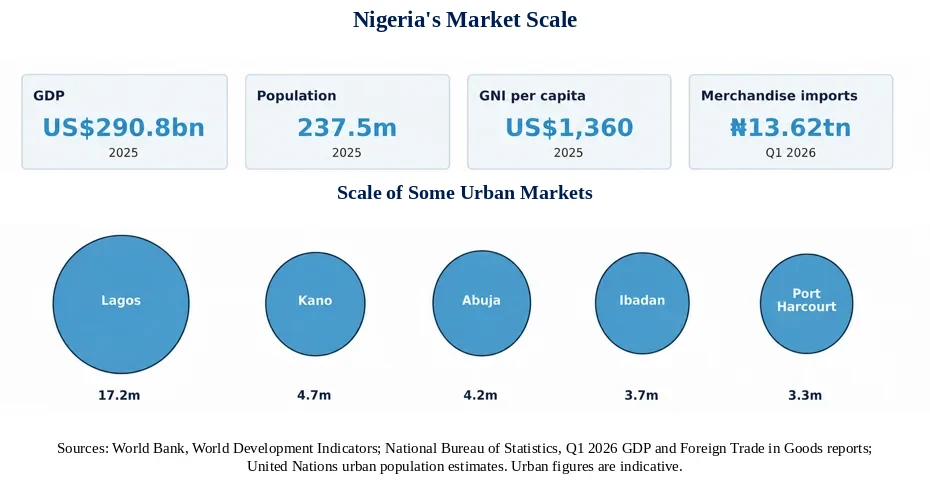
Nigeria offers market scale through a population estimated at 237.5 million in 2025 and an economy valued at approximately US$290.8 billion in current prices. Real GDP increased by 3.87 per cent in 2025 and by 3.89 per cent in the first quarter of 2026.
World Bank estimates placed GDP per capita at US$1,223 and Atlas method GNI per capita at approximately US$1,360 in 2025. Household purchasing power has remained constrained by the cumulative increase in prices since 2023, higher transport and distribution costs and the naira value of imported goods. A large population therefore coexists with low average income and substantial differences among households, states and cities. Commercial demand has remained concentrated in Lagos, Abuja, Kano, Port Harcourt, Ibadan and other urban centres, while access to smaller markets can require higher logistics, warehousing and distribution costs.
Household consumption has remained the major source of demand for food, communication, financial services, housing, transport, health care and consumer goods. Demand for imported products has also remained large. Merchandise imports amounted to ₦13.62 trillion in the first quarter of 2026 and were concentrated in machinery, transport equipment, chemicals, fuels and manufactured products. High imports can indicate unmet domestic production, but they do not ensure easy entry into the market. Foreign exchange availability, tariffs, customs processing, product registration and distribution networks determine whether demand can be served commercially.
The opportunity differs by sector. Telecommunications, finance, construction and selected digital activities recorded stronger growth than the national economy in the first quarter. Trade, agriculture, real estate and manufacturing provided much larger shares of output but expanded more slowly. Nigeria’s market opportunity has consequently remained substantial but uneven. Scale is strongest where firms can serve dense urban markets, adapt products to household incomes, manage distribution and secure local supply or foreign exchange for imports.
Infrastructure
Nigeria has expanded its infrastructure base, but the capacity available to firms has remained below installed capacity in several systems. The Nigerian Electricity Regulatory Commission (NERC) reported installed generation capacity of approximately 13,625 MW in April 2026, but only about 4,286 MW was available for dispatch. Plant availability was 31 per cent. Average hourly grid generation was approximately 4,453 MW in the fourth quarter of 2025. The gap reflects unavailable generation units, gas constraints, transmission limits and other operating conditions. Access to electricity does not establish that a firm receives uninterrupted supply. Electricity tariffs have moved towards cost recovery for customers receiving higher service bands. Firms that receive interrupted service have continued to deploy self-generation systems. The burden remains greatest for manufacturing, cold chain operations, health facilities and hospitality businesses.
Nigeria’s maritime trade is served by several port complexes, but cargo handling has remained concentrated by location, terminal function and commodity. The national port network comprises the Lagos Port Complex, Tin Can Island Port Complex, Lekki Deep Sea Port, Rivers Port Complex, Onne Port Complex, Delta Port Complex and Calabar Port Complex. These facilities do not provide equivalent capacity. Apapa and Tin Can Island have remained the major gateways for containerised imports, vehicles and general merchandise, while Lekki Deep Sea Port has increased container capacity within Lagos commercial corridor. The three ports have remained exposed to common constraints affecting the Lagos transport network, customs administration, warehousing and cargo distribution. Differences in capacity, shipping frequency and inland transport determine the cargo that each port can receive and the extent to which one facility can absorb traffic displaced from another.
Onne Port Complex performs a distinct national function. It supports container traffic, general cargo and offshore petroleum operations and serves firms operating in the Niger Delta. Rivers Port, Warri, Koko, Sapele and Calabar handle combinations of general cargo, liquid bulk, industrial materials and petroleum-related traffic. Their contribution to national logistics depends on navigational depth, terminal infrastructure, shipping frequency and road connections. These ports cannot be regarded as substitutes for the Lagos terminals merely because they possess available berths or record cargo activity.
Petroleum and gas exports depend on a separate network of pipelines, storage facilities and specialised terminals. Bonny, Forcados, Qua Iboe, Escravos, Bonga and other export terminals are connected to defined production systems. Container ports and general cargo terminals cannot absorb crude oil, condensate or liquefied natural gas exports without the required pipelines, storage and loading infrastructure.
Nigeria’s inland dry ports have not yet made a measurable contribution to national freight movement. Kaduna is operational, while Dala and Funtua have been commissioned but lack published cargo throughput data. Dala was still operating as a bonded terminal in September 2024 rather than exercising the full functions of a port of origin and final destination. The remaining approved facilities are not operational.
Badagry Deep Seaport was under implementation following federal approval but had not commenced commercial operations by mid-year 2026. Ondo Deep Seaport remains in procurement despite receiving business case approval, while Ibom Deep Seaport has recorded no recent progress beyond the procurement stage. These projects have therefore made no contribution to Nigeria’s operational port capacity during the assessment period. If completed, Badagry and Ondo would increase capacity in the South West, while Ibom would expand deep water capacity in the South South and reduce the geographical concentration of maritime activity.
Nigeria’s imports from Asia and the Middle East have remained exposed to disruption along the Red Sea and Suez route. Diversion around the Cape of Good Hope has lengthened delivery times and raised freight, insurance and inventory costs. Road transport carries most domestic freight. Rail services from port terminals and selected intercity routes have increased, but frequency, terminal integration and last mile connections remain limited. Air cargo supports high value and time-sensitive goods, while its cost limits use for bulk trade. Customs procedures can reduce processing time, although inspections, documentation and coordination among agencies remain material to actual clearance.
The Nigerian Communications Commission (NCC) recorded approximately 187.8 million active mobile subscriptions in April 2026. MTN and Airtel accounted for most subscriptions. Concentration among service operators means that technology decisions taken by the largest networks affect a substantial share of households and firms. Network infrastructure also depends on foreign systems, radio equipment, software, cybersecurity support and spare parts supplied by companies such as Ericsson and Huawei. Domestic hosting and interconnection capacity has increased through facilities in Lagos and other commercial centres but remains subject to foreign provider’s technology, commercial terms and international regulation. Export controls have added a source of exposure because access depends on product classification, end use and the identity of the end user. Nigeria’s strongest domestic capability lies in applications and services; its highest external exposure has remained in advanced hardware, proprietary software, specialised equipment, cloud platforms and replacement parts provided or authorised by the original manufacturer.
The World Intellectual Property Organization (WIPO) ranked Nigeria 105 of 139 economies in the 2025 Global Innovation Index. Business sophistication and knowledge outputs performed better than institutions, infrastructure and human capital. Innovation has been strongest in private applications and services, while basic infrastructure, research capacity and financing continue to constrain adoption across the country.
Infrastructure conditions support large scale activity in selected cities and corridors but have imposed additional cost on firms that require access to electricity, reliable freight carriage or service outside major commercial centres. The effect is visible in location decisions and the ability of domestic producers to compete with imported goods.
Legal System
Nigeria’s Constitution is supreme and vests judicial authority in federal and state courts. The Supreme Court is the final appellate court, while the Court of Appeal receives appeals from federal and state superior courts and from election tribunals. The Federal High Court has jurisdiction over matters assigned to the Federal Government, including taxation, banking, company regulation, intellectual property, customs, immigration and federal agencies. State High Courts retain jurisdiction over civil and criminal matters, while the National Industrial Court has authority over employment, labour relations and related disputes.
The World Justice Project gave Nigeria a Rule of Law score of 0.41 in 2025, ranking it 120 of 143 countries and 23 of 34 countries in sub Saharan Africa. Civil Justice scored 0.45 and ranked 104 globally and 16 in the region. The result indicates a legal system that is constrained by delay, cost, corruption, government influence and the enforcement of decisions. In its 2026 assessment, Freedom House awarded Nigeria 2 out of 4 for judicial independence and 1 out of 4 for due process in civil and criminal matters. Judicial independence has remained contested where judicial welfare, appointments, budgets or enforcement depend on authorities that may be parties to litigation. The constraint has affected decisions to use arbitration and the amount of time and capital a firm must reserve for litigation.
Nigeria’s constitutional and statutory framework recognises private enterprise, property ownership, enforcement of contracts, intellectual property, property rights and asset protection. The domestic framework for foreign investment is established by the Nigerian Investment Promotion Commission Act and the Foreign Exchange (Monitoring and Miscellaneous Provisions) Act. The NIPC framework permits foreign participation in sectors outside the negative list and provides guarantees concerning the transfer of dividends, profits, loan repayments and capital following liquidation. The NIPC Act also protects an enterprise against nationalisation or expropriation except where acquisition is undertaken for a national interest or public purpose, under a law that provides fair compensation and access to the courts. International investor protection has been reinforced by Nigeria’s participation in the International Centre for Settlement of Investment Disputes Convention (ICSID) and the New York Convention on the Recognition and Enforcement of Foreign Arbitral Awards. Nigeria was the first state to ratify the ICSID Convention and has remained an ICSID contracting state. It is also party to several bilateral investment treaties.
Section 26 of the NIPC Act provides for amicable settlement and permits unresolved investment disputes to proceed to arbitration. A foreign investor may invoke an applicable bilateral or multilateral investment agreement or another national or international dispute resolution mechanism agreed by the parties. Where the investor and the Federal Government disagree over the applicable method, the Act directs the dispute towards the ICSID Rules. This gives foreign investors an alternative to exclusive dependence on domestic court proceedings, but access to international arbitration is determined by consent, nationality, treaty coverage, the nature of the investment and the protections in the contractual or statutory provision.
The Arbitration and Mediation Act 2023 supports domestic and international arbitration and incorporates the New York Convention framework for recognising and enforcing foreign arbitral awards. Nigeria’s ratification of the Singapore Convention on Mediation in November 2023 has also strengthened the legal position of qualifying international commercial settlement agreements resulting from mediation. These developments have improved the compatibility of Nigeria with accepted international dispute resolution practice.
Arbitration does not completely eliminate enforcement risk. Nigerian courts may be required to grant interim measures, compel compliance with an arbitration agreement, recognise an award or permit execution against assets. Challenges based on jurisdiction, public policy, sovereign immunity or the identity of attachable assets can prolong recovery. Protection of the investing public in the securities market has been updated by the Investments and Securities Act 2025, which repealed the 2007 Act. The legislation establishes the Securities and Exchange Commission as the apex regulator of the Nigerian capital market and requires it to act in the public interest, protect investors and maintain fair, efficient and transparent markets. Its mandate extends to securities exchanges, public offers, collective investment schemes, capital market operators, custodians, clearing and settlement entities, credit rating agencies, digital asset operators, virtual asset service providers and online foreign exchange trading platforms. The Act prohibits market manipulation, misleading statements and insider dealing, while imposing reporting, internal control and disclosure obligations on public companies. The 2025 Act also requires securities exchanges to maintain investor protection funds. These funds may compensate investors for specified pecuniary losses arising from the insolvency, bankruptcy, negligence or defalcation of a licensed dealing member, or from the revocation or cancellation of an operator’s registration. Capital market disputes may be brought before the Investments and Securities Tribunal, which has jurisdiction over disputes involving the SEC, exchanges, capital market operators, public companies and investors.
Sector regulation has added further protection but has also increased legal complexity. Banks and other financial institutions are regulated by the Central Bank of Nigeria under the CBN Act and the Banks and Other Financial Institutions Act 2020, while insured deposits and failed bank resolution involve the Nigeria Deposit Insurance Corporation (NDIC). Banking supervision supports depositor and creditor confidence, but changes introduced through circulars, prudential directives, foreign exchange rules and supervisory interventions can materially affect shareholders and financial institutions. The Petroleum Industry Act 2021 established separate regulatory authorities for upstream, midstream and downstream activities. It provides a more comprehensive structure for licensing, commercial activities, host community obligations and investment decisions than the former petroleum legislation. The Electricity Act 2023 decentralised electricity regulation by permitting states to establish intrastate electricity markets and regulators, while NERC retains responsibility for interstate activities, the national grid, transmission, system operation and states that have not completed regulatory transfer. This has created new investment opportunities but may also produce different licensing, tariff and enforcement practices across states. Investors may therefore face both federal and state regulatory requirements depending on the geographical scope and technical configuration of a project. Telecommunications are regulated by the Nigerian Communications Commission through licensing, spectrum administration, competition regulation, service standards and consumer protection. Competition and merger issues also engage the Federal Competition and Consumer Protection Commission (FCCPC), while the Nigeria Data Protection Commission (NDPC) regulates personal data under the Nigeria Data Protection Act 2023.
The legislature is key to the legal protection of investment. Under the Constitution, legislative powers are vested in the National Assembly, comprising the Senate and House of Representatives. Its functions include lawmaking, representation, appropriation and oversight of public institutions. Through these powers, the National Assembly establishes regulatory agencies, defines their mandates, approves public expenditure, investigates regulatory conduct and determines the standards governing capital markets, banking, petroleum, electricity, competition, taxation and corporate activity.
Bureaucratic Capacity
Nigeria’s public administration combines institutions with strong technical capacity and services that remain slow, fragmented or unavailable outside major cities. Business registration, tax filing, selected permits and payments have become digitalised. Digital services can reduce administrative contact and processing time, but their effect depends on integration of records and whether an electronic approval is accepted by relevant authorities.
The World Bank Statistical Performance Indicator gave Nigeria a score of 69.1 in 2024. The Open Budget Survey gave Nigeria a transparency score of 31 out of 100 in its 2023 edition, below the global average. Budget documents are published, but delays, incomplete reporting and differences between recorded expenditure and financing have reduced the ability of firms and investors to access or rely on the published information.
Bureaucratic capacity affects licensing, customs, tax administration, procurement and access to official data. Processing time is often determined by the least integrated institution in a sequence. A business may complete federal registration but remain unable to operate until state and local approvals are obtained. The same issue appears where a digital application still requires physical verification or discretionary endorsement.
Corruption
Corruption affects business activity through public procurement, customs, permits, inspections and access to public contracts. Transparency International gave Nigeria a score of 26 out of 100 in the 2025 Corruption Perceptions Index and ranked it 142 of 182 countries. The World Justice Project gave Nigeria 0.33 for absence of corruption in 2025 and ranked it 118 globally. These are perceptions and indicators, showing that respondents and experts have continued to regard the misuse of public authority as a material constraint.
Nigeria has anti-corruption agencies, procurement rules and financial reporting obligations. Enforcement is politically contested. Investigations may be lengthy, recoveries may not be fully reconciled and cases involving politically connected persons can create concern about selective action. Firms must therefore assess the environment surrounding agents, public contracts, gifts, facilitation demands and third parties.
Sector Performance
The named sectors do not correspond exactly to every National Bureau of Statistics activity.
Healthcare
In Nigeria, a large unmet demand for health services coexists with low household income, limited insurance coverage and unequal geographical provision. Public and private hospitals, laboratories, imaging services, pharmacies and health technology providers serve a population of more than 237 million, but provision of services remains dependent on household out-of-pocket expenditure and the ability to pay, not on clinical need. Health insurance schemes remain largely underdeveloped. Pharmaceutical products and medical equipment are majorly imported, creating exposure to foreign exchange and product registration.
Nigeria’s progress towards universal health coverage remains limited in both service availability and financial protection. The WHO and World Bank UHC Service Coverage Index placed Nigeria at 47 out of 100 in 2023, below the global score of 71. Within West Africa, Nigeria performed below Cabo Verde at 71 and Ghana at 56, close to Senegal at 48 and Côte d’Ivoire at 46, but above Togo at 42 and Niger at 39. Continental comparators also performed more strongly, including Kenya at 57, Rwanda at 59 and South Africa at 74.
Health insurance coverage was reported at 12 per cent in November 2025, although another government estimate placed combined federal, state and vulnerable group coverage at 17 per cent. The variation reflects differences in programme coverage and enrolment, but both estimates show that most Nigerians have remained outside pooled health financing. Out-of-pocket payments account for approximately 75 per cent of health expenditure, while 15.8 per cent of multigenerational households incur health spending above 10 per cent of household expenditure, compared with a WHO African Region average of 9.4 per cent. Nigeria is also among the African countries where at least 15 per cent of the population faces catastrophic health expenditure. Expansion of insurance enrolment under the National Health Insurance Authority Act 2022 has therefore not yet displaced household payment as the principal means of accessing care.
Health received 5.2 per cent of Nigeria’s national budget in 2025, substantially below the 15 per cent commitment established by the Abuja Declaration. The 2026 budget proposal allocated ₦2.48 trillion to health, equivalent to 4.26 per cent of total proposed expenditure, although the government reported a 6 per cent share after excluding liabilities. The latest internationally comparable WHO expenditure data, which measure actual domestic government health expenditure rather than budget allocations, placed Nigeria at 4.31 per cent of total government expenditure in 2023. This was below Côte d’Ivoire at 6.58 per cent, Niger at 6.15 per cent and Cabo Verde at 13.79 per cent among West African peers. Nigeria also trailed Kenya at 8.65 per cent, Rwanda at 8.92 per cent and Namibia at 14.99 per cent among other African comparators. Namibia was effectively at the Abuja threshold, while Nigeria allocated less than one third of the committed proportion. Public health financing therefore remains below Nigeria’s continental commitment and the levels recorded by several regional and continental peers.
Nigeria's medical device market is projected to grow from US$414.8 million in 2025 to US$632.48 million by 2030, an 8.56 per cent CAGR, the largest such market in West Africa. The Federal Ministry of Health has committed US$1.2 billion to infrastructure and workforce development, and the Nigeria Sovereign Investment Authority is co-funding oncology and diagnostic capacity expansion.
Nigeria already produces an estimated 60 per cent of West African pharmaceutical output, and the federal government's Presidential Initiative for Unlocking the Healthcare Value Chain (PVAC) plans to commission at least 11 new pharmaceutical manufacturing projects in 2026, including diagnostic test kit facilities and a technology transfer agreement with Bayer for local family planning product manufacturing.
Approximately 70 per cent of medicines sold in Nigeria are still imported, Nigeria spent approximately US$643 million on pharmaceutical imports in 2024, and the National Drug Policy target of shifting to 70 per cent local production within five years represents an import substitution opportunity for manufacturers with local production capacity. The Central Bank of Nigeria's Healthcare Sector Intervention Facility has already channelled ₦100 billion in concessional financing to local pharmaceutical manufacturers, and four pharmaceutical companies ranked among the ten best performing stocks on the Nigerian Exchange in 2025, a signal that market investors priced in this shift.
Nigeria's digital health ecosystem grew from 63 startups pre-pandemic to 128 active companies mid-2026, with cumulative venture and private equity funding of approximately US$147 million across 52 funded companies. But the funding trajectory illustrates a boom correction pattern rather than steady growth: annual funding fell more than 67 per cent, from a pandemic-era peak to approximately US$18 million in 2024 and roughly US$3 million in 2025. The collapse of 54gene, a genomics startup that raised US$45 million before shutting down in 2023, has become a reference case for the sector's difficulty in converting seed stage funding into scaled businesses, a pattern a 2025 health economics review attributes to regulatory friction, infrastructure gaps, market barriers, and talent constraints rather than a lack of addressable need.
Nigerians spent an estimated US$151.5 million, US$189.4 million, and US$208.4 million on health-related overseas travel in the first three quarters of 2025 respectively, an annualised rate approaching US$700 million to US$750 million. The expenditure indicates substantial demand for advanced diagnostics, oncology and specialist surgical procedures, although overseas treatment may also reflect patient preference, referral practices and perceptions of service quality.
Several developments have reduced some of the risks associated with private capital deployment. CBN’s Healthcare Sector Intervention Facility provides below-market financing specifically for local pharmaceutical manufacturing capacity. Nigeria’s accession to African Medicines Agency and continued AfCFTA implementation extend the total addressable market for Nigerian-based manufacturers from a domestic population of approximately 230 million to a regional market approaching 460 million, a scale argument the federal government has used to court manufacturers. The PVAC/IMPACT initiative functions as a coordinating mechanism between government, development partners, and private pharmaceutical manufacturers. And demographically, Nigeria's population scale and growth rate provide a demand base that remains underexploited relative to its size.
Agriculture
Agriculture remains Nigeria's largest source of employment and a major pillar of the non-oil economy, historically contributing approximately 28 per cent of GDP over 2021–2024 and employing an estimated 40 per cent of the labour force. Crop production accounts for roughly two-thirds of agricultural output, with livestock, fishing, and forestry comprising the remainder. Real sector GDP growth strengthened to 3.15 per cent year-on-year in Q1 2026, from 0.07 per cent a year earlier.
The country provides a large domestic market for food, agricultural processing, farm inputs, machinery and logistics. Productivity remains constrained by smallholdings, limited mechanisation and weak logistics systems. Conflict between farming communities and pastoralist herders, concentrated in the Middle Belt states of Benue, Plateau, Nasarawa, Taraba and Kaduna and increasingly present in the North West and parts of the South, has continued to constrain activity in some of the country's agricultural belts.
Agricultural commodities made a substantial contribution to non-oil exports in 2025. Crop production remained the dominant activity. Cocoa beans generated US$1.99 billion, cashew nuts US$456.9 million and sesame seeds US$300.3 million. Export earnings, nevertheless, remain concentrated in raw or minimally processed commodities, limiting domestic value addition.
Nigeria's fiscal commitment to agriculture remains well below the target to which it committed under the 2003 Maputo Declaration. The sector received approximately 1.75 per cent of the 2025 national budget, against the 10 per cent threshold. The IMF's 2026 Article IV Consultation assessed that food insecurity is likely to worsen further. In response, the federal government declared a state of emergency on food security in July 2023, authorising the release of grain reserves, and has directed subsidised inputs to wheat producers under the National Agricultural Growth Scheme–Agro-Pocket Project.
The African Development Bank facilitated US$2.2 billion in capital mobilisation for Phase II of Nigeria's Special Agro-Industrial Processing Zones (SAPZ) initiative at the December 2024 Africa Investment Forum. In March 2026, the World Bank approved a US$500 million International Development Association (IDA) credit for the Nigeria Sustainable Agricultural Value-Chains for Growth (AGROW) Project, designed to attract an additional US$220 million in agribusiness investment over the six-year programme.
The sector has attracted renewed multilateral, public and private financing, particularly in fertiliser manufacturing and agro-industrial processing. Nigeria's two largest fertiliser producers have announced a combined US$3.75 billion in capacity expansion commitments. Existing production has made Nigeria a net urea exporter, while federal officials target export hub status by 2028. Urea exports generated US$1.29 billion in 2025, while Indorama and Dangote Fertiliser were the two largest non-oil exporters by value. Nigeria has more than 90 operational fertiliser blending plants, and the Presidential Fertiliser Initiative targeted 1.1 million tonnes of fertiliser in 2026, with 449,000 tonnes of inputs secured by May. Agro-industrial processing also expanded through the US$538 million Special Agro-Industrial Processing Zones programme. Construction has commenced in Phase I states, while the US$1.107 billion first tranche of Phase II covering ten additional states has been approved but has not yet added processing capacity.
Under the 2026 Fiscal Policy Measures and Tariff Amendments, effective April 2026, Nigeria began phasing out import adjustment taxes on a range of agricultural imports, including reducing the additional duty on wheat imports from 15 per cent to zero and reducing duties on rice, animal feed and live breeding animals, while maintaining import prohibitions on 73 product categories. Nigeria has also adopted the CAADP Kampala Declaration (2026–2036) framework, committing to accelerated agro-industrialisation and reduced post-harvest losses.
The commercial phase of the US$1.1 billion Nigeria–Brazil Green Imperative Project was signed in March 2025, providing for 10,000 tractors and 50,000 units of agricultural equipment to be assembled in Nigeria. The bilateral programme also includes a US$2.5 billion JBS livestock and agricultural supply chain investment, although no completed processing facilities had been confirmed by mid- 2026.
Beyond inputs, private capital is increasingly organised around the SAPZ framework and related financing vehicles. In March 2025, a coalition of private investors presented the federal government with a privately led Large-Scale Agribusiness Financing Programme framed around industrial-scale production and food sovereignty. A distinct investment track has grown around financial technology services for smallholders and commodity market infrastructure. Firms including ThriveAgric, Babban Gona and Crop2Cash operate vertically integrated contract farming models, providing inputs on credit, technical support and guaranteed offtake. Babban Gona reports that it is the largest maize-producing enterprise in West Africa by volume and that loan repayment rates among its smallholder network exceed 99 per cent. Nigeria's commodity exchanges, including AFEX, the Nigeria Commodity Exchange, Lagos Commodities and Futures Exchange and Gezawa Commodity Market, received a stronger statutory foundation for warehouse receipt financing under the Investments and Securities Act 2025, which formalises Securities and Exchange Commission oversight of registered warehouses and receipt trading.
Aerospace
Commercial aviation connects Nigeria’s major cities with regional and international markets, but passenger demand remains sensitive to fares and household income. Aircraft, engines, navigation systems and most components are imported. The Civil Aviation Act 2022 and Nigeria Civil Aviation Regulations 2023 govern airline operations, aircraft maintenance, aerodrome certification, economic activities and remotely piloted aircraft systems.
Nigeria recorded over 10 per cent growth in air transport in the year to mid-2026, with the Federal Airports Authority of Nigeria (FAAN) reporting more than 10.5 million domestic passengers and confirming Nigeria's position as Africa's second largest domestic passenger market. Murtala Muhammed International Airport (MMIA) in Lagos recorded 11.8 per cent growth in air traffic in 2025, the highest among Africa's leading airports, and by June 2026 Nigeria's domestic seat capacity had grown 21.7 per cent year-on-year, the fastest rate recorded on the continent.
This growth, however, is built on a comparatively small fleet base. Nigerian airlines typically operate five to ten active aircraft each. An estimated 16 million passengers were carried in Nigeria in 2024. This remained below the passenger volumes reported for the Ethiopian and South African aviation markets. Lagos accounts for close to half of Nigeria's passenger traffic, at approximately 7 million passengers, followed by Abuja at nearly 5 million, indicating that growth remains geographically concentrated even as new entrants proliferate. At least seven state governments, including Akwa Ibom, Cross River, Enugu and Bayelsa, with Ogun, Anambra and Lagos at earlier stages, have collectively invested an estimated ₦500 billion in state-owned or state-backed carriers since Akwa Ibom launched Ibom Air in 2019.
Federal commitments over the past eighteen months have concentrated on regulatory reform and flagship infrastructure rather than fleet or airline ownership. In April 2026, the Minister of Aviation and Aerospace Development received Nigeria's first externally developed Civil Aviation Master Plan (CAMP) from ICAO, a 20-year framework (2025–2045) aligned with national development planning. In 2025, the government approved ₦987 billion for aviation infrastructure, of which ₦712.26 billion was allocated to the MMIA redevelopment, covering terminal reconstruction and apron expansion within a 22-month implementation period. Nigeria's adoption of the Cape Town Convention and the Irrevocable Deregistration and Export Request Authorisation (IDERA) framework is intended to improve aircraft leasing and financing. The reform was highlighted at the April 2026 Nigeria Aircraft Acquisition and Investment Summit as important to attracting additional private capital.
Domestic maintenance of aircraft systems remains under development. The maintenance, repair and overhaul (MRO) facility at Victor Attah International Airport, Akwa Ibom State, had been substantially completed, but commercial operations had not commenced by mid-2026. The state government expected the facility and associated aviation infrastructure to enter operation during 2026. The Air Peace maintenance facility at Murtala Muhammed International Airport, developed with Embraer of Brazil, Fidelity Bank and the Bank of Industry, commenced construction in September 2025 and is scheduled for completion within 24 months. Air Peace estimates that the facility could create more than 50,000 direct and indirect jobs and save the aviation industry more than ₦180 billion annually in offshore maintenance expenditure. The Air Peace project will provide an additional measure of Nigeria's capacity to complete and operate a major domestic maintenance, repair and overhaul facility.
Information & Communications Technology
Information and communications represented 11.31 per cent of real GDP and grew by 10.98 per cent in the first quarter of 2026. Mobile, internet and broadband subscriptions provide national scale for payments, commerce, media, software and digital services. The Nigerian Communications Commission (NCC) recorded approximately 187.8 million active mobile subscriptions in April 2026, with MTN and Airtel accounting for 85.8 per cent. This concentration has given the two operators substantial influence over network investment, pricing and service quality. Nigeria's National Broadband Plan for 2020 to 2025 set a target of 70 per cent broadband penetration by December 2025. Actual penetration reached 50.58 per cent, a shortfall of close to twenty percentage points representing tens of millions of Nigerians who were expected to have broadband access and do not. A constraint behind this gap is the cost and complexity of obtaining rights of way for fibre deployment, including differences in charges and approval procedures among transit states that have made it considerably cheaper to carry fibre traffic from Lagos to London than from Lagos to Abuja.
The Nigerian Communications Act 2003 remains the major telecommunications legislation, while the Nigeria Startup Act 2022 and Nigeria Data Protection Act 2023 regulate startup support, personal data processing and digital business compliance. The Nigerian Communications Commission has since opened public consultation on a new National Telecommunications Policy for 2026, intended to update the regulatory framework for the current market structure.
Satellite communications infrastructure includes NigComSat-1R, launched in 2011 and operated by NIGCOMSAT, together with domestic teleport, network operations and VSAT installations supporting broadband, broadcasting, mobile backhaul, navigation and government communications. Licensed gateway earth stations in Lagos, Kano and Tarau also connect Nigeria to Avanti, Intelsat and Starlink satellite systems. This extends coverage beyond terrestrial networks but retains dependence on foreign constellations, terminals and specialist equipment. Financing discussions commenced in February 2026 for the approved NIGCOMSAT 2A and 2B satellites, although neither had been deployed by mid-2026. The Nigerian Communications Commission also opened consultation on direct-to-device satellite connectivity in January 2026, but no final licensing or spectrum framework had been adopted by 30 June.
Project BRIDGE moved into financing, investor selection and network design during the first half of 2026. The planned 90,000-kilometre open access fibre network had secured US$800 million in government financing by April 2026, comprising US$500 million from the World Bank, US$200 million from the African Development Bank and US$100 million from the European Bank for Reconstruction and Development. A €22 million European Union grant provided additional support. The Nigeria Universal Communication Access Project also sought private investors for 3,700 communications sites in underserved communities. Neither programme had begun large-scale deployment by mid-2026.
Nigeria participates in transcontinental digital infrastructure through the 2Africa and Equiano submarine cable systems. 2Africa connects Africa, Europe and Asia through landing points in Lagos and Akwa Ibom, while Equiano connects Nigeria with Europe and Southern Africa. These systems increase international bandwidth and route diversity, although their economic effect depends on domestic fibre networks, data centres, wholesale capacity and access to internet services.
Nigeria's data centre market was valued at approximately US$288 million in 2025 and is projected to reach US$1.09 billion by 2031, a growth rate of approximately 25 per cent annually, with around 20 to 28 colocation facilities now operating or under construction, concentrated mainly in Lagos. Investment is increasingly oriented toward artificial intelligence workloads: Airtel's Nxtra facility, expected to become operational by the end of 2026, will be the first of five planned hyperscale data centres across Africa and the largest data centre in Nigeria on completion, while Kasi Cloud is developing a 100-megawatt, purpose-built artificial intelligence focused hyperscale campus spanning 42 hectares. Equinix has committed US$100 million to its Africa expansion, including a US$22 million facility in Lagos which opened in early 2026.
The sector has one of the strongest growth positions in the economy, but it remains constrained by unreliable electricity, uneven fibre coverage, service quality, foreign exchange costs for imported equipment and the concentration of investment in major cities.
Financials
Finance and insurance accounted for approximately 3.76 per cent of real GDP and grew by 8.54 per cent in the first quarter of 2026. Digital payments, fintech, pension assets and capital market activity have expanded, but financial intermediation remains constrained. Private sector credit was approximately 12 per cent of GDP in 2025. High sovereign yields, the 45 per cent Cash Reserve Ratio and an increase in non-performing loans to 8 per cent have continued to restrict lending to firms and households.
The Banks and Other Financial Institutions Act 2020 remains the principal legislation for banks and other institutions regulated by the Central Bank. The Investments and Securities Act 2025 repealed the 2007 Act and strengthened the Securities and Exchange Commission’s authority over capital raising, market conduct, digital assets and prohibited investment schemes. The Nigerian Insurance Industry Reform Act 2025 consolidated the principal insurance legislation, while pension activity remains governed by the Pension Reform Act 2014.
The major financial regulators have each issued recapitalisation requirements for their respective industries within the same time window, representing an unusual degree of simultaneous reform across the financial sector and producing different outcomes to date. The Central Bank of Nigeria's March 2024 circular set a 24-month compliance window, from 1 April 2024 to 31 March 2026, requiring international commercial banks to hold ₦500 billion in capital, national commercial banks ₦200 billion and regional commercial banks ₦50 billion, with lower thresholds for merchant and non-interest banks. The recapitalisation exercise concluded after ₦4.65 trillion was mobilised over the two-year period, with 33 of 37 banks meeting the revised requirements. The National Pension Commission announced in September 2025 that pension fund administrators and custodians must recapitalise, raising minimum capital for administrators on a tiered basis tied to assets under management (AUM). The original December 2026 deadline was subsequently extended by six months to June 2027. The Nigerian Insurance Industry Reform Act 2025 gave the National Insurance Commission a comparable mandate, with insurance companies required to meet new minimum capital requirements by July 2026 or face loss of their operating licence. The reform is proceeding alongside complementary measures, including a new Insurance Policyholders Protection Fund, mandatory recording of the National Identification Number on insurance policies and a partnership with the Bureau of Public Procurement to integrate insurance bonds, including bid bonds, performance bonds and advance payment guarantees, into government procurement processes. The Securities and Exchange Commission is pursuing a parallel recapitalisation of capital market operators, with a final deadline of June 2027, under the authority of the Investments and Securities Act 2025, which market participants described as a major overhaul of Nigeria's securities legislation.
The banking sector's recapitalisation drew a large and, by regional standards, unusually global response. International investors contributed 27.45 per cent of total recapitalisation capital, and foreign capital inflows into the banking sector rose 93.25 per cent year-on-year to US$13.53 billion in 2025, representing 58.26 per cent of Nigeria's total foreign capital importation of US$23.22 billion that year. This activity coincided with an extraordinary run in the equity market. The NGX All-Share Index closed 2025 at 155,613 points, a 51.2 per cent annual gain and Nigeria's strongest equity market performance in nearly two decades, before climbing further to a record 201,287 points by 31 March 2026, a 29.35 per cent gain within a single quarter, with total market capitalisation expanding from approximately ₦62.8 trillion to ₦100 trillion within twelve months.
Nigeria's pension assets reached a record ₦31.32 trillion in May 2026, and pension fund administrators increased their exposure to the equity market that the banking recapitalisation helped fuel: holdings of domestic ordinary shares rose from ₦3.96 trillion at the end of 2025 to ₦5.46 trillion by March 2026, a 38.09 per cent year-to-date increase, alongside a 49.4 per cent year-on-year rise in infrastructure fund exposure to ₦242.8 billion in the first half of 2025. At the same time, the sector's recapitalisation drive is expected to trigger consolidation, given that most pension fund administrators entered the process undercapitalised relative to the new threshold.
By contrast, the insurance sector's response has so far been limited. By June 2026, only 20 of 58 insurers had submitted their capital for verification ahead of the July 2026 compliance deadline, and the underlying market forces remain structurally shallow, with insurance penetration below 1 per cent. Nigeria is among Africa’s five largest insurance markets by aggregate premium income, but insurance penetration remains limited relative to the size of the economy and population. Across Africa, insurance premiums averaged 3.5 per cent of GDP at the end of 2023, while South Africa recorded 11.5 per cent. The Nigerian market’s limited penetration restricts premium income, the size of insurers’ investment portfolios and the investment proposition available to prospective shareholders. The comparatively limited response in insurance reflects low market penetration, restricted premium income and uncertainty over the returns available on the additional capital required. With insurance penetration below 1 per cent, the recapitalisation requirement has not attracted capital on the scale recorded in banking.
The Nigerian equity market recorded strong nominal growth. The NGX All-Share Index reached 250,385.47 points in May 2026, an increase of 124.1 per cent from May 2025. This exceeded the corresponding gains recorded by the Egyptian Exchange, the BRVM, the Johannesburg Stock Exchange and the Casablanca Stock Exchange, but remained below the 133.4 per cent increase recorded by the Ghana Stock Exchange. Domestic equity market capitalisation on NGX stood at approximately US$139.7 billion in May 2026. It was considerably smaller than the Johannesburg Stock Exchange at US$1.44 trillion, but exceeded Casablanca at US$117.7 billion, Egypt at US$68.9 billion, the BRVM at US$29.1 billion and Ghana at US$23.9 billion. Market liquidity remains comparatively limited: equity trading on NGX amounted to US$606.7 million in May, compared with US$28.4 billion in Johannesburg and US$3.23 billion in Egypt. The market therefore combines considerable valuation growth with lower trading depth and fewer listed companies than the principal exchanges in South Africa and Egypt.
Nigeria's financial technology sector is one of the most developed segments of the country's financial system when assessed by capital raised and transaction volume. Flutterwave's acquisition of Mono, Moniepoint's acquisition of a Kenyan microfinance bank and Carbon's acquisition of Vella Finance all indicate that larger entities are acquiring smaller competitors as funding conditions tighten.
Mining
Nigeria's solid minerals sector remains small in absolute GDP terms, contributing under 2 per cent of national output despite a resource base comprising more than 44 commercially viable minerals across more than 500 locations, but it is now one of the fastest-growing segments of the economy. Solid minerals exports of ₦354 billion in 2025 represented roughly 0.4 per cent of total exports and about 3 per cent of non-oil exports, well below the nearly 5 per cent share that mining held in Nigeria's total exports in the years immediately following independence. The Minister of Solid Minerals Development reported in October 2025 that the solid minerals sector contributed 1.8 per cent to GDP, up from under 0.5 per cent a decade earlier, while the Solid Minerals Development Fund has described the sector as still contributing less than 1 per cent of GDP, a discrepancy that may reflect differences in statistical framework, reference period and treatment of informal production, as well as the sector's comparatively underdeveloped statistical reporting relative to oil and gas.
The Ministry of Solid Minerals Development has pursued a Seven-Point Agenda since 2023 centred on reform, transparency, investor confidence and local value addition, with a target of raising the sector's GDP contribution to 3 per cent by 2030. A key feature of this reform has been what officials describe as cooperative federalism, under which states have been encouraged to apply for mining licences and operate through limited liability companies, resulting in joint venture investments. The Solid Minerals Development Fund launched its Early-Stage Mineral Exploration and Research Grant Endowment in June 2026, described as Nigeria's first competitive funding programme dedicated to geoscience research, offering exploration funding, critical minerals research support and investment readiness training. Government reform has also extended to actions against illegal mining and unlicensed artisanal activity.
At the continental level, Nigeria's push for local value addition led to the formation of the Africa Minerals Strategy Group, with Minister Alake elected as its first chairman. Bilaterally, the July 2024 Commercial and Investment Partnership with the United States opened a further channel for commercial and investment cooperation. Under the partnership, Nigeria was described as the United States' second largest African trading partner, while bilateral trade in goods and services reached nearly US$13 billion in 2024, although critical minerals were not explicitly identified as a formal workstream in the published structure. Officials report approximately US$2.6 billion in investment commitments since the 2023 reforms began, including what is described as the largest single mining investment in Nigerian history: a US$1.3 billion alumina refinery with planned annual capacity of 1.5 million tonnes, alongside a further US$400 million rare earth metals facility reported to be under development.
Lithium has become a prospective source of sector growth, supported by international demand for electric vehicle batteries. The Federal Government has announced plans to inaugurate in July 2026 a lithium processing plant in Nasarawa State owned by Diamond New Energy Company, with a capacity of 6,000 metric tonnes per day. A separate US$200 million lithium processing plant in Zamfara State was also reported to be under development as a joint investment involving Zam Mining Company, Bima Mines, Jinlide Mining Company and other partners. Chinese firms are already established in the country's lithium supply chain, consistent with Chinese upstream acquisitions of African critical minerals assets, including investments documented across Botswana, Mali and Tanzania.
Insecurity remains an issue where mineral wealth is concentrated. Armed groups in Zamfara, Niger and Kaduna states frequently target mining operations, disrupting production, threatening worker safety and deterring both local and foreign investors from fully committing to projects in these areas. Illicit mining networks are both a consequence of weak state control and a reported source of revenue for militia groups.
Lithium and other critical minerals could support sector growth where processing projects become operational, security conditions improve and investment commitments result in completed facilities. The government's 3 per cent GDP target by 2030 will depend on sustained sector growth for several more years and on addressing the security constraints in the same mineral-rich states now attracting investment. The government's enforcement campaign against illegal mining, while a necessary complement to strengthening the sector, also carries the risk of disruption in the short term for informal miners who continue to supply a share of the sector's output.
Energy
Nigeria remains a major petroleum and gas producer. The oil sector grew by 2.57 per cent in the first quarter of 2026 and accounted for approximately 3.92 per cent of real GDP in Q1 2026. The sector accounted for 3.44 per cent in Q3 2025, up marginally from 3.38 per cent a year earlier, while its annual real GDP share declined from 5.67 per cent in 2022 and 7.24 per cent in 2021, as non-oil sectors including agriculture, telecommunications, and financial services have grown faster than oil and gas. Despite this modest and declining GDP share, oil remains central to Nigeria's fiscal position, generating over 80 per cent of the country's foreign exchange earnings and underpinning the naira's stability and the government's external financing capacity. Electricity and renewable energy do not have a separate and directly comparable GDP figure in Nigerian national accounts, but the World Bank has estimated that chronic power shortages cost the economy the equivalent of 5 to 7 per cent of GDP annually in lost productivity and forgone investment, a scale of drag that arguably makes the electricity sector's economic significance larger than accounting contribution suggests.
The Petroleum Industry Act 2021, together with recent executive orders, was associated in official statements with US$16 billion to US$17 billion in investment commitments reported for 2024, although this was a sector-wide figure and cannot be attributed solely to indigenous operator participation. NNPC announced plans in January 2026 to raise at least US$30 billion by 2030 to develop new oil fields, scale domestic production and expand gas infrastructure, alongside a continuing production target of 1.8 million barrels per day in 2026 and 2 million barrels per day by 2027 against output averaging 1.62 million barrels per day in 2025. The gap is associated with oil theft, pipeline sabotage, ageing infrastructure, field decline and underinvestment. Fuel subsidy removal, in effect since 2023, was estimated by federal revenue officials, under a high oil price scenario, to have prevented subsidy expenditure from consuming up to 76 per cent of the 2026 budget. Gross external reserves were estimated by the Central Bank of Nigeria at US$45.01 billion at the end of 2025, compared with US$40.19 billion at the end of 2024, reflecting stronger foreign exchange inflows and foreign exchange reforms rather than subsidy removal as the sole factor.
Nigeria's power sector was partially privatised in 2013, with generation and distribution companies largely in private ownership, while the Transmission Company of Nigeria retains responsibility for the transmission network and the Nigerian Independent System Operator performs system operation and market administration. The Nigerian Electricity Regulatory Commission's Band A tariff framework, introduced to stabilise distribution company finances, raised tariffs by approximately 231 per cent, from about ₦68 to ₦225 per kilowatt hour, before subsequent reductions and distribution company-specific adjustments; the approximately ₦2.4 trillion figure refers to total distribution company revenue rather than revenue generated solely by Band A customers. To address a legacy debt exceeding ₦4 trillion owed to generation companies, the government raised ₦501 billion in bonds in early 2026 and initiated an ₦3.3 trillion payment plan, with the ₦501 billion issuance constituting the inaugural tranche; further financing remained prospective as of 30 June 2026. The Central Bank of Nigeria has separately provided financing through several electricity-market, infrastructure and metering intervention facilities since the privatisation era, and the Presidential Power Initiative, developed in partnership with Siemens, has begun a phased transmission and grid upgrade programme. The Electricity Act 2023 permits states to regulate intrastate electricity markets while the Nigerian Electricity Regulatory Commission retains responsibility for interstate and international operations. By May 2026, regulatory authority had been transferred to 15 states. This has expanded opportunities for state electricity markets, embedded generation, distribution investment and renewable energy, but electricity supply remains constrained by insufficient generation delivered to users.
Renewable energy, by contrast, is one of the sector's fastest growing and most privately financed segment. Nigeria's renewable energy market is projected by market estimates to grow from US$4.8 billion in 2026 to over US$22 billion by 2035, but the figures are not official national statistics. Nigeria's Renewable Energy Master Plan targeted raising the renewable share of electricity generation from 13 per cent in 2015 to 23 per cent by 2025 and 36 per cent by 2030, and industry reporting has cited a long-term objective of 209,000 megawatts of total power capacity by 2050, alongside a prospective US$11 billion pipeline of 53 large-scale solar projects. The public programme is the Distributed Access through Renewable Energy Scale-Up initiative, a US$750 million World Bank-supported programme implemented by the Rural Electrification Agency, targeting access to electricity for 17.5 million Nigerians through 3,244,900 households, sales of more than one million solar systems and 1,225 mini-grids by 2028, and designed to draw in a further US$1.1 billion in private investment through a results-based financing model. The Nigerian Electricity Regulatory Commission's Mini-Grid Regulations 2026 expanded allowable mini-grid capacity from 1 megawatt to 5 megawatts for isolated systems and 10 megawatts for interconnected systems, materially improving the economics of commercially viable off-grid projects.
Seplat Energy completed a US$1.28 billion acquisition of ExxonMobil's shallow-water offshore business, Mobil Producing Nigeria Unlimited, in December 2024, creating an enlarged portfolio with 11 oil blocks, 48 fields, three export terminals and five gas processing facilities. The transaction was one of the largest recent examples of the divestment of Nigerian assets by international oil companies to indigenous operators. TotalEnergies and Sapetro signed a production sharing contract in September 2025 for the offshore PPL 2000 and PPL 2001 exploration licences awarded through the 2024 exploration round. The Dangote Petroleum Refinery, Africa's largest single-train refinery at 650,000 barrels per day capacity, contributed to a substantial reduction in refined petroleum imports in 2025, though it continues to import a significant share of its crude feedstock from the United States, Brazil, Angola, Equatorial Guinea, Algeria and other suppliers, despite Nigeria producing sufficient crude to meet the refinery's needs domestically. This reflects crude availability, contractual terms, domestic supply obligations, commercial pricing and producer export preferences.
Private capital in renewable energy has increased substantially alongside the Distributed Access through Renewable Energy Scale-Up (DARES) programme. Nigeria reported approximately US$425 million in commitments in 2025 for eight domestic renewable energy manufacturing facilities, and a group of Nigerian off-grid developers secured US$83 million in IFC-backed financing under DARES in April 2026. United Capital deployed a ₦5 billion revolving facility to Husk Power Systems, described as the largest naira-denominated mini-grid debt financing to date. InfraCredit has guaranteed off-grid projects including CEESOLAR through its Clean Energy Funding Programme, and FCMB partnered with the Rural Electrification Agency on a ₦100 billion credit programme targeting two million households. Nigeria added 803 megawatts of solar capacity in 2025, bringing total installed solar capacity to approximately 1,019 megawatts. Firms such as Auxano Solar now hold international certification and have developed capacity to serve regional markets, including reported exports to Ghana.
Evidence of private capital supporting electricity supply outside the national grid is visible in Abia State, where Geometric Power's 188-megawatt independent plant and distribution network supplied parts of the Aba electricity market during the national grid collapse of January 2026. The Nigerian Electricity Regulatory Commission recorded one 30-megawatt embedded-generation licence, three captive-generation permits totalling 72.10 megawatts and 20 mini-grid permits totalling 5.89 megawatts in the third quarter of 2025. These approvals form part of a trend of commercial and industrial users adopting self-generation options above 1 megawatt to reduce exposure to interruptions in the national grid. Corporate embedded solar capacity has also increased. Daystar Power signed an agreement to install and operate a 4.2-megawatt system with battery storage at Nigerian Breweries in Lagos while Seven-Up Bottling contracted 10.5 megawatts across five factories.
Oil and gas is likely to remain central even as its GDP share continues to shrink in relative terms. The Dangote refinery's full impact, which the IMF estimated could add 1.5 percentage points to overall GDP growth in 2025 and later identified as contributing to lower refined fuel imports and a stronger current account in 2025, depends on resolving the domestic feedstock allocation problem, not merely on refinery capacity. The national grid's near-term outlook remains constrained because debt payments and tariff reform have not yet reversed the interruptions recorded through mid-2026, while payment shortfalls, subsidy obligations and incomplete remittances remain unresolved. Renewable energy and off grid power have recorded increased private financing and regulatory activity, although they remain smaller in output than petroleum and grid electricity.
Real Estate, Construction & Infrastructure
Real estate's reported GDP contribution changed markedly following the National Bureau of Statistics' GDP rebasing exercise. The sector contributed approximately 5.20 per cent to real GDP in Q1 2024 under the 2010 base-year series, while the rebased national accounts placed real estate at 10.78 per cent of GDP in 2024. Rather than a proportional increase in underlying economic activity, the jump should not be read as a like-for-like growth signal without accounting for the rebasing effect. Real estate's nominal quarterly contribution reached approximately ₦16.42 trillion in Q1 2025, while the rebased national accounts placed the sector as Nigeria's third largest activity, behind crop production and trade and ahead of crude petroleum and natural gas. Construction, a related but statistically distinct national accounts category, is forecast by GlobalData to grow by 3.1 per cent in real terms in 2026, with real estate business activities rising 3.4 per cent year-on-year in Q4 2025, following 3.5 per cent in Q3 and 3.8 per cent in Q2 2025.
The housing deficit remains large. Estimates range from 14.9 million to 28 million units depending on methodology, a range wide enough to complicate investment planning, though every estimate implies a multi-decade delivery gap at current construction rates. Construction costs remain exposed to currency volatility, though a shift toward local material substitution is providing some relief. Mortgage finance remains underdeveloped relative to the housing deficit it would need to address. Long-standing sector estimates place Nigeria's mortgage-to-GDP ratio below 1 per cent, while commercial mortgage interest rates have frequently exceeded 20 per cent, leaving home loans prohibitively expensive for most Nigerian households, even where housing supply exists.
The public mortgage institution has been under-capitalised for years. The Federal Mortgage Bank of Nigeria, the country's public housing finance institution, disclosed in February 2026 that its paid-up capital stood at only ₦2.56 billion. Its ₦2.56 billion paid-up capital against a proposed ₦750 billion recapitalisation target shows a gap between the scale of the housing finance mandate and the resources historically allocated to it. The Nigeria Mortgage Refinance Company, a public-private partnership established in 2013 between the Federal Government and private financial institutions, operates a ₦440 billion Federal Government-guaranteed bond programme and listed a further ₦11.5 billion corporate bond on the FMDQ Securities Exchange in May 2026 to strengthen mortgage liquidity.
The MOFI Real Estate Investment Fund, sponsored by the Ministry of Finance Incorporated, is designed as a ₦1 trillion programme with a 99-year fund life and mortgages offering repayment tenors of up to 25 years at targeted interest rates of 11 to 12 per cent, and has raised ₦250 billion to date across two funding phases. The fund's structure is to mobilise long-term capital for mortgage finance and provide off-take support through participating institutions, with an objective of supporting financing for up to 1 million homes over time.
Nigeria's National Integrated Infrastructure Master Plan targets raising the country's infrastructure stock to 70 per cent of GDP by 2043, and the 2025 federal budget contained substantial infrastructure-related capital allocations, with the 2026 budget proposal assigning ₦3.56 trillion to infrastructure and ₦3.52 trillion to education. Among the Federal Government's flagship infrastructure projects are the Lagos-Calabar Coastal Highway alongside the Sokoto-Badagry Superhighway. The coastal highway has become one of the recent examples of large-scale private and multilateral infrastructure financing. Deutsche Bank led a US$747 million syndicated loan for Phase 1 Section 1, described as the first syndicated road infrastructure loan of its size in Nigeria, while ICIEC announced US$626 million in insured financing support for Phase II in June 2026, structured in favour of First Abu Dhabi Bank under a Non-Honouring of Sovereign Financial Obligations policy covering 95 per cent of two tranches. The financing supports construction of the coastal highway, although the published disclosures establish sovereign borrowing and political risk insurance rather than a toll revenue or concession repayment structure. The coastal highway corridor has attracted reported local and diaspora real estate interest in anticipation of the infrastructure's completion, with industry figures warning that continuing uncertainty over the project execution and property rights is already deterring further local and diaspora capital commitment.
Nigerian pension funds have separately become a growing source of infrastructure capital, investing ₦262.567 billion in infrastructure in the first ten months of 2025, a 48.1 per cent year-on-year increase, consistent with the pension-sector shift toward domestic capital markets and infrastructure. Sovereign Sukuk has also become another source of domestic infrastructure finance. The Debt Management Office raised ₦300 billion through the seven-year Series VII Ijarah Sukuk in May 2025, with the proceeds dedicated to the construction and rehabilitation of roads and bridges across the six geopolitical zones, bringing cumulative sovereign Sukuk issuance since 2017 to approximately ₦1.39 trillion.
Infrastructure financing is likely to remain the sector's most active segment of large-scale private and multilateral capital deployment, with the coastal highway's syndicated and sovereign risk-insured financing structure informing subsequent infrastructure transactions, but its significance will depend on project execution, debt servicing and completion of the project. Housing finance reform, through the Federal Mortgage Bank of Nigeria recapitalisation, the MOFI Real Estate Investment Fund (MREIF), and the Nigeria Mortgage Refinance Company (NMRC), has the potential to narrow the housing deficit over a multi-year horizon, but progress depends on public commitment given the institutions' historic under-capitalisation. Housing finance vehicles such as the MOFI Real Estate Investment Fund and Nigeria Mortgage Refinance Company bonds provide capital market participation in housing finance without direct responsibility for land acquisition, verification and registration of property ownership or construction, although their performance depends on mortgage repayment and housing delivery.
Hospitality
The contribution of the hospitality and tourism sector is measured differently across sources because available estimates use different sector boundaries and methodologies. W Hospitality Group projects the hospitality sector specifically at approximately 4.5 per cent of GDP for 2026, while the World Travel and Tourism Council's (WTTC) Travel and Tourism measure forecast the sector's contribution at ₦11.2 trillion in 2025, up from ₦10.9 trillion in 2024, and includes direct and indirect economic effects beyond hospitality. The Federal Ministry of Art, Culture, Tourism and the Creative Economy has set an objective of generating US$100 billion in economic value across tourism and creative industries by 2030, although the policy descriptions do not define the figure specifically as annual GDP contribution or make it comparable with the measures above.
The Federal Ministry of Art, Culture, Tourism and the Creative Economy has entered into a partnership with the Infrastructure Concession Regulatory Commission (ICRC) to develop a pipeline of large-scale tourism infrastructure projects, to be delivered through public-private partnerships as part of the government's push toward its US$100 billion objective. This builds on an earlier reform led by the Bureau of Public Enterprises (BPE), which privatised previously moribund state-owned hospitality assets and opened the sector to globally recognised brands including Marriott, Radisson Blu, and Protea by Marriott, a reform the Bureau credits with improving service delivery, occupancy, and Nigeria's positioning as a West African meetings, conferences, and exhibitions destination. The Creative and Tourism Infrastructure Corporation, approved as a special purpose public-private partnership vehicle to invest in creative and tourism infrastructure, forms the mechanism for this effort. Complementary policy support has included progressively eased visa requirements and international tourism promotion campaigns, cited by industry analysts as gradually improving the environment for hotel investment even as project delivery timelines remain slow.
A Nigeria-specific dataset supplied by W Hospitality Group placed Nigeria's hotel development pipeline at 61 hotels and 9,147 rooms across 11 international chains as of the first quarter of 2026, with Marriott International leading at 23 planned hotels, followed by Radisson Hotel Group with 9, Hilton with 8, and Accor and Continent with 6 each. The published continental report, however, recorded 57 hotels and 8,480 rooms for Nigeria, indicating a difference in coverage or timing between the two datasets. Lagos hosts all 11 active chains, while Abuja carries a smaller but active pipeline led by the same four largest operators. Independent analysis places Nigeria's pipeline as the third largest in Africa by pipeline rooms and the largest in Sub-Saharan Africa, and W Hospitality Group's 2026 Hotel Chain Development Pipelines in Africa report showed an approximately 11 per cent increase in Sub-Saharan Africa's overall hotel pipeline, with Nigeria among the region's leading markets. Individual projects illustrate the scale of ongoing private investment. The Transcorp Hilton Lagos, a flagship property exceeding 300 rooms under development in Ikoyi, is being developed by Transcorp Hotels Plc, with Heirs Holdings as its equity partner and Hilton as hotel brand and technical partner, building on the existing 667-room Transcorp Hilton Abuja. International hotel chain signing activity is likely to continue over the next two to three years, but the pace of completed openings remains uncertain.
W Hospitality Group projects hotel occupancy at around 70 per cent in 2026, although this is an industry forecast rather than a comprehensive measured national rate. While occupancy has edged down slightly, revenue per available room has risen, a pattern W Hospitality Group attributes partly to falling inflation and a more stable currency reviving domestic investor interest. The increase in revenue per available room may nevertheless reflect higher room rates rather than stronger occupancy or equivalent real growth. Evidence of concentrated seasonal demand is visible during Nigeria's Detty December season. Lagos State reported an estimated US$71.6 million in tourism, hospitality, and entertainment activity in December 2024, with hotels contributing over US$44 million and short-let apartments a further US$13 million, while an industry estimate placed nationwide Detty December spending at approximately ₦1.5 trillion across hospitality, logistics, nightlife, and entertainment.
The gap between the government's 2030 objective and current sector scale cannot be measured directly from the figures above because they cover different activities. The US$100 billion objective covers tourism and the creative industries and is not clearly defined as annual GDP contribution, while the WTTC's approximately US$7.5 billion conversion relates to its 2025 Travel and Tourism forecast. The objective therefore remains aspirational but cannot be tested through a numerical comparison with the WTTC estimate. The assessment of the hotel pipeline should therefore account for financing gaps, construction delays and projects that have not entered operation.
The sector remains exposed to the same power and cost pressures experienced in other sectors. Seasonal demand concentration, particularly among leisure-oriented and event-dependent properties, creates a mismatch with capacity planning, complicating the economics of new hotel development sized purely around peak season demand.
Retail
Nigeria's trade sector, encompassing wholesale and retail commercial activity, contributed 17.89 per cent to GDP in the first quarter of 2026, slightly below the 18.21 per cent recorded in the same quarter of 2025 but above the 16.84 per cent posted in the fourth quarter of 2025, confirming trade as one of Nigeria's largest economic activities and the largest single contributor to real GDP in Q1 2026 under the activity classification used in the report. The sector recorded year-on-year growth of 2.08 per cent in Q1 2026, modestly ahead of 1.78 per cent a year earlier, but nominal growth of 38.15 per cent over the same period, a gap that reflects inflationary pressure on transaction values rather than a proportional increase in the actual volume of goods traded.
The most significant policy intervention affecting retail recently is the Nigeria Tax Reform Acts of 2025, comprising the Nigeria Tax Act, the Nigeria Tax Administration Act, the Nigeria Revenue Service Act, and the Joint Revenue Board Act, signed into law in June 2025 and effective from January 1, 2026. Despite legislative proposals to raise the VAT rate to 12.5 or even 15 per cent, the enacted legislation retained the rate at 7.5 per cent while instead expanding the list of zero-rated essential goods, including food, health, and education-related items. The reform also doubled the small company income tax exemption threshold from ₦25 million to annual gross turnover of ₦50 million or less, subject to total fixed assets not exceeding ₦250 million and other statutory conditions, benefiting qualifying incorporated businesses. It also established the legal framework for fiscalisation and electronic invoicing, with operational application to taxable suppliers dependent on deployment, regulations and transition provisions determined by the Nigeria Revenue Service, a measure designed to expand tax compliance across the retail and wholesale trade sector.
Nigeria's e-commerce sector includes platforms such as Jumia, Konga, and Temu. Jumia processed 21.3 million orders across all its operating markets in 2023 rather than in Nigeria specifically, while its Nigerian market position is more appropriately assessed through country-level order growth, customer reach and logistics coverage. Buy-now-pay-later partnerships with fintechs such as CredPal have expanded checkout financing options and may support higher transaction values, although the scale of their effect on Nigerian e-commerce has not been independently established. Jumia entered 2026 with what it described as a positive outlook, citing stabilising inflation, interest rates, and the exchange rate as factors expected to translate into higher and more frequent e-commerce spending through the year. E-commerce logistics costs have remained a persistent constraint. Poor road networks and high vehicle importation costs have continued to inflate last-mile delivery costs and delivery times, tempering how e-commerce's growth can translate into margins.
Shoprite, Nigeria's dominant supermarket chain for two decades and a major anchor tenant in the organised mall market, operated 26 stores across eight states and the Federal Capital Territory before widespread closures and reduced operations produced reports of a nationwide shutdown in March 2026, which the operator disputed. The decline followed reported supplier disputes associated with a pay-as-you-sell payment model introduced by new owner Ketron Investment Limited, with suppliers alleging prolonged payment delays that contributed to widespread stockouts and empty shelves through 2024 and 2025, compounded by a separate ₦1.76 billion court judgment against the operating entity and additional pressure from naira depreciation, weak consumer spending, and high inflation. The company maintains that the closures represent a business model reset rather than a full exit and announced plans to reopen smaller stores with increased domestic sourcing. Shoprite's operational difficulties extend an established pattern rather than representing an isolated event. Woolworths exited the Nigerian market in 2013, Truworths and Mr Price entered and subsequently withdrew, and Massmart's Game chain exited in 2022, with the exits reflecting different combinations of import exposure, currency depreciation, weak domestic consumer spending power, operating costs, ownership structures and market entry strategies. Shoprite Holdings had sold its Nigerian business to a Nigerian investor in 2021, so the subsequent difficulties concern the locally owned operator.
E-commerce may continue to grow faster than large retail, supported by online purchasing, deferred payment services and the entry of low-cost competitors. Logistics expenditure and delivery times will continue to affect margins. The difficulties experienced by major retail chains also show the importance of domestic procurement, reduced import exposure and flexible sourcing models, while domestically produced goods remain exposed to exchange rate movements through imported inputs, machinery, logistics and packaging.
Manufacturing
Manufacturing's contribution to Nigeria’s GDP reached 9.57 per cent in Q1 2026, a modest decline from 9.62 per cent in the same quarter of 2025 but an improvement over the 7.40 per cent recorded in Q4 2025, while the sector's nominal contribution stood at 10.08 per cent, down from 10.78 per cent a year earlier. Year-on-year growth doubled to 3.29 per cent in Q1 2026 from 1.69 per cent in Q1 2025, the sector's strongest quarterly performance since Q1 2022, when manufacturing grew 5.89 per cent.
The Manufacturers Association of Nigeria (MAN) has attributed its positive 2026 outlook to three policy developments: effective execution of incentives under the new tax laws, phased operationalisation of the National Single Window Project intended to streamline cross-border trade documentation, and anticipated implementation of the Nigeria Industrial Policy, subject to its adoption within the reporting period, in alignment with the government's Nigeria First Policy framework favouring domestic production and sourcing. On tax incentives, the Nigeria Tax Reform Acts of 2025 replaced the long-standing Pioneer Status Incentive, under which the Nigerian Investment Promotion Commission (NIPC) ceased accepting new applications, with the credit-based Economic Development Tax Incentive, providing an annual tax credit equal to 5 per cent of qualifying capital expenditure for five years for approved projects in designated priority sectors, rather than the former tax holiday structure. Monetary policy has moved in a complementary direction, with MAN projecting that the Central Bank of Nigeria could reduce its benchmark interest rate toward approximately 23 per cent in line with the disinflationary trend, although the Monetary Policy Rate stood at 26.5 per cent as of May 2026, and the completion of the banking sector's recapitalisation exercise is expected to strengthen bank capital and financial system resilience, although any resulting increase in credit and capacity utilisation will also depend on lending rates, bank risk appetite, collateral requirements and manufacturers' debt service capacity.
Several multinational companies have altered, reduced or discontinued parts of their Nigerian operations beginning in 2023. Procter & Gamble announced in December 2023 that it would cease local manufacturing and restructure toward an import-only model, a decision the company attributed to the difficulty of operating a dollar-denominated business amid the naira's devaluation, despite Nigeria contributing only about US$50 million in net sales to P&G's US$85 billion global portfolio. GlaxoSmithKline ended its former Nigerian operating structure and transferred product distribution to third parties in August 2023. Kimberly Clark announced the closure of its Nigerian manufacturing operation in May 2024. Sanofi and Bayer changed parts of their commercial or distribution operations. Diageo sold its controlling interest in Guinness Nigeria to Tolaram without ending local manufacturing, while Unilever discontinued domestic production of selected home and personal care brands and concentrated on other product categories. By mid-2025, the International Institute for Management Development ranked Nigeria 67th of 69 economies in its World Competitiveness Ranking, with particularly weak scores on infrastructure, government efficiency, and business efficiency, demonstrating competitiveness constraints without establishing a single cause for the different corporate restructuring decisions.
A different set of companies is leading the 2026 rebound. Foreign capital importation into manufacturing rose by approximately 17.2 per cent in Q1 2026 to about US$152.3 million. An analysis of ten leading consumer goods firms, including BUA Foods, Nestle Nigeria, Unilever Nigeria, Nascon Allied Industries, Dangote Sugar Refinery, Cadbury Nigeria, Champion Breweries, International Breweries, Guinness Nigeria, and Nigerian Breweries, found combined Q1 2026 profits of ₦307.5 billion, a 19.6 per cent increase. The result indicates improved profitability among the selected listed consumer goods and brewing companies rather than the entire manufacturing sector. Multinational manufacturing remains present through Nigerian operating companies and subsidiaries, including Nestlé Nigeria, Cadbury Nigeria under Mondelez, Nigerian Breweries with Heineken participation, Nigerian Bottling Company within the Coca-Cola system and Reckitt's Nigerian operations.
Innoson Vehicle Manufacturing, headquartered in Anambra State, introduced locally branded electric vehicles in 2024. Stallion Group has continued to operate vehicle assembly facilities in Lagos, with Nissan and Hyundai among the brands connected to its local production base, while its automobile division represents Honda, Changan, MG, Ashok Leyland and other brands through distribution, sales and after sales services. Peugeot Automobile Nigeria also remains part of Nigeria's assembly base, producing Peugeot cars and sport utility vehicles at its Kaduna facility. Mahindra's presence in Nigeria is concentrated in farm equipment assembly rather than passenger vehicle production. The automotive subsector is therefore developing through indigenous vehicle production, assembly capacity and the gradual expansion of electric mobility, although future output will depend on domestic demand, access to credit, component sourcing and implementation of the National Automotive Industry Development Plan.
Manufacturing's near-term trajectory depends partly on whether the improvement in foreign exchange conditions during Q1 2026 proves sustainable, alongside developments in domestic demand, input availability, energy costs, credit conditions and sector-specific production; a reversal would disproportionately affect the same conditions that contributed to corporate restructuring between 2023 and 2025.
Maritime
Nigerian national accounts do not report an integrated maritime sector GDP percentage in the way agriculture, manufacturing, or trade are reported. Water transport is reported as a distinct activity within Transportation and Storage, while port services, freight handling, warehousing, shipping support, petroleum terminal activity and maritime trade are distributed across several national accounts categories, complicating direct sizing. Industry and government estimates instead emphasise the sector's significance in terms of untapped potential. The Federal Ministry of Marine and Blue Economy, established in August 2023 to reduce Nigeria's dependence on crude oil revenue, has been associated in government and industry commentary with an estimated US$296 billion in unrealised marine and blue economy value, although the methodology and activities included in the estimate have not been published. Effective coordination among the Nigerian Ports Authority (NPA), the Nigerian Shippers' Council (NSC), the Nigerian Maritime Administration and Safety Agency (NIMASA), and the National Inland Waterways Authority (NIWA) remains important to improving sector performance. One of the indicators of the sector's current underperformance relative to its scale is regional. According to the Nigerian Ports Authority, Nigeria accounts for more than 60 per cent of West Africa's GDP but handles only approximately 25 per cent of the region's cargo traffic, a gap maritime authorities describe as reversible through reform and infrastructure investment.
Container throughput provides a basis for comparing Nigeria with regional and continental peers. The latest comparable UN Trade and Development series records Nigeria at 1.466 million twenty-foot equivalent units (TEUs), below Togo at 1.907 million units but above Ghana at 1.228 million units. Nigeria's throughput also remains substantially below Morocco's 9.964 million units, Egypt's 8.361 million units and South Africa's 4.124 million units. Nigeria therefore handles fewer containers than some smaller West African economies and remains far behind Africa's principal container port systems despite the size of its domestic market and industrial base. Togo's performance reflects Lomé's transhipment role, while Morocco and Egypt benefit from major port systems positioned on established international shipping routes.
The Nigerian Ports Authority recorded an increase in total container throughput from 1,591,194 twenty-foot equivalent units in 2023 to 1,744,972 units in 2024, representing growth of 9.7 per cent. In Q1 2026, total container traffic remained relatively stable at 541,229 units, but outward laden container traffic increased by 67.6 per cent from 61,332 units in Q1 2025 to 102,803 units. Transhipment container activity increased by 83.1 per cent, while inward laden container traffic rose by 5.2 per cent. The result indicates a substantial change in the composition of container traffic, particularly export and transhipment activity, rather than a comparable increase in total container volume. Cargo throughput excluding crude oil terminals increased by 11.6 per cent to 32.38 million tonnes, while gross registered vessel tonnage rose by 19.5 per cent to 46.75 million tonnes. Vessel calls declined marginally from 1,102 to 1,092, indicating that larger vessels carried more cargo per call.
The Federal Government has secured a £746 million (US$902 million) financing agreement with UK Export Finance for the upgrade of Lagos port infrastructure, part of an additional effort to position Nigerian ports to capture a larger share of expanding regional trade under the African Continental Free Trade Area (AfCFTA). The government has approved large scale rehabilitation of the Apapa and Tin Can Island ports to restore handling capacity, alongside renewed investment in eastern ports, including Warri, Port Harcourt, and Calabar, intended to rebalance cargo flows away from the historically congested Lagos corridor. The implementation stage of the eastern port programme remains important because announced financing, procurement and rehabilitation approvals do not constitute completed restoration of port capacity.
Onne Port is a major operating seaport outside the Lagos corridor, combining container handling, general cargo, offshore support services and petroleum logistics. Its position near the Niger Delta and the West Africa Container Terminal have given it a significant commercial appeal, while continued growth depends on terminal capacity and access to the South East and South South markets. Rivers Port at Port Harcourt serves industrial inputs, general cargo and petroleum-related activity, but ageing infrastructure and channel limitations have restricted the size of vessels it can receive. Warri Port has potential in petroleum services, agricultural exports, minerals and industrial cargo, although channel conditions and inland transport costs constrain utilisation. Calabar Port has geographical value for Cross River State, parts of the South East, the North East and trade with Cameroon, but restricted channel depth has continued to limit vessel size and frequency.
Several proposed seaports remain at development or procurement stages. Ibom Deep Sea Port received Federal Executive Council approval but has not achieved commercial close in the latest Infrastructure Concession Regulatory Commission record. It is planned as a multipurpose port serving containers, petroleum products, vehicles and bulk cargo within an adjoining free trade zone. Bonny Deep Water Port received approval for its full business case, but public records do not demonstrate financed construction or operational capacity. Bakassi Deep Sea Port remains in procurement and could serve Cross River State and commerce with Cameroon if it progresses to financing and construction. Burutu Port and Ondo Deep Sea Port have also received government attention as prospective facilities for agricultural products, minerals, industrial cargo and inland waterway traffic, but they should not be counted as available port capacity until commercial close, financing and construction are completed.
The most significant, and most delayed, public commitment in the sector is the Cabotage Vessel Financing Fund (CVFF), established under the Coastal and Inland Shipping (Cabotage) Act 2003 and funded through a 2 per cent surcharge on all cabotage contracts, with the purpose of financing indigenous vessel acquisition and reducing Nigerian dependence on vessels registered under foreign flags. For more than two decades, the Fund has remained largely undisbursed due to what officials have described as bureaucratic bottlenecks and accountability concerns. NIMASA opened a new application portal in January 2026. President Bola Tinubu approved commencement of disbursement in April 2026 under a financing structure requiring 15 per cent applicant equity, 35 per cent financing from Primary Lending Institutions, and 50 per cent from NIMASA. There was no independently verified evidence that any beneficiary had received funds as of June 2026.
Nigerian seafarer certification has limited international acceptance. Despite approximately 30 approved maritime training institutions, Nigeria's Certificate of Competency is not consistently recognised by major flag administrations and international employers because of limited mutual recognition and insufficient sea service opportunities required under the Standards of Training, Certification and Watchkeeping for Seafarers Convention, limiting Nigerian seafarers' access to international employment and, by extension, the country's indigenous shipping workforce. Security-related costs remain elevated even as outcomes improve. Gulf of Guinea piracy incidents have declined, but war risk insurance premiums remain elevated, continuing to affect shipping costs and routing decisions for vessels calling at Nigerian ports.
The Lekki Deep Sea Port, a privately financed deep water facility capable of receiving larger ocean-going vessels than Nigeria's older port infrastructure, is a major private capital project in the sector, with the Nigerian Ports Authority’s Q1 2026 report attributing rising vessel tonnage partly to Lekki's expanding role. Nigeria's Minister of Marine and Blue Economy has described Lekki as a template for how vision, policy, and investment can align, noting in August 2025 that the port was still operating at only about 20 per cent of its total capacity even as it was already easing congestion and drawing further global investor interest, a caution against assuming its current growth trajectory will continue linearly. Beyond Lekki, the Nigerian Ports Authority has signalled commitments to bridging its infrastructure funding gaps through private project financing structures, with officials stating this approach is already improving efficiency and providing access to funding for critical infrastructure.
Nigeria's maritime performance is improving, particularly in cargo tonnage, outward laden containers, transhipment activity and the accommodation of larger vessels. However, container throughput remains below the level implied by the size of the economy and trails major regional and continental port systems. Lekki and Onne provide the strongest current points of expansion, while the rehabilitation of Apapa and Tin Can Island addresses capacity within the established Lagos corridor. Rivers Port, Warri and Calabar can support a more geographically distributed port system if their channel, terminal and inland transport constraints are resolved. Proposed ports will not alter national throughput until they progress from approval and procurement to financed construction and operation.
FDI Momentum
Nigeria’s position strengthened in headline terms during 2025 and the first quarter of 2026, but the composition of the inflows indicates that the improvement was driven mainly by portfolio investment rather than foreign direct investment. Total capital importation increased from US$12.32 billion in 2024 to US$23.22 billion in 2025, before reaching US$10.37 billion in Q1 2026, representing growth of 83.8 per cent compared with Q1 2025. Foreign direct investment amounted to only US$135.08 million in Q1 2026, equivalent to 1.30 per cent of total capital importation, while portfolio investment accounted for 95.09 per cent. Foreign direct investment also declined by 62.3 per cent from the US$357.80 million recorded in Q4 2025, even as total capital importation increased significantly. The result demonstrates strong foreign demand for Nigerian financial instruments, but does not indicate a corresponding expansion in foreign ownership of productive enterprises, new production facilities or long-term operating assets. Nigeria’s capital inflow recovery is therefore substantial in value but remains exposed to changes in financial market conditions because the largest component can be withdrawn or reduced more abruptly than investment committed to production, infrastructure or permanent business operations.
The National Bureau of Statistics and UN Trade and Development provide different estimates of Nigeria’s foreign direct investment because they apply different statistical systems. The National Bureau of Statistics records capital imported through the domestic banking system and supported by certificates of capital importation, while the international balance of payments measure used by UN Trade and Development includes equity capital, reinvested earnings and intercompany debt between foreign parent companies and resident enterprises. UN Trade and Development estimated Nigeria’s 2025 foreign direct investment inflow at approximately US$4 billion, compared with the National Bureau of Statistics figure of US$923.01 million. On the UN Trade and Development measure, Nigeria ranked fourth in Africa, behind Egypt, Guinea and Mozambique. Africa received approximately US$70 billion during the year, compared with the unusually high level recorded in 2024 when a small number of major transactions increased the continental total. Nigeria’s position among the largest African recipients represents an improvement from the low inflows recorded earlier in the decade, but the comparison remains less favourable when economic scale is considered. Nigeria attracted an amount comparable with Côte d’Ivoire’s recent inflows despite having a significantly larger domestic market, population and nominal output.
The sectoral distribution of Q1 2026 capital importation reinforces the distinction between financial inflows and productive investment. Banking received US$7.55 billion, equivalent to 72.79 per cent of total capital importation, while financing services received US$2.43 billion, or 23.42 per cent. Production and manufacturing received US$152.27 million, trading received US$65.79 million and agriculture received US$38.08 million. These are capital importation figures by recipient sector and should not be interpreted as sectoral foreign direct investment figures. The concentration in banking occurred during the conclusion of the Central Bank of Nigeria’s recapitalisation programme, which required banks to meet revised minimum paid in capital requirements by 31 March 2026, and during a period when Nigerian money market instruments and government securities offered comparatively high nominal returns. The concentration confirms that the recent acceleration in foreign capital has principally strengthened financial institutions and securities markets rather than materially increasing capital formation across manufacturing, agriculture and other productive activities.
Foreign direct investment across the productive sectors remains selective. International capital is most visible where investors can identify operating assets, contracted revenues, export earnings or demand that is less exposed to domestic household purchasing power. Energy, mineral processing, data centres, telecommunications infrastructure, ports and selected industrial projects have therefore continued to attract foreign participation. Interest in lithium processing, alumina refining and other critical minerals reflects access to mineral resources and international demand, while investment in data centres and digital infrastructure reflects Nigeria’s large population, increasing data consumption and strategic position in West Africa. However, announced projects, memoranda of understanding and investment commitments must be distinguished from realised capital expenditure, operating facilities and recorded foreign direct investment.
Several international companies have closed production facilities, transferred distribution to third parties, reduced product categories or sold controlling interests to Nigerian investors. These decisions were not uniform exits from Nigeria. Domestic companies have expanded in some of the same markets, indicating a transfer in ownership and production structure rather than the disappearance of economic activity.
Nigeria’s FDI momentum at mid-2026 is consequently mixed. Sustained FDI momentum will require an increase in greenfield projects, expansion of existing foreign owned enterprises, reinvestment of earnings, technology transfer, local production and employment creation. It will also require a reduction in the present concentration of capital importation in short maturity financial instruments. Until those changes become visible in the composition of recorded inflows, Nigeria should be assessed as having achieved a recovery in external capital mobilisation without yet securing sufficient foreign direct investment growth.
Cross-Cutting Country Risk
This synthesises assessments by independent risk institutions of the economic, political, security, business and global risks affecting Nigeria.
Economic Risk
Nigeria’s sovereign credit position has strengthened in 2026. S&P has attributed its rating upgrade to higher oil production and prices, increased domestic petroleum refining, stronger economic growth and improved balance of payments outcomes following the liberalisation of the exchange rate. The agency has also raised Nigeria’s transfer and convertibility assessment from B- to B. Its stable outlook balances the improved external position against the narrow tax base, low employment and substantial fiscal deficits. Fitch’s B rating and Moody’s B3 rating remain consistent with substantial sovereign credit risk. Moody’s continues to identify weaknesses and high borrowing costs despite improvements in policy and market conditions. The convergence of the three agencies around B-category ratings places Nigeria above the most acute stages of sovereign distress, but below the rating levels associated with moderate credit risk.
Nigeria’s external financial indicators continue to support the improved assessment. The IMF has reported that gross international reserves increased from US$40 billion at the end of 2024 to US$46 billion at the end of 2025. Net international reserves increased from US$23 billion to US$35 billion over the same period. The reserve increase reflected a current account surplus, foreign participation in Central Bank instruments and Eurobond issuance. The current account remains in surplus, although the IMF projects a reduction from 4.8 per cent of GDP in 2025 to 3.9 per cent in 2026. Current account earnings supported the increase in reserves, while portfolio inflows into high-yielding Central Bank instruments and Eurobond borrowing also contributed. The external position is therefore stronger than in 2024 but continues to include interest-sensitive portfolio funds and additional external debt.
Allianz Trade has recorded a reduction in sovereign default risk. Its assessment refers to increased reserves, a current account surplus, limited short-term debt maturities and a comparatively low share of foreign currency-denominated debt. The agency nevertheless retains Nigeria in its sensitive enterprise risk category. Foreign exchange market conditions have improved following the severe shortages and multiple exchange rates of the preceding period. S&P has identified the 2023 exchange rate liberalisation as a major factor behind improved balance of payments outcomes. Credendo has also recorded stabilisation of the naira and recovery in foreign exchange reserves after the sharp depreciation associated with the reform period.
Currency risk remains elevated despite the improvement in market conditions. Credendo’s classifications distinguish between short-term political risk and the more adverse position attached to longer-term transactions. Short-term political risk stands at 5 out of 7, while medium- and long-term political risk is assessed at 6 out of 7. Currency inconvertibility and transfer restriction is also assessed at 6 out of 7. The pattern places Nigeria in a more adverse category where foreign currency conversion and transfer extend over a longer period.
Nigeria’s fiscal position remains weaker than its external position. S&P projects the general government deficit at more than 4 per cent of GDP on average during 2026 and 2027. The IMF estimates that the consolidated government deficit increased to 4.4 per cent of GDP in 2025. Non-oil revenue met the authorities’ target, but oil revenue remained below budget expectations and some public investment expenditure occurred outside the original budget perimeter.
The public debt ratio remains moderate in relation to GDP, but government revenue remains low. S&P estimates that Nigeria’s debt-to-revenue ratio will decline from approximately 500 per cent in 2023 to 338 per cent in 2026. The scale of the ratio continues to distinguish Nigeria from countries where a similar debt-to-GDP position is supported by a stronger revenue base. Credendo similarly identifies public revenue collection, debt-service costs and dependence on hydrocarbons as continuing fiscal weaknesses. Its November 2025 assessment recorded public revenue at approximately 6 per cent of GDP over preceding years, against a sub–Saharan African average of approximately 18 per cent. It expected fiscal measures to raise the ratio to approximately 10 per cent, which would remain low for a major oil-exporting economy. Growth assessments are positive but moderate. The IMF projects real GDP growth of 4.1 per cent in 2026. BMI retains a forecast of 4.4 per cent after growth of 3.9 per cent in Q1 2026. Allianz Trade forecasts growth of 3.7 per cent. Services remain the major source of expansion, while industrial growth reflects higher oil output and increased refining activity.
Inflation declined substantially from the levels recorded during 2024, but the downward movement weakened in early 2026. The IMF has reported inflation of 15.4 per cent in March 2026 following more than a year of decline. BMI has revised its monetary policy assessment after renewed price pressure and forecasts average inflation of 16.6 per cent for 2026. Allianz Trade projects a lower annual figure of 12.9 per cent. The reduction in the inflation rate has not restored household purchasing power lost during the preceding period of price increases. The IMF has estimated that poverty had reached 63 per cent under the national poverty line and that 27 million Nigerians faced food insecurity during the latter part of 2025. Its 2026 assessment states that improved macroeconomic outcomes have not eliminated difficult conditions for a large proportion of the population.
Political Risk
Risk agencies have not identified an immediate threat to the truncation of the civilian government. Allianz Trade expects civilian leadership to remain in place despite speculations of military intervention during late 2025. The federal executive retains control of the national administration, while the governing All Progressives Congress remains the dominant political organisation. Business Monitor International (BMI) expects President Bola Tinubu and the APC to win the election, despite the record of the opposition presidential candidates. BMI also anticipates the continuation of the current macroeconomic policies after the election. The governing party’s electoral advantage has not eliminated uncertainties. Allianz Trade identifies increasing poverty, regional divisions, communal tensions and insecurity as sources of pressure before the election. The IMF identifies election expenditure and social demands among the risks to the fiscal outlook. S&P also incorporates higher pre-election expenditure and fuel price pressure into its projections for the 2026 and 2027 fiscal deficits.
The assessment therefore concerns the conduct of the election, competition over party structures, public expenditure before voting and the acceptance of the electoral outcome. Litigation affecting opposition participation reached the Supreme Court in April 2026. Economic conditions remain an important component of the risk outlook. Allianz Trade identifies the administration’s declining popularity in the context of increasing poverty. Credendo records high living costs, unemployment, poverty and social tensions as continuing sources of public discontent. The IMF reports that food and fuel prices remain connected to poverty and food insecurity in 2026. Allianz Trade identifies the North-South political division, farmer-herder violence in North Central Nigeria and continuing grievances in the Niger Delta. Credendo also identifies several hotspots of violence and unequal economic development across the country.
Security Risk
Security remains one of the most adverse components of Nigeria’s risk assessment. Credendo places political violence risk in category 6 out of 7. Allianz Trade identifies Islamist terrorism as the country’s major security threat and records an increase in the number and scale of attacks by Boko Haram and Islamic State West Africa Province. Control Risks identifies Nigeria as a significant global kidnapping hotspot in its 2026 assessment. Its incident data recorded a substantial increase in mass kidnappings between 2020 and 2025, with Nigeria accounting for a notable proportion of reported incidents. Control Risks associates the concentration of mass abductions principally with armed groups operating in the North West and North Central regions.
The IMF lists domestic insecurity among the principal risks to economic activity. Allianz Trade identifies security conditions as a continuing constraint on agricultural production and oil output. Credendo includes security risk among the reasons Nigeria remains in elevated country risk categories despite recent macroeconomic improvements.
Business Risk
Nigeria’s business risk assessments remain materially more adverse than its sovereign rating direction. Coface assigns Nigeria a C country risk assessment. Under its methodology, category C represents high average corporate credit risk. Coface’s D business climate assessment represents very high risk in the quality of the business environment. Allianz Trade retains Nigeria in its sensitive enterprise risk category. Its assessment incorporates economic risk, financing risk, political risk, commercial risk and business environment risk. The unchanged category indicates that improved reserves, lower sovereign default risk and stronger growth have not been sufficient to produce a lower enterprise risk assessment. S&P revised its country risk assessment for Nigeria from category 6, very high risk, to category 5, high risk, in May 2026. The revision accompanied the sovereign upgrade and reflected its more favourable assessment of economic growth and the business environment. The country nevertheless remains in S&P’s high-risk category.
The assessments have continued to identify infrastructure deficiencies as a business constraint. Coface’s D business climate assessment remains consistent with weak infrastructure and governance conditions. Allianz Trade identifies transport infrastructure, low oil-sector investment, governance challenges and security problems among Nigeria’s continuing business environment limitations. Credendo lists inadequate infrastructure among the reasons Nigeria remains in elevated risk categories. Corporate financing conditions also remain restrictive. Moody’s records high debt costs across Nigeria’s sovereign, banking and corporate sectors. Allianz Trade reports a stable banking sector and improving capital adequacy, while identifying non-performing loans as a continuing concern. BMI forecasts that the monetary policy rate will stand at 26.5 per cent at the end of 2026, reflecting its expectation that renewed inflationary pressure will limit further monetary easing.
Nigeria and Global Risk
Nigeria’s risk profile corresponds with the global risks associated with commodity prices, inflation, armed conflict, trade disruption and international financing conditions. The IMF’s June 2026 assessment has recorded higher international fuel, food and fertiliser prices as favourable to Nigeria’s export earnings and fiscal revenue but adverse to domestic inflation, poverty and food security.
Nigeria’s position as an oil exporter produces a different risk profile from that of a net energy importer. Higher crude oil prices have strengthened export receipts and government revenue. Domestic refining has reduced petroleum product imports, while crude oil prices and foreign exchange conditions remain relevant to domestic fuel pricing. BMI has identified Nigeria among the sub-Saharan African markets facing food price pressure following the 2026 global energy shock. Its assessment refers to the high proportion of household expenditure allocated to food and continuing food inflation.
Global financial conditions remain relevant because part of Nigeria’s reserve accumulation has reflected portfolio participation in Central Bank instruments and Eurobond issuance. Moody’s 2026 global outlook has identified volatile financial conditions, high debt costs and limited fiscal space as constraints across emerging economies. Nigeria’s high domestic interest rates and below investment-grade sovereign ratings place it among the countries sensitive to changes in international risk appetite and borrowing costs.
Geoeconomic confrontation also corresponds with Nigeria’s dependence on imported machinery, industrial inputs and several categories of essential goods. Allianz Trade records Europe and Asia as Nigeria’s major trade partners and identifies oil, machinery and consumer products as important components of the country’s trade structure. The World Economic Forum (WEF) places trade restrictions, sanctions, investment controls and supply chain restrictions at the centre of its 2026 geoeconomic risk assessment. The WEF ranks state-based armed conflict second among the immediate global risks, while Control Risks has recorded an international increase in organised crime, kidnapping and security threats. Nigeria’s security position therefore remains adverse against an already deteriorating global security environment.
Nigeria’s scale of opportunity is immense, yet it cannot compensate for the cost of uncertainty. Reforms should be measured by the extent to which firms can invest, households can recover purchasing power and public authority can secure the conditions under which firms and households can prosper.
Disclaimer
The scope of this analysis may differ according to its intended use. Unless otherwise agreed in relation to a specific mandate, it was not prepared by reference to the circumstances or requirements of any particular audience. Nothing in it constitutes investment advice or a determination of its suitability or appropriateness for a particular recipient. The material reflects the evidence and conditions relevant to the period examined and may be affected by subsequent developments. Users are responsible for determining the relevance of its content to their circumstances and for obtaining appropriate advice where a decision requires specialist judgement.
About the Chief Analyst

Nsikan Nyauko is an economist and Chartered Management Consultant with decades of cross-industry experience and a range of postgraduate qualifications spanning Economics, Big Data and Analytics, International Affairs and Diplomacy, International Commercial Law, Digital Transformation, Project Management, Business and Management, and Public Health. He serves the Centre as Faculty, Executive Development and Lead Advisor, Group Regional Programme for EMEA, APAC and the Americas. He has built relationships across industry, government, international organisations, academia, think tanks and civil society and has developed policy and strategy papers to support decision-making by corporations and sovereign entities.
Associate Analysts Nadine Karam; Marek Zieliński; Yun-seo Han; Camila Arriagada; Elias Nordström; Graham Bellamy