
The Search for Economic Integration in Latin America

Regionalism in Latin America is less a model than a method, a search for collective leverage in a region where unity is elusive but necessary. The region’s history of fragmentation has driven repeated efforts to create frameworks that promote shared markets and external relations. The inability of Mercado Común del Sur (MERCOSUR) to insulate itself from national preferences has hindered its capacity to serve as a potent force. The recurring ideological oscillation has sapped the bloc’s momentum. The existence of multiple, ideologically distinct blocs has splintered regional diplomacy and undercut MERCOSUR’s claim to primacy. The Pacific Alliance has offered a more outward-looking approach. However, it has grappled with the challenges of political volatility. Mexico’s integration through United States-Mexico-Canada Agreement (USMCA) and Central America’s ties under Dominican Republic-Central America-United States Free Trade Agreement (CAFTA-DR), have demonstrated how access to external markets can prove more economically consequential than regional diplomacy. The Andean Community has retained influence through supranational rules that have continued to determine corporate rights and obligations. This analysis examines the competing economic geographies and national calculations of the region.
The Structure of Economic Integration in Latin America
Latin America’s integration is defined by overlapping commitments rather than a single regional structure. Bolivia participates in MERCOSUR and the Andean Community; Colombia and Peru in the Andean Community and the Pacific Alliance. Mexico belongs to the Pacific Alliance while USMCA governs trade with Canada and the United States. Five Central American economies participate in regional economic integration and CAFTA-DR, while Panama is not a party to CAFTA-DR. Economic scale does not correspond closely with trade among members. In 2024, the GDPs of MERCOSUR and the Pacific Alliance were about US$2.95 trillion and US$2.87 trillion respectively, yet intra-group exports represented 10.7 per cent and 2.1 per cent of total exports. The Andean Community stood at 5.4 per cent while the Inter-American Development Bank (IDB) Central America and Dominican Republic grouping reached 23.8 per cent.
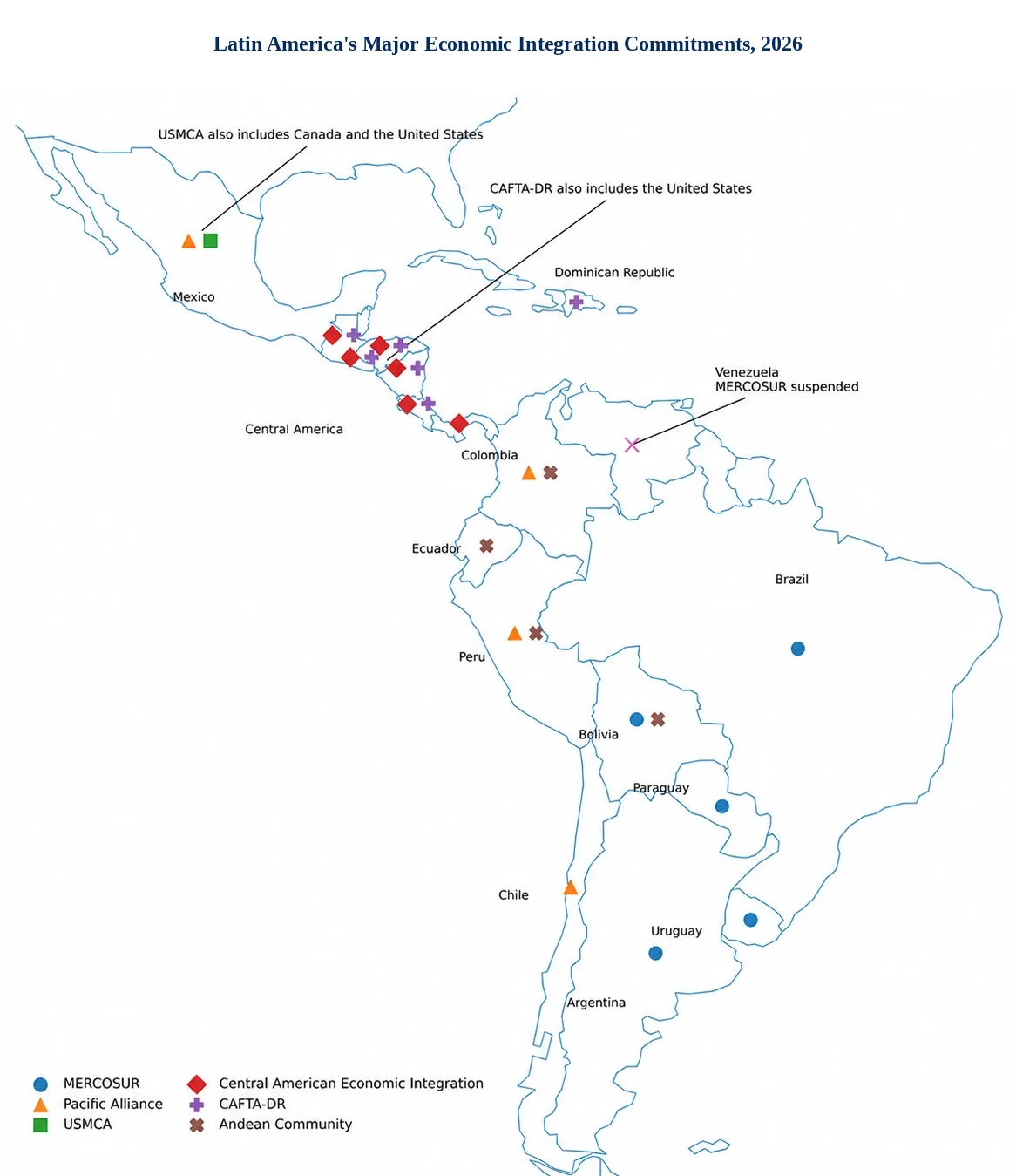
Membership and status are derived from official MERCOSUR, Pacific Alliance, United States Trade Representative, Secretariat for Central American Economic Integration and Andean Community sources. Venezuela is shown as a suspended MERCOSUR State Party. Bolivia is shown as a MERCOSUR State Party and an Andean Community member.
| Measure | MERCOSUR | Pacific Alliance | Andean Community | Central America and the Dominican Republic |
|---|---|---|---|---|
| GDP (US$ tn) | 2.95 | 2.87 | 0.89 | 0.51 |
| Population (million) | 268 | 237.7 | 117.7 | 63.6 |
| Merchandise exports (US$ bn) | 437.8 | 840.9 | 167.3 | 86.3 |
| Merchandise imports (US$ bn) | 367.7 | 835.9 | 154.8 | 177.8 |
| Intraregional trade (% of exports) | 10.7% | 2.1% | 5.4% | 23.8% |
2024 GDP and population figures are calculated from the World Bank World Development Indicators country series. Merchandise exports and imports use the comparable Inter-American Development Bank country series. Intra-group trade is measured as the share of exports directed to members of the same grouping. For its 2024 MERCOSUR trade series, the Inter-American Development Bank covers Argentina, Brazil, Paraguay and Uruguay and excludes Bolivia because its accession took place in 2024. The Central America comparison includes Costa Rica, El Salvador, Guatemala, Honduras, Nicaragua, Panama and the Dominican Republic.
Why New Regional Initiatives Emerged
Regional initiatives emerged from different economic constraints. MERCOSUR transferred external tariff policy and negotiations with third countries to bloc institutions. The Pacific Alliance created a common commercial framework across four economies that retained multiple external agreements and directed attention towards Asia-Pacific markets. USMCA changed the conditions governing the North American production network, especially through revised rules of origin. In the six economies of Central America, regional commerce, customs procedures and border integration operate alongside CAFTA-DR access to the United States. The Andean Community has placed greater authority in supranational rules. Its 2026 intervention in the Colombia–Ecuador trade dispute has demonstrated that its authority can constrain national trade measures.
| Regional initiative | Gap identified | Policy response | Economic objective | External orientation |
|---|---|---|---|---|
| MERCOSUR | Fragmented national markets; Separate external tariff policies | Free movement; Common external tariff; Unified trade policy | Regional market; Policy coordination | Bloc negotiation with third countries |
| Pacific Alliance | Extensive national trade agreements without one common commercial framework | Additional Protocol; Tariff liberalisation; Cumulation of origin | Trade, investment and production connections | World markets; Asia-Pacific emphasis |
| Mexico under USMCA | Established North American production network | USMCA replaced NAFTA in 2020; Revised origin and production requirements | North American content; Preferential access | Canada-Mexico-United States production system |
| Central America and CAFTA-DR | Small national markets; Border frictions; Uneven access to US market | Regional integration and CAFTA-DR; Customs rules; Origin requirements | Regional commerce; Export manufacturing | United States market plus regional trade |
| Andean Community | Development differences; External vulnerability; Fragmented regulation | Free trade area; Supranational legal rules | Growth and employment; Common economic rules | Regional market; Improved international position |
MERCOSUR’s Treaty of Asunción provides for free movement, a common external tariff and unified trade policy towards third countries. The Pacific Alliance was established in 2011 to promote movement of goods, services, capital and people and identifies international projection, with emphasis on Asia-Pacific, among its objectives. USMCA replaced NAFTA on 1 July 2020 and revised the rules governing North American trade and production. The Central American framework addresses regional economic integration, customs and productive structures, while CAFTA-DR provides a separate trade framework with the United States. The Andean Community rests on the Cartagena Agreement and a supranational framework binding Bolivia, Colombia, Ecuador and Peru.
| Framework | Selected developments |
|---|---|
| Pacific Alliance | 2011 Alliance established; 2016 Additional Protocol entered into force; 2020 CPTPP entered into force for Mexico, Peru and Chile; 2024 Costa Rica accession process; 2026 Fourth Additional Protocol approved |
| MERCOSUR | 2024 Bolivia deposits ratification instrument; 2025 MERCOSUR-EFTA FTA signed; 2026 EU-MERCOSUR trade agreement applies |
| Mexico / USMCA | 2020 USMCA replaces NAFTA; 2026 review; agreement remains in force |
| Central America | 2026 First joint integration with Guatemala and Honduras advances; 2026 El Salvador operational |
| Andean Community | 2026 Community challenges unilateral Colombia-Ecuador trade measures |
The Pacific Alliance was established in 2011, and its Additional Protocol entered into force in 2016. Costa Rica’s accession process remained active in January 2026, and the Pacific Alliance Free Trade Commission approved a Fourth Additional Protocol in June 2026. Bolivia deposited its MERCOSUR ratification instrument in July 2024. MERCOSUR and European Free Trade Association (EFTA) signed a free trade agreement in September 2025, followed by the provisional application of the European Union–MERCOSUR trade agreement from 1 May 2026. USMCA replaced North American Free Trade Agreement (NAFTA) in July 2020 and remained in force following the first six-year joint review in July 2026. In May 2026, negotiations advanced towards El Salvador’s participation in the integration process with Guatemala and Honduras.
MERCOSUR: Customs Union, Common External Policy and Industrial Integration
MERCOSUR’s internal trade is modest in aggregate terms but unusually industrial in composition. In 2024, 10.7 per cent of members’ exports went to member states. The share rose to 11.4 per cent in the first half of 2025. Automotive products appear the most concentrated. Chapter 87 of the Harmonized System, covering vehicles other than railway or tramway rolling stock and their parts and accessories, accounted for 23.1 per cent of intra-MERCOSUR exchange in 2022, and rising Brazilian vehicle exports to Argentina accounted for much of the first half 2025 increase. Argentina-Brazil automotive trade is governed through the Economic Complementation Agreement No. 14 (ACE-14), under which qualifying products receive zero duty subject to origin requirements, rather than through a single MERCOSUR automotive regime. Toyota, Stellantis and Volkswagen have shown how access to the regional market can support plants and export allocation. General Motors has shown the exposure created by the same relationship. Weaker Brazilian demand was followed by repeated production stoppages at Alvear in 2025. The evidence therefore points to an industrial corridor whose gains depend on regional demand, compliance with origin requirements and sector rules.
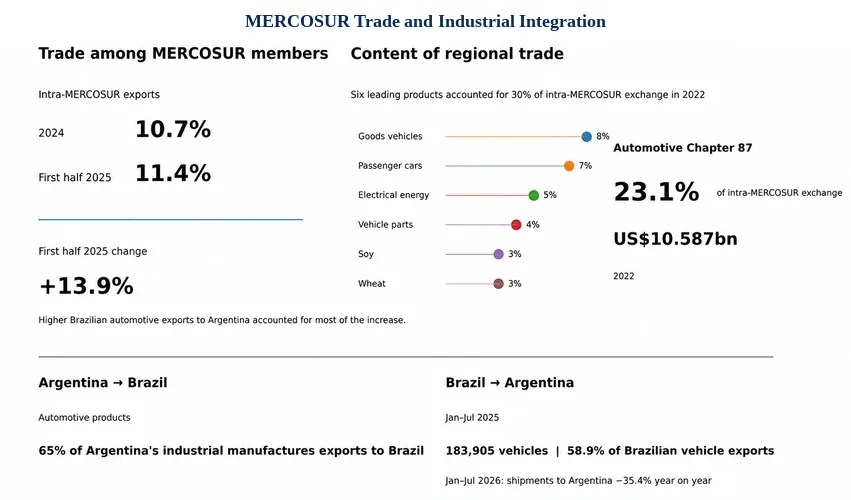
Intra-MERCOSUR trade data are derived from Inter-American Development Bank sources, and Argentina-Brazil automotive trade data are derived from the Asociación de Fábricas de Automotores (ADEFA) and the Associação Nacional dos Fabricantes de Veículos Automotores (ANFAVEA).
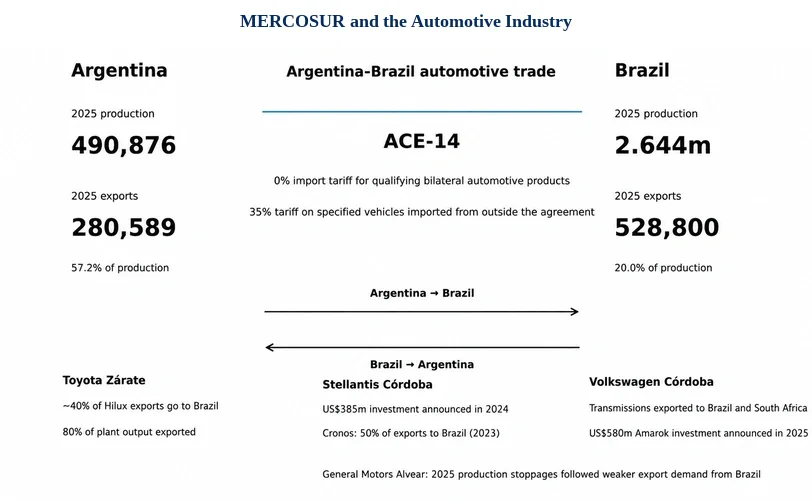
2025 production and export totals are derived from ADEFA and ANFAVEA. ACE-14 tariff treatment is from Brazil’s Ministry of Development, Industry, Commerce and Services. Company evidence is from Toyota Argentina, Stellantis and Volkswagen Group, supplemented by company statements reported in automotive industry sources.
| Company | Policy mechanism | Response | Outcome | Period | Source |
|---|---|---|---|---|---|
| Toyota | ACE-14 origin rules; 0% qualifying trade | Zárate production directed primarily to export markets; Brazil is the largest Hilux destination | 180,352 vehicles produced in 2025; 80% exported; about 40% of Hilux exports to Brazil | 2025 | Toyota Argentina |
| Stellantis | ACE-14; regional market access | Córdoba expanded vehicle, component and engine production for regional sales | US$385m investment announced; 1,800 jobs planned; Cronos: 50% of exports to Brazil in 2023 | 2023-25 | Stellantis; Argentine Government |
| Volkswagen | ACE-14; regional production allocation | Córdoba exports transmissions; next Amarok assigned to Pacheco for the South American market | US$580m investment announced; 100% of current Córdoba transmission output exported to Brazil and South Africa | 2025-26 | Volkswagen Group; VW Argentina |
| General Motors | Regional market access; Brazil demand exposure | Alvear Tracker production was reduced after exports to Brazil fell | Plant halted 25 Mar-14 Apr 2025; five Friday stoppages plus 28-30 May; one week per month announced for Jul-Dec 2025 | 2025 | GM statement reported by MarkLines / GM Authority |
Corporate evidence is drawn from Toyota Argentina, Stellantis, Volkswagen Group and General Motors statements reported by MarkLines and GM Authority.
Pacific Alliance: Trade Liberalisation and External Markets
The Pacific Alliance has not generated a significant increase in commerce among Chile, Colombia, Mexico and Peru. Mexico’s exports have remained directed toward the United States, while Chile and Peru have expanded trade across Asian markets. The Alliance’s relevance lies less in creating a large internal market than in tariff liberalisation, cumulation of origin, investment provisions, services and coordination across economies that retain separate external trade policies. Cumulation allows qualifying inputs and production undertaken in one member to count towards originating status in another, but Pacific Alliance origin does not automatically carry into each member’s separate agreements with third markets. Corporate attribution is limited. Grupo SURA, Falabella, Cencosud, LATAM Airlines, BBVA and Telefónica have multiple regional operations, yet public disclosures rarely isolate gains arising from Alliance provisions.
| Selected preferential market | Chile | Colombia | Mexico | Peru |
|---|---|---|---|---|
| United States | ✓ | ✓ | ✓ | ✓ |
| Canada | ✓ | ✓ | ✓ | ✓ |
| European Union | ✓ | ✓ | ✓ | ✓ |
| United Kingdom | ✓ | ✓ | ✕ | ✓ |
| China | ✓ | ✕ | ✕ | ✓ |
| Japan | ✓ | ✕ | ✓ | ✓ |
| South Korea | ✓ | ✓ | ✕ | ✓ |
| CPTPP | ✓ | ✕ | ✓ | ✓ |
| EFTA | ✓ | ✓ | ✓ | ✓ |
Preferential market coverage is based on official trade agreement registers from Chile’s SUBREI, Colombia’s Ministry of Trade, Mexico’s Secretariat of Economy and Peru’s Ministry of Foreign Trade and Tourism.
| Company | Channel | Evidence | Attributable outcome |
|---|---|---|---|
| Grupo SURA | MILA / financial integration | DJSI MILA participation; regional financial operations. | No quantified gain attributed to an Alliance provision. |
| Falabella | MILA / investment | MILA index participation; regional retail operations. | Regional expansion predates the Commercial Protocol. |
| Cencosud | MILA / investment | MILA index participation; regional retail operations. | No disclosed sourcing, financing or investment gain tied to an Alliance provision. |
| LATAM Airlines | Services / business mobility | Extensive South American passenger and cargo network. | No measured Alliance provision effect located in reviewed public reports. |
| BBVA | MILA / financial integration | BBVA Peru included in DJSI MILA; BBVA commentary on regional financial integration. | No quantified business gain attributed to Pacific Alliance rules. |
| Telefónica | Digital agenda / services | Company participation in Pacific Alliance digital policy discussions. | Policy engagement documented; no disclosed financial result tied to Alliance measures. |
Company evidence is derived from Grupo SURA, Falabella, Cencosud, LATAM Airlines, BBVA and Telefónica public disclosures.
Mexico under USMCA
Mexico under USMCA is less a case of trade among neighbouring economies than a production system governed by qualification rules. From January to November 2024, intermediate goods represented 75.6 per cent of Mexican imports, while manufactures accounted for 89.9 per cent of exports. Mexico imported US$31.6 billion of vehicle parts from the United States, while United States imports of Mexican light vehicles reached US$77.9 billion. USMCA raised the regional value content requirement for light vehicles to 75 per cent and added separate thresholds for core parts, labour value content, steel and aluminium. Manufacturers reported sourcing changes across 31 model lines, with an average variable cost increase of about US$200 per affected vehicle. Some producers instead paid ordinary duties. For vehicles that changed sourcing, the estimated price effect was US$207, while for vehicles that paid duties, it was US$726. The rules redirected demand towards North American parts and steel suppliers while increasing input, certification and compliance costs for manufacturers.
| Company | USMCA provision | Corporate response | Consequence |
|---|---|---|---|
| Stellantis | Alternative staging under the automotive appendix | FCA North America received approval for staged compliance | Annual progress reporting; more time to reach full rule thresholds |
| Ford | Alternative staging under the automotive appendix | Ford received approval for staged compliance | Transition period for vehicle content, core parts and other thresholds |
| General Motors | Standard light vehicle schedule | GM did not participate in alternative staging | Full light vehicle thresholds applied on the standard timetable |
| Volkswagen | Alternative staging; regional sourcing requirements | Volkswagen received approval for staged compliance | Company testimony records cases where regional sourcing raised costs, often offset by zero duty treatment |
| Toyota | Alternative staging; light truck classification | Toyota received staged compliance approval; 2024 Tacoma hybrid ruling applied light truck rules | Tacoma hybrid subject to light truck content and core parts requirements |
USMCA automotive content requirements, alternative staging plans and manufacturer responses are from the United States International Trade Commission, USMCA Automotive Rules of Origin: Economic Impact and Operation, 2025. Approved staging plans covered FCA North America, now associated with Stellantis, Ford, Toyota and Volkswagen; General Motors followed the standard timetable.
Central America: Regional Commerce and United States-Oriented Production
Central American integration and CAFTA-DR support two related trade patterns. The Secretariat for Central American Economic Integration (Secretaría de Integración Económica Centroamericana) (SIECA) recorded US$16.6 billion of intraregional goods exports in 2024, equal to 24.5 per cent of regional exports, while the United States absorbed US$28.8 billion, or 56.1 per cent of exports outside the region. Customs integration has reduced border frictions through common documentation, integrated posts and the Central American Single Declaration Form (Factura y Declaración Única Centroamericana) (FYDUCA), although the customs union remains incomplete. CAFTA-DR's yarn-forward rule requires qualifying yarn spinning, fabric formation and apparel assembly to occur in the United States or CAFTA-DR economies, subject to specified exceptions. Gildan is one of the few firms whose disclosures have allowed the effect of CAFTA-DR to be identified at company level. Its United States yarn-spinning operations supply production in Honduras, Nicaragua and the Dominican Republic, while the company associates this structure with duty-free access under CAFTA-DR. For Hanesbrands and Fruit of the Loom, public disclosures have not isolated a measurable CAFTA-DR effect.
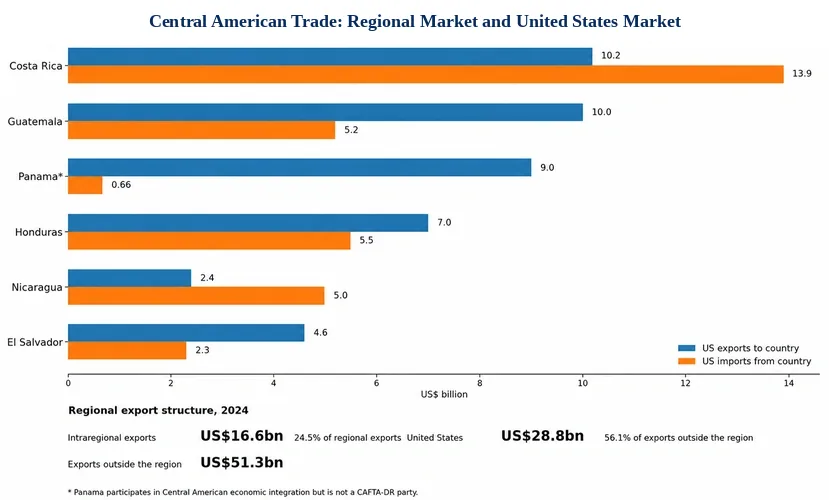
Regional trade data are derived from the Secretariat for Central American Economic Integration, Informe Economico Regional 2024-2025. The 2025 country comparison uses United States Trade Representative goods trade summaries for Costa Rica, El Salvador, Guatemala, Honduras, Nicaragua and Panama. Panama is shown for regional comparison but is not a CAFTA-DR party; its United States trade is governed by the United States-Panama Trade Promotion Agreement.
Andean Community: Common Economic Rules Under Divergent External Policies
The Andean Community remains consequential because common rules have continued to govern firms despite divergent external trade commitments. Bolivia has adopted MERCOSUR obligations. Colombia and Peru have retained agreements with the United States. Ecuador and Peru have agreements with China. Peru has participated in CPTPP. This diversity has not displaced Andean regulation of industrial property, competition, telecommunications, customs valuation, origin, transport and product standards. Claro and Telefónica have faced Andean interconnection rules in Colombian disputes. Bayer, Novartis and Nestlé have had patent or trademark rights assessed under Decision 486. Decision 608 has produced sanctions of US$17.06 million against the Kimberly-Clark group and US$16.86 million against Productos Familia. The Community therefore retains force through supranational regulation even where member governments pursue different external agreements. For firms, the exposure is regulatory authority rather than a common external trade policy.
| Country | Common Andean rules | National external trade commitments |
|---|---|---|
| Bolivia | Industrial property - Decision 486; Competition - Decision 608; Telecommunications - Decision 462 / Resolution 432; Customs valuation - Decision 571; Origin - Decision 416 and amendments; Road freight - Decision 837; Cosmetics - Decision 833 | ✓ MERCOSUR State Party; ✕ Pacific Alliance; ✕ United States FTA; ✕ European Union trade agreement; ✕ China FTA; ✕ CPTPP; ✕ EFTA; ✕ Canada FTA; ✕ South Korea FTA |
| Colombia | Industrial property - Decision 486; Competition - Decision 608; Telecommunications - Decision 462 / Resolution 432; Customs valuation - Decision 571; Origin - Decision 416 and amendments; Road freight - Decision 837; Cosmetics - Decision 833 | ✕ MERCOSUR State Party; ✓ Pacific Alliance; ✓ United States FTA; ✓ European Union trade agreement; ✕ China FTA; ✕ CPTPP; ✓ EFTA; ✓ Canada FTA; ✓ South Korea FTA |
| Ecuador | Industrial property - Decision 486; Competition - Decision 608; Telecommunications - Decision 462 / Resolution 432; Customs valuation - Decision 571; Origin - Decision 416 and amendments; Road freight - Decision 837; Cosmetics - Decision 833 | ✕ MERCOSUR State Party; ✕ Pacific Alliance; ✕ United States FTA; ✓ European Union trade agreement; ✓ China FTA; ✕ CPTPP; ✓ EFTA; ✕ Canada FTA; ✕ South Korea FTA |
| Peru | Industrial property - Decision 486; Competition - Decision 608; Telecommunications - Decision 462 / Resolution 432; Customs valuation - Decision 571; Origin - Decision 416 and amendments; Road freight - Decision 837; Cosmetics - Decision 833 | ✕ MERCOSUR State Party; ✓ Pacific Alliance; ✓ United States FTA; ✓ European Union trade agreement; ✓ China FTA; ✓ CPTPP; ✓ EFTA; ✓ Canada FTA; ✓ South Korea FTA |
Common regional rules are derived from Andean Community Decisions 486, 608, 462, 571, 416, 837 and 833, together with Resolution 432. External commitments are based on official Andean Community, MERCOSUR, Pacific Alliance and national trade agreement registers for Bolivia, Colombia, Ecuador and Peru.
Economic and Geopolitical Interests
External market exposure has influenced the development of each integration path. Mexico’s production system remains integrated with the United States, while China has become the largest export market for Brazil, Chile and Peru and a leading import source across several South American economies. Colombia retains prominent United States export exposure while importing significantly from China. Argentina still depends on Brazil for a significant share of exports, even as Chinese supply has gained importance. These patterns help explain why Latin American states have accepted different constraints on external commercial policy. Mexico has accepted stringent North American origin rules because access to the neighbouring economies has remained valuable. Chile and Peru have preserved agreement networks across Asia Pacific. Brazil and Argentina have operated through MERCOSUR’s common external framework. CAFTA-DR economies have used regional sourcing alongside United States demand. Firm outcomes reflect the same distribution. Toyota, Stellantis and Volkswagen have gained from regional production allocation. General Motors has absorbed demand risk. Lear and Magna have faced qualification requirements. Gildan has retained access supported by preferences. Andean rules have imposed regulatory burden. External markets have therefore altered both national choice and the distribution of gains and costs.
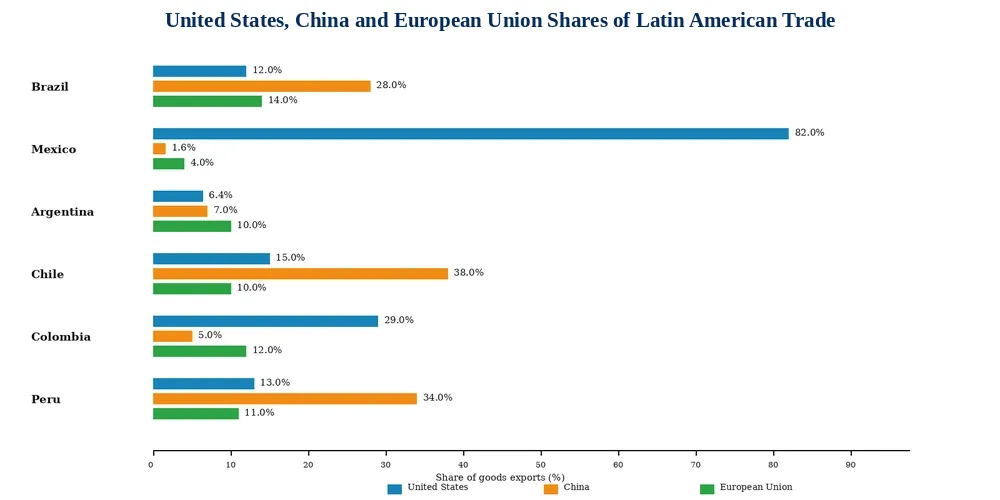
The export shares are derived from 2024 national customs and trade publications: Brazil COMEX Stat, Mexico INEGI, Argentina INDEC, Chile SUBREI, Colombia Ministry of Commerce, Industry and Tourism, and Peru MINCETUR and SUNAT. Percentages are rounded to show the scale of exposure rather than minor annual variation.
| Country | Largest export market | Largest import source | Regional commitments | Major external agreements |
|---|---|---|---|---|
| Brazil | China | China | MERCOSUR | MERCOSUR external framework |
| Mexico | United States | United States | USMCA; Pacific Alliance | USMCA; CPTPP; EU; Japan; EFTA |
| Argentina | Brazil | Brazil | MERCOSUR | MERCOSUR external framework |
| Chile | China | China | Pacific Alliance | CPTPP; US; EU; China; South Korea |
| Colombia | United States | China | Andean Community; Pacific Alliance | US; EU; EFTA; UK; South Korea |
| Peru | China | China | Andean Community; Pacific Alliance | CPTPP; US; EU; China; EFTA |
| Costa Rica | United States | United States | CAFTA-DR; regional customs integration | CAFTA-DR; EU; China; UK |
| Guatemala | United States | United States | CAFTA-DR; regional customs integration | CAFTA-DR; EU Association Agreement; Taiwan |
Export markets, import sources and trade commitments are based on national trade statistics and agreement registers, supplemented by MERCOSUR, Pacific Alliance, Andean Community, CPTPP, CAFTA-DR and European Union agreement records. The comparison separates regional membership from external agreements.
Comparative Outcomes
Evidence has shown that the five frameworks produce different economic effects. MERCOSUR recorded 10.7 per cent intra-group exports in 2024 and an industrial Argentina-Brazil automotive corridor, but its common external tariff restricts national external tariff autonomy. The Pacific Alliance recorded 2.1 per cent intra-group exports in 2024 with its value residing more in tariff liberalisation, origin cumulation and members’ separate external agreements than in internal trade. Mexico under USMCA has shown evidence of production integration with intermediate goods represented 75.6 per cent of Mexican imports, while automotive origin rules redirected sourcing and raised compliance burden. Central America recorded 24.5 per cent intra-regional exports in 2024, with CAFTA-DR connecting regional apparel production to United States demand. The Andean Community recorded 5.4 per cent intra-group exports, yet its supranational rules created regulatory burden, including US$33.92 million in sanctions.
Implications for Firms
For firms, regional integration should be assessed by how applicable rules affect production, sourcing, and regulatory obligations. Manufacturers operating across multiple countries need to establish whether preferential access compensates for the cost of satisfying origin requirements. USMCA has shown that preferences can increase demand for regional components while raising sourcing and compliance costs. Firms that concentrate production in one member state also need to test their exposure to demand in neighbouring markets. MERCOSUR has made alternative export destinations and the ability to reallocate production important when assigning location mandates.
For industries dependent on preferential rules, location advantage must be assessed against competing production centres. CAFTA-DR has shown that tariff treatment can support regional manufacturing without neutralising differences in labour cost, productivity, logistics or input prices. Firms using regional initiatives primarily for access to external markets should distinguish institutional participation from measurable commercial advantage. Evidence from the Pacific Alliance has indicated that regional operations do not necessarily establish that regional provisions have altered firms’ costs, sourcing decisions, investment allocation or access to markets.
Regulated industries face a different exposure. Andean rules can affect patents, trademarks, competition liability and market access even where trade among members is limited. Each regime should therefore be evaluated against the firm’s production configuration, sourcing requirements, destination markets, qualification costs, regulatory exposure and capacity to shift production as conditions change.
Latin America has borne the contradictions of the global economy with unusual weight: abundant in resources, exposed to volatility, and continually testing the extent to which collective action can overcome inherited constraints.
Disclaimer
The scope of this analysis may differ according to its intended use. Unless otherwise agreed in relation to a specific mandate, it was not prepared by reference to the circumstances or requirements of any particular audience. Nothing in it constitutes investment advice or a determination of its suitability or appropriateness for a particular recipient. The material reflects the evidence and conditions relevant to the period examined and may be affected by subsequent developments. Users are responsible for determining the relevance of its content to their circumstances and for obtaining appropriate advice where a decision requires specialist judgement.
About the Chief Analyst

Nsikan Nyauko is an economist and Chartered Management Consultant with decades of cross-industry experience and a range of postgraduate qualifications spanning Economics, Big Data and Analytics, International Affairs and Diplomacy, International Commercial Law, Digital Transformation, Project Management, Business and Management, and Public Health. He serves the Centre as Faculty, Executive Development and Lead Advisor, Group Regional Programme for EMEA, APAC and the Americas. He has built relationships across industry, government, international organisations, academia, think tanks and civil society and has developed policy and strategy papers to support decision-making by corporations and sovereign entities.
Associate Analysts Nadine Karam; Marek Zieliński; Yun-seo Han; Camila Arriagada; Elias Nordström; Graham Bellamy