
Vietnam and the Limits of China+1 Strategy
Vietnam is one of the most visible beneficiaries of the reallocation of manufacturing activity triggered by the 2018-19 United States-China tariff conflict and reinforced by the pandemic. The strongest evidence points to a more complex redistribution of functions across connected economies. In Vietnam, factories have expanded, new products have entered production, semiconductor packaging and testing capacity has increased, and multinational producers have given Vietnamese sites lasting functions in regional production systems.
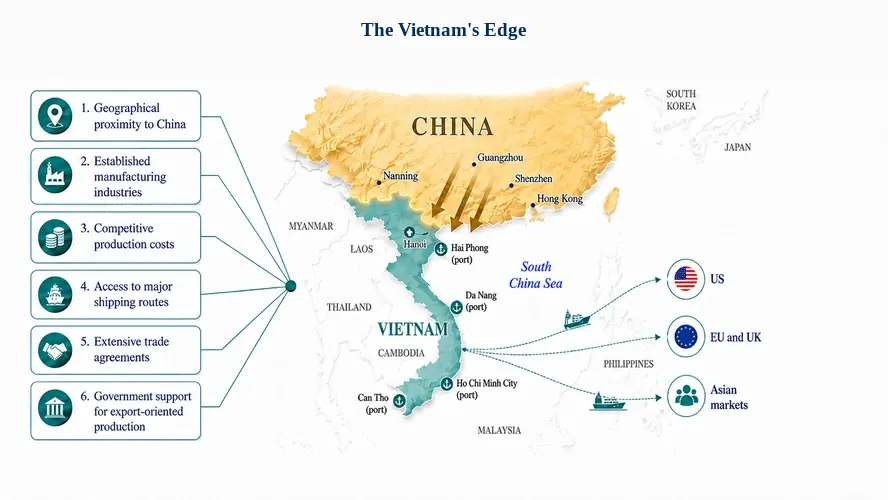
Vietnam has become a leading location partly because it has remained close to Chinese industrial capacity. The same connection that has strengthened Vietnam as a production base now exposes firms to closer scrutiny of ownership, the origin of inputs and the depth of production undertaken in Vietnam. This analysis examines production fragmentation, domestic value creation, power exercised through economic networks, enforcement of trade policy, Vietnamese political economy and product-specific rules of origin.
What China+1 Actually is
China+1 is frequently interpreted as an exit from China. That interpretation confuses reduction in concentration with substitution. For most multinational manufacturers, the decision is to preserve economically valuable Chinese capacity while establishing additional production in another jurisdiction. A firm may assign final assembly to Vietnam, retain component sourcing in Guangdong, keep product design in the United States, use semiconductor fabrication in Taiwan or South Korea, and coordinate procurement from a regional headquarters. The product becomes multinational before it becomes Vietnamese, Chinese or American in customs terms.
The location of the final factory reveals only one part of the production system. Shifting assembly can reduce tariff exposure and risks associated with the location of production without transferring the supplier ecosystem, technology ownership or corporate decision-making that supported production in China. China+1 therefore represents a reallocation of tasks rather than a replacement of national manufacturing systems. Vietnam illustrates the distinction unusually well. Federal Reserve researchers found that Chinese-owned firms accounted for 25 per cent of Vietnamese exports to the United States during 2020-23, up from 11 per cent in 2018-19, after excluding shipments flagged as possible rerouting. Chinese-owned firms also expanded their share of imports from China. The evidence points to Chinese and other multinational firms placing more production in Vietnam while retaining supplier relationships in China.
Why Vietnam Became the Destination of Choice
Vietnam’s attraction is relational rather than independent of China. The trade war between the United States and China has increased the cost of importing Chinese products into the United States since 2018. The coronavirus pandemic also demonstrated the risk of concentrating production in one country. Firms responded by adding factories and suppliers in Vietnam, Mexico, India and other economies while preserving parts of their operations in China. Research on global supply chains finds that the fall in the share of goods supplied directly by China to the United States was accompanied by increases in the shares supplied from Vietnam, Mexico and Taiwan. The change occurred through a repositioning of production across additional countries.
Vietnam was suitable because it shares a land border with China. Northern manufacturing hubs such as Bac Ninh, Bac Giang and Thai Nguyen sit close to southern China and can receive components and industrial materials without reconstructing an entire supplier network. This reduces the cost of adding a second production jurisdiction. The same geography also gives firms access to major ports and to the East Asian manufacturing system. Vietnam’s advantage has therefore been the combination of separation from Chinese customs territory and continued proximity to Chinese production.
China+1 did not create Vietnam’s production capacity from zero. It accelerated investment into an environment that had already demonstrated large-scale manufacturing capability. Prior multinational presence reinforced this advantage before the 2018 tariff conflict. Samsung began major mobile-phone production in Bac Ninh in 2009 and subsequently expanded into Thai Nguyen. That earlier production created industrial zones and supplier-development programmes that later investors could use as models.
Vietnam also offers access to markets through a network of trade agreements covering economies that produce almost 90 per cent of global GDP. The Comprehensive and Progressive Agreement for Trans-Pacific Partnership (CPTPP), the Regional Comprehensive Economic Partnership (RCEP) and agreements with the European Union and the United Kingdom support access to several markets. These agreements have not eliminated United States tariffs, but they make Vietnam suitable for firms serving several destinations from the same production base. In 2024, Vietnam received US$38.23 billion in foreign investment, of which manufacturing and processing accounted for US$25.58 billion, or 66.9 per cent. Chinese investors accounted for the largest number of new projects, while Singapore and South Korea recorded the largest values. Manufacturing and processing also represented 61.4 per cent of the stock of foreign investment at the end of 2024.
Vietnam, China+1 and Multinational Investments
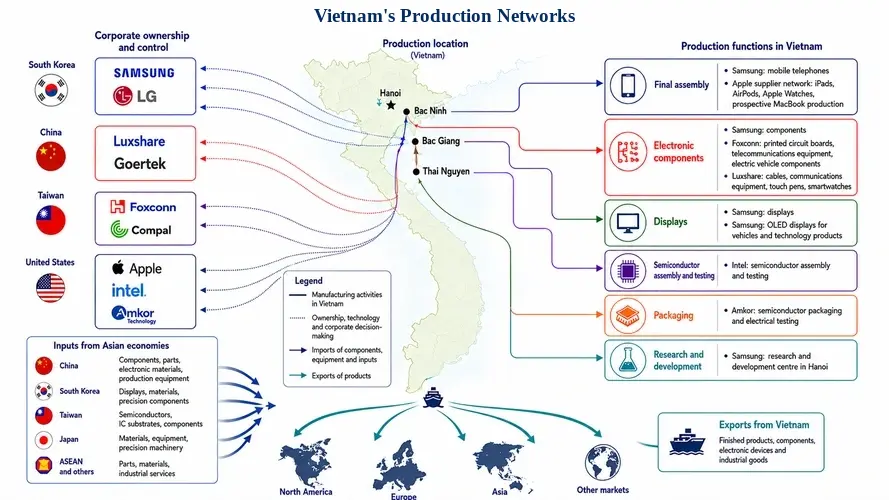
The evidence is strongest when classified by function rather than by investment value. Samsung’s Vietnamese operations now include mobile-phone assembly, displays, household electronics, components and research. By June 2025, its Bac Ninh and Thai Nguyen factories had produced two billion handsets since 2009, and Samsung Vietnam reported US$28 billion in exports in the first six months of 2025. Though these figures show scale, they do not establish Vietnamese ownership of the technology or product. The factories are major production assets in a Korean multinational system.
Apple’s production network reveals a different structure. The company reported in April 2024 that it had spent nearly VND400 trillion in cumulative expenditure through its local supply chain since 2019 and supported more than 200,000 jobs. The network was producing iPads, AirPods and Apple Watches, while suppliers associated with MacBook production were also investing in the country. This expansion added manufacturing activities in Vietnam through firms that continued to operate in China and other economies.
Intel identifies Ho Chi Minh City as an assembly and testing location, not a wafer fabrication site. In 2025, the company announced that it intended to consolidate its Costa Rica assembly and test operation into larger sites in Vietnam and Malaysia. Amkor’s Bac Ninh facility, opened in 2023, adds advanced packaging capacity and offers functions from design to electrical testing. These are technologically significant activities, but they occupy the back-end and post-fabrication parts of the semiconductor chain rather than leading-edge wafer fabrication.
Foxconn had invested more than US$3.2 billion by 2024, principally in manufacturing centres such as Bắc Ninh and Bắc Giang. Its additional investment licences covered printed circuit boards, telecommunications equipment, electric vehicle components, smart entertainment products and smart-system equipment.
Chinese ownership has added a further complexity to the China+1 narrative. Luxshare began investing in Vietnam in 2019 and received approval in 2023 for an additional US$330 million at its Bắc Giang operation, increasing the project’s investment to US$504 million. The proposed output included cables for smart devices, communications equipment, touch pens, positioning devices and smartwatches. These investments indicate that Vietnam’s role has extended beyond the assembly of a narrow group of consumer products to the production of components and related electronic equipment. The ownership of these investments also qualifies the interpretation of China+1. Luxshare and Goertek are Chinese enterprises, while Foxconn is headquartered in Taiwan and maintains a presence in China. Federal Reserve analysis shows that Chinese-owned firms in Vietnam more than doubled in number between 2018 and 2023, from 1,287 to 2,864, and accounted for 15 per cent of foreign-owned firms by 2023. Their share of Vietnamese exports to the United States also increased markedly. Production has therefore been reallocated geographically, while Chinese ownership or commercial influence have not necessarily declined at the same rate.
The Scale of Vietnam’s Gains
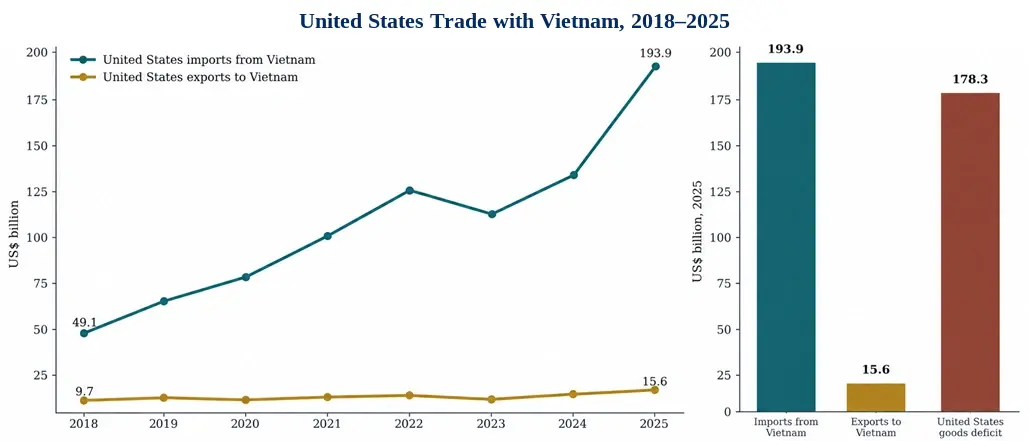
The increase in trade with the United States demonstrates the scale of Vietnam’s gains. United States imports from Vietnam rose from US$49.1 billion in 2018 to US$193.9 billion in 2025. United States exports to Vietnam increased from US$9.7 billion to US$15.6 billion over the same period. The United States’ trade deficit with Vietnam consequently increased from US$39.5 billion to US$178.3 billion. New factories have been established, existing factories have increased output, and firms have expanded production capacity for products that Vietnam did not previously export in large quantities. A 2026 World Bank study using customs and firm data found that domestic value added in Vietnam’s exports increased substantially after 2018. This evidence shows that demand created by the trade conflict has also generated real production in Vietnam. The gains nevertheless remain concentrated in an economy whose exports are dominated by foreign firms. This concentration also means that decisions about products, technology and destination markets are frequently made by multinational firms rather than by Vietnamese firms.
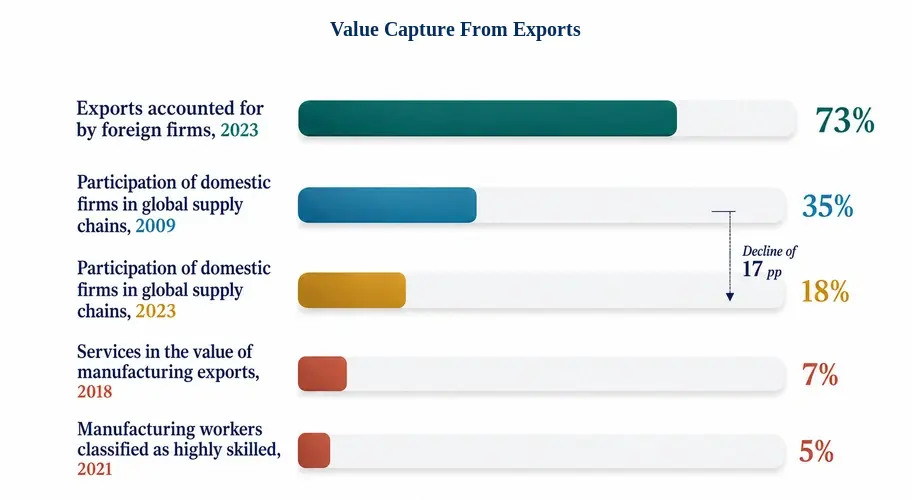
For much of the export sector, decisions about product design, technology standards, supplier qualification, procurement, pricing and destination markets are made by foreign multinational groups. The World Bank’s 2026 Economic Update describes a dual economy in which foreign-invested and global-value-chain-linked firms account for only about 5 per cent of firms but around half of value added and 73 per cent of exports. Domestic firms remain less connected to export production. A Vietnamese site can assemble a processor, package a chip or test a finished device while the underlying architecture, design software, fabrication process and intellectual property remain in another country. Intel’s site classification is revealing. Vietnam is an assembly and test location, while its wafer fabrication sites are in the United States, Ireland and Israel. Ownership affects where profits and income from intellectual property and licensing accrue and where strategic decisions are made. The Federal Reserve has found that Chinese-owned firms accounted for a rising share of Vietnamese exports to the United States after the tariff conflict, even after excluding exports flagged as potential rerouting. This has created a paradox. United States tariffs can reduce direct imports from China while encouraging Chinese firms to establish production in Vietnam and retain Chinese supplier connections.
At the aggregate level, multinational firms can allocate new product lines or incremental capacity to Vietnam when tariff, pandemic, logistics or political risks make concentration in China undesirable. Vietnam has benefited from being a tested alternative before it becomes a full substitute. That distinction explains why the country can attract large investment even while the industrial system supporting that investment remains connected to China.
China Remains Part of Vietnam’s Production Capacity
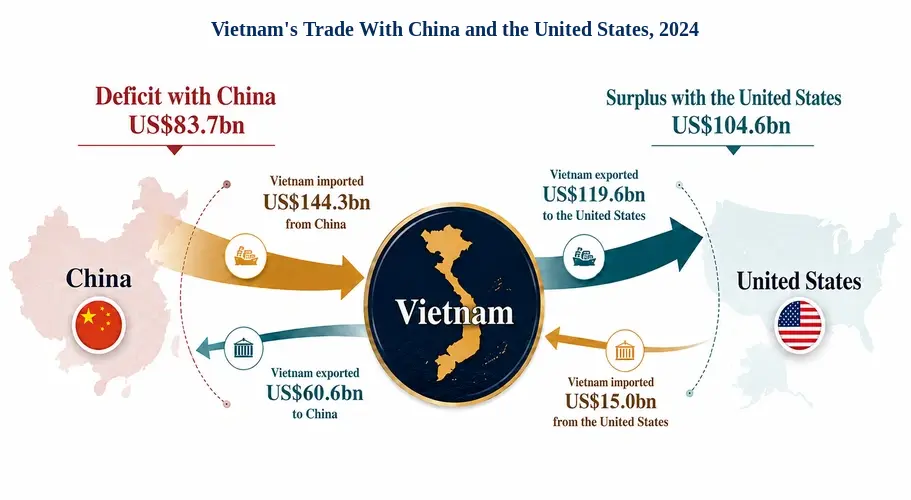
Vietnam’s trade pattern with China and the United States is not an anomaly. It is the expected signature of a regional production system. China is Vietnam’s largest source of imports, while the United States is its largest export market. In 2024, Vietnam exported US$119.6 billion in goods to the United States and imported US$15.0 billion from the country, producing a surplus of US$104.6 billion. In the same year, Vietnam’s exports to China totalled US$60.6 billion, while its imports from China reached US$144.3 billion, producing a deficit of US$83.7 billion. China was Vietnam’s largest source of imports, while the United States was its largest destination for exports.
China’s exports to Vietnam totalled US$38.1 billion during the first quarter of 2025, making China the country’s largest source of imports. The United States was the largest destination for Vietnamese exports, which reached US$31.4 billion in the same period. In the first half of 2026, Vietnam’s imports from China stood at US$115.2 billion and its exports to the United States at US$86.5 billion. The trade flows show that Vietnam’s production economy is linked upstream to China and downstream to American demand.
This pattern is consistent with a regional production system in which components and industrial materials enter Vietnam from China and finished goods leave Vietnam for the United States. The success of Vietnam under the China+1 strategy has therefore been partly supported by Chinese industry rather than by the complete substitute of Chinese production.
Rerouting and Vietnam’s Export Growth
Though rerouting has contributed to the expansion of Vietnam’s export after the imposition of United States tariffs on Chinese goods, its occurrence cannot be inferred from bilateral trade growth. Imports from China and exports to the United States can rise together because a factory uses Chinese intermediate inputs to manufacture a different product in Vietnam. They can also rise because a trader changes documentation without significant production. Aggregate trade data cannot distinguish those cases. The relevant evidence is transaction-level product matching, firm behaviour and the production actually undertaken.
Under United States non-preferential rules of origin, the origin of a product depends on the production undertaken in Vietnam and the rules applicable to the product, not solely on the geographical source of its inputs. In 2021, a national comparison of matching Chinese imports and Vietnamese exports classified 16.5 per cent of Vietnam’s exports to the United States as potential rerouting. The causal estimates confirmed that the tariffs introduced during the United States–China trade conflict increased rerouting, but the size of the effect remained considerably below the expansion of Vietnam’s exports. The evidence establishes neither that Vietnam’s export expansion was wholly domestic nor that it consisted predominantly of disguised Chinese exports. Vietnam has experienced three developments simultaneously including increased domestic production, greater processing of imported inputs and tariff circumvention. Broad assumptions based on rising imports from China and rising exports to the United States cannot establish rerouting because the same pattern is also consistent with production integrated with Chinese supply chains.
United States Customs and Border Protection determines a product’s origin by examining several factors, including the components, the complexity of assembly, the skill required, machining, testing and whether the essential component is produced in Vietnam. At a manufacturer’s request, Customs and Border Protection may review whether the manufacturing carried out in Vietnam is substantial enough for the finished products to be regarded as products of Vietnam. The outcome is different where the processing in Vietnam consists mainly of packaging, labelling or minor assembly. Goods can also remain subject to duties associated with China when their essential component is produced in China and the later processing does not create additional value. A certificate identifying Vietnam as the country of origin is not sufficient when the underlying production records do not support that claim. Importers may need records showing the origin of essential components, the production steps performed in Vietnam, bills of materials, factory records, ownership records, transfers between related companies and the basis for the declaration of origin. The more a factory depends on finished Chinese subassemblies, the more difficult it may be to demonstrate that Vietnam produced the final product rather than merely performing minor finishing operations.
Differences Among Industries
Electronics
Electronics provide some of the several pieces of evidence of production in Vietnam. Multinational firms assemble printed circuit boards and undertake programming, testing and final assembly. Customs and Border Protection has repeatedly recognised that surface-mount technology and programming can create the essential component and establish Vietnamese origin. The hurdle lies in the source of components, production equipment, design and intellectual property. Vietnam continues to import large quantities of computers, electronic products and components, while foreign firms control much of the industry. The country has attracted investment in semiconductors and components, but the small proportion of skilled manufacturing workers and the limited contribution of services to manufacturing exports constrain the value retained in Vietnam.
Textiles, garments and footwear
Vietnam has recorded growth in the production of textiles, garments and footwear over several decades. Cutting, sewing, assembly, finishing and quality control employ large numbers of workers and create goods that are commercially different from imported fabrics and accessories. Vietnam’s dependence on imported fabrics, yarns, chemicals, accessories and machinery nevertheless limits domestic value added. The International Labour Organization (ILO) describes the need for the industry to advance beyond its present position in the value chain through higher skills and productivity. The importance of imported materials also means that rules of origin under trade agreements can determine whether a product receives preferential tariff treatment.
Furniture and wood products
Customs and Border Protection has recognised Vietnamese origin for products in which Chinese fabric, plywood or metal parts were cut, moulded, sewn, welded, upholstered and assembled in Vietnam. The industry remains vulnerable when products are subjected to limited processing. The difference between a Vietnamese furniture industry using imported materials and the rerouting of Chinese furniture depends on factory operations, records and the extent to which inputs lose their separate identity.
Solar cells and modules
The solar industry demonstrates the limits of relying on the place of final manufacture as the only guide to economic origin. Vietnam has developed production capacity for solar cells and modules, but ownership, equipment, wafers and subsidies from China remain important in parts of the industry.
The United States Department of Commerce determined that circumvention had occurred in specified cases involving solar products completed in Vietnam from Chinese inputs. In its 2023 solar circumvention determination, the Department of Commerce concluded that specified solar cells and modules completed in Vietnam using Chinese wafers and components were circumventing antidumping and countervailing duty orders on Chinese solar products. The department nevertheless found that qualifying products produced and exported by Boviet Solar Technology were not circumventing the orders, demonstrating that the outcome depended on the production process and supporting records rather than the location of final assembly.
The proceedings also involved disputes over individual companies. Red Sun Energy challenged the Department’s use of adverse facts before the United States Court of International Trade. A settlement in 2024 resulted in Commerce removing the company from the list of producers restricted from using the certification procedure established under the circumvention determination. Separate investigations concluded in 2025 that solar cells from Vietnam were being sold in the United States at less than fair value and that producers were receiving countervailable subsidies.
The Department later made affirmative antidumping and countervailing duty determinations concerning solar cells from Vietnam in 2025. The rates varied by producer and were far higher than the general tariff applied to Vietnamese goods. The cases show that establishing a factory in Vietnam does not necessarily eliminate duties associated with Chinese production or government support. Product-specific investigations can determine ownership, the origin of components and the production stage undertaken in Vietnam.
Tariffs and Enforcement by the United States
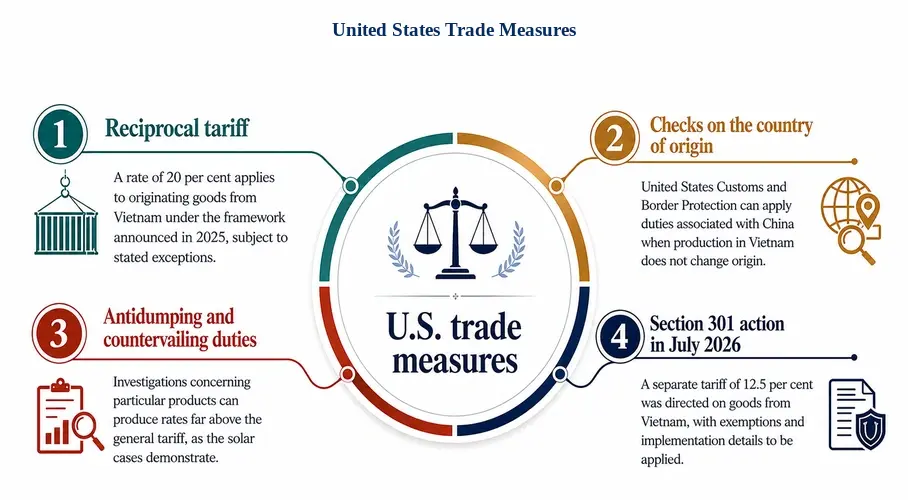
The treatment of Vietnamese goods in the United States is no longer determined solely by ordinary customs duties. Under the framework announced by the United States and Vietnam in October 2025, the United States would maintain a 20 per cent reciprocal tariff on originating goods of Vietnam, while identifying selected products that could receive a zero per cent reciprocal tariff rate. Vietnam committed to removing tariffs on almost all goods imported from the United States and to addressing several non-tariff barriers. On 23 July 2026, the United States Trade Representative (USTR) announced a separate Section 301 action imposing an additional 12.5 per cent duty on products of Vietnam, after finding that Vietnam had failed to impose and effectively enforce a prohibition on imports of goods produced with forced labour. The action included product exemptions and was implemented through modifications to the Harmonized Tariff Schedule of the United States. The total duty payable on an individual product therefore depends on its classification, origin, applicable exemptions and the interaction among ordinary customs duties, reciprocal tariffs, Section 301 duties and other applicable trade remedies. The Section 301 duty became applicable on 24 July 2026, subject to limited provisions for goods already in transit.
A product declared to be of Vietnamese origin may be subject to duties applicable to Chinese goods if the production undertaken in Vietnam does not confer Vietnamese origin. Antidumping and countervailing duty orders can also apply to particular products and industries. The solar determinations demonstrate that these product-specific duties can exceed the general reciprocal tariff by a large margin. This complexity has weakened one of Vietnam’s attractions. Firms selected Vietnam partly to reduce the effect of tariffs on goods produced in China, but goods from Vietnam now face higher general tariffs, closer scrutiny of origin and separate product-specific investigations. The economic advantage remains where production costs and the tariff differential between Vietnamese and Chinese goods are sufficient, but the advantage is narrower and requires stronger evidence that production occurred in Vietnam than it did when China+1 began.
Vietnam and Other Locations in Comparative Lens
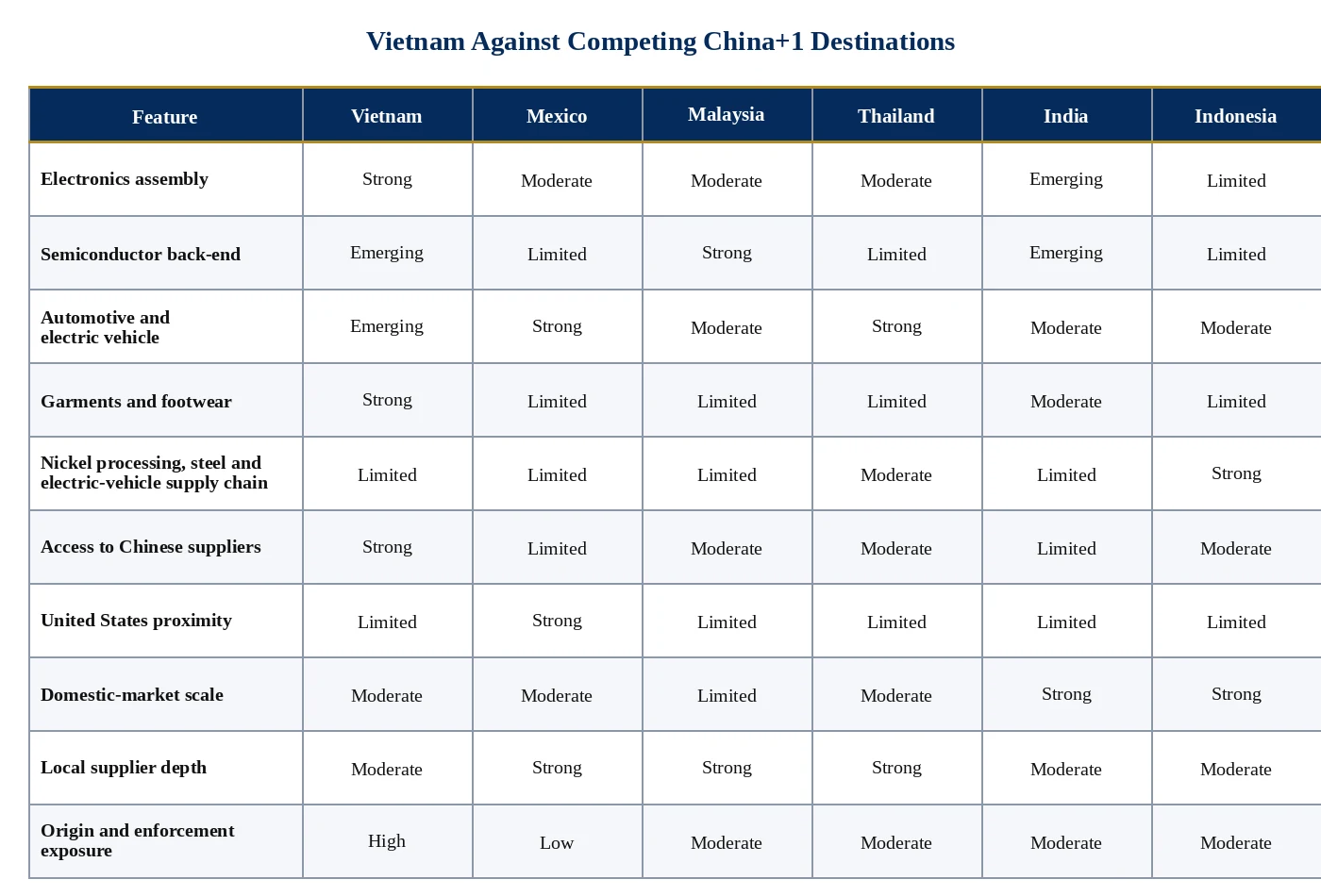
The advantage of Vietnam is highest where firms value proximity to Chinese suppliers, export-oriented industrial zones and broad access to markets. The same features can become disadvantages when a firm’s objective is decoupling from Chinese inputs or when United States enforcement gives greater weight to ownership and upstream sourcing. Comparison must therefore be made by industry and production function, not by a single national ranking.
Mexico is the strongest competitor for production aimed primarily at the United States because geography, North American supply chains and the United States-Mexico-Canada Agreement (USMCA) can reduce logistics and support integrated automotive and industrial production. World Bank research published in 2026 finds that Mexican municipalities producing goods affected by United States tariffs on Chinese imports recorded stronger export growth, indicating that some United States demand shifted from China to producers in Mexico. Mexico’s weakness relative to Vietnam is its distance from East Asian component ecosystems when the production chain remains Asia-centred.
Malaysia is stronger where semiconductor back-end capability, technical skills and a mature electronics ecosystem matter more than low-cost mass assembly. The Malaysian Investment Development Authority (MIDA) estimates that Malaysia accounts for roughly 13 per cent of global semiconductor testing and packaging and more than 7 per cent of global semiconductor trade. Vietnam’s semiconductor industry has expanded, but its competitive position should be assessed not only against China. Malaysia is also a major benchmark because it has built semiconductor manufacturing capability over five decades and seeks to expand further into design and advanced packaging.
Thailand has well-developed automotive and appliance supply systems and has developed electric vehicle, battery, solar and advanced electronics production. The World Bank reports that manufacturing accounts for 25 per cent of Thai GDP and that more than 80 per cent of existing auto parts production can be adapted to electric vehicles with limited modification. For automotive and selected green manufacturing, that supplier depth can outweigh Vietnam’s cost and China-proximity advantages.
India offers a different proposition with a large domestic market, rapidly expanding ICT exports and industrial policies directed at electronics production. The World Bank’s 2025 Digital Progress and Trends Report recorded a 45 per cent rise in India’s ICT goods exports during 2022-23 and attributed part of that increase to industrial policy and expanding smartphone production. India’s scale can justify local supplier investment that a smaller market cannot, but production chains that still depend significantly on East Asian components may face higher coordination and logistics costs than in Vietnam.
Indonesia’s case lies less in consumer electronics assembly than in nickel processing, steel production and parts of the electric vehicle supply chain. World Bank research on Indonesia’s nickel export ban has found that downstream policies raised the domestic value-added ratio in some exports but also generated efficiency costs. Indonesia therefore signifies a different route to enhancing manufacturing capacity with the use of controls over critical mineral inputs to pull downstream processing and manufacturing into the domestic economy.
The comparison is sector-specific. Vietnam remains unusually strong for electronics assembly, selected components, garments and production systems that need timely access to Chinese suppliers. Mexico is stronger for many North America-facing industrial products; Malaysia for semiconductor back-end capability; Thailand for automotive and selected advanced manufacturing; India where domestic-market scale supports supplier localisation; and Indonesia where access to critical minerals matters. The next China+1 phase is likely to result in the distribution of production among several destinations rather than in the emergence of one universal successor to China.
Implications for Firms and Policymakers
For firms, the first decision is functional rather than geographical. Before assigning production to Vietnam, management should specify which stages can be performed in Vietnam, which Chinese inputs remain essential, what alternative suppliers exist, whether the Vietnamese process is sufficient for the intended claim of origin, and whether the tariff differential remains large enough after all applicable duties and compliance costs. A location decision based on wage rates and headline tariffs is no longer adequate.
The growing role of Chinese-owned firms has made corporate structure relevant to geopolitical exposure even where the origin of the product is Vietnam. Authorities may examine supplier records, subsidies, affiliated-company transactions and production steps. Firms need auditable evidence capable of distinguishing production from minor finishing and of separating Chinese ownership from Chinese origin, which are different legal and economic concerns.
Trade diplomacy must also become more product-specific. Vietnam is party to several trade agreements, but preferential treatment depends on rules of origin, while sales to the United States are subject to reciprocal tariffs, Section 301 measures and product-specific trade remedies. Government support should therefore focus on helping firms understand origin requirements, improve traceability and strengthen domestic supplier capability rather than assuming that treaty membership or a Vietnamese certificate of origin settles access to the market.
The geopolitical objective is to preserve strategic flexibility. Vietnam has benefited from commercial relations with China, the United States, South Korea, Japan, the European Union and other major economies. Its China+1 advantage has been created by being connected enough to Asian production to be efficient and separate enough from China to offer an additional location. The more strategic competition forces firms to choose supply systems, the more difficult that position becomes. Vietnam’s task is therefore to increase domestic capability before external pressure narrows the space available for cross-border production.
The limit of China+1 is not that Vietnam has failed to become China. It is not whether Vietnam can attract more factories. It is whether the functions surrounding those factories become sufficiently Vietnamese to preserve value, withstand scrutiny and survive the next reordering of global production.
Disclaimer
The scope of this analysis may differ according to its intended use. Unless otherwise agreed in relation to a specific mandate, it was not prepared by reference to the circumstances or requirements of any particular audience. Nothing in it constitutes investment advice or a determination of its suitability or appropriateness for a particular recipient. The material reflects the evidence and conditions relevant to the period examined and may be affected by subsequent developments. Users are responsible for determining the relevance of its content to their circumstances and for obtaining appropriate advice where a decision requires specialist judgement.
About the Chief Analyst

Nsikan Nyauko is an economist and Chartered Management Consultant with decades of cross-industry experience and a range of postgraduate qualifications spanning Economics, Big Data and Analytics, International Affairs and Diplomacy, International Commercial Law, Digital Transformation, Project Management, Business and Management, and Public Health. He serves the Centre as Faculty, Executive Development and Lead Advisor, Group Regional Programme for EMEA, APAC and the Americas. He has built relationships across industry, government, international organisations, academia, think tanks and civil society and has developed policy and strategy papers to support decision-making by corporations and sovereign entities.
Associate Analysts Nadine Karam; Marek Zieliński; Yun-seo Han; Camila Arriagada; Elias Nordström; Graham Bellamy